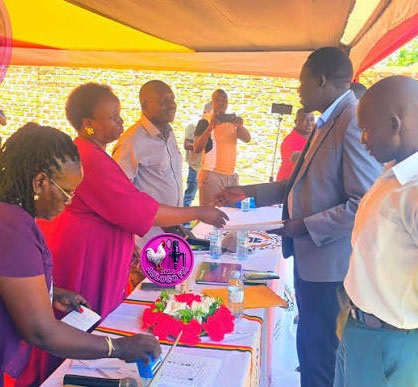

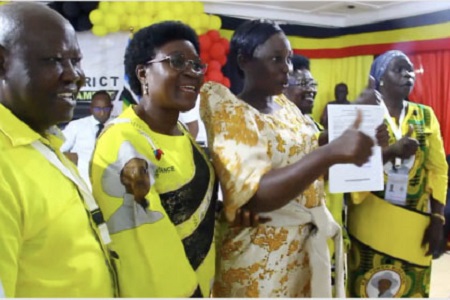
Nabayiga (3rd Left) with other NRM big guns celebrate the election win
HABARI DAILY I Kampala, Uganda I The direct presidential intervention is one of the reasons why the opposition could not stand their ground in Kalangala, where the ruling National Resistance Movement (NRM) reclaimed the District Woman Member of Parliament seat after deploying an elaborate political machinery that overwhelmed its rivals in the by-election.
The by-election, occasioned by the death of former Woman MP Hellen Nakimuli, ended with the NRM’s Idah Nabayiga securing a convincing victory after polling 12,642 votes against National Unity Platform (NUP) candidate Irene Nampala’s 7,474 votes.
Political analysts say the outcome was not merely a result of campaign popularity but rather a carefully coordinated operation involving direct presidential involvement, an energized grassroots network, a united party structure and a resource-intensive campaign that the opposition struggled to match.
Museveni’s appeal
Perhaps the most decisive factor was the personal involvement of President Yoweri Museveni during the closing days of the campaign. The President traveled to the island district and addressed a mega rally where he urged residents to elect the NRM candidate, arguing that voting for the ruling party would strengthen the district’s connection to the central government.
Museveni appealed to voters by linking development to political cooperation with the government. He pointed to long-standing concerns affecting island residents, including unreliable transport across Lake Victoria, inadequate infrastructure, challenges facing the fishing industry and limited public services, telling voters that these could be addressed more effectively if they elected an NRM legislator capable of working closely with the Executive.
The President’s message has historically resonated in many rural constituencies where government investment in roads, health facilities and electrification remains a major campaign issue. In Kalangala, where transport and service delivery are particularly challenging because of the district’s island geography, the development argument appeared to carry considerable political weight.
Sweeping grassroots campaign
The NRM also mounted one of its most organized grassroots campaigns in recent years. Unlike previous elections that were characterized by internal divisions and competing factions, party leaders maintained a united front throughout the campaign.
Senior mobilizers, led by NRM Director for Mobilisation Rosemary Sseninde, spent weeks traversing the islands, coordinating local leaders, village structures, women’s groups and youth mobilizers to ensure maximum voter turnout.
Party officials reportedly set an ambitious internal target of winning at least 70 percent of the vote, a goal that kept campaign teams focused throughout the exercise. Mobilizers concentrated on ensuring that local communities became active participants in the campaign rather than passive supporters.
The ruling party also enjoyed a significant logistical advantage. Campaign teams were deployed across the scattered islands well ahead of polling day, backed by financial resources that enabled them to sustain prolonged voter engagement.
Kalangala’s unique geography presents enormous logistical challenges during elections. Reaching the various islands requires extensive marine transport and coordination, making campaigns expensive and difficult to sustain. The NRM’s ability to finance transportation, maintain campaign teams on the islands and continuously engage voters gave it an advantage over opposition parties operating with comparatively limited resources.
Passing the political test
The by-election was also widely viewed as an important political test ahead of Uganda’s next general elections. For the NRM, retaining the seat carried symbolic significance, prompting senior party leaders to invest heavily in ensuring victory.
While the ruling party celebrated the outcome as evidence of growing public confidence, the opposition disputed the results almost immediately after they were announced.
NUP leaders alleged that the election was marred by heavy military deployment, voter intimidation and ballot stuffing at several polling stations. They argued that the state’s involvement created an uneven playing field that disadvantaged opposition candidates throughout the campaign.
However, the Electoral Commission rejected the allegations, maintaining that the tallying process was conducted in accordance with Uganda’s electoral laws. District Returning Officer Ronald Agaba declared Idah Nabayiga the duly elected Woman Member of Parliament after the official tally was completed.
Electoral trends
The Kalangala outcome also reflects broader electoral trends in Uganda, where the NRM often combines its extensive grassroots structures, incumbency advantages and high-profile national leaders to consolidate support, particularly in by-elections. Such contests frequently attract significant attention because they are viewed as indicators of each party’s organizational preparedness ahead of nationwide elections.
For NUP, the defeat highlights the challenges opposition parties continue to face in remote constituencies where logistical limitations, financial constraints and the ruling party’s entrenched local structures remain formidable obstacles.
With the 2026 general elections approaching, both the NRM and the opposition are likely to draw important lessons from Kalangala. For the ruling party, the victory reinforces the effectiveness of coordinated mobilization and presidential campaigning, while for the opposition it underscores the need to strengthen grassroots organization if it hopes to compete effectively in strategically important districts..







About the Author