
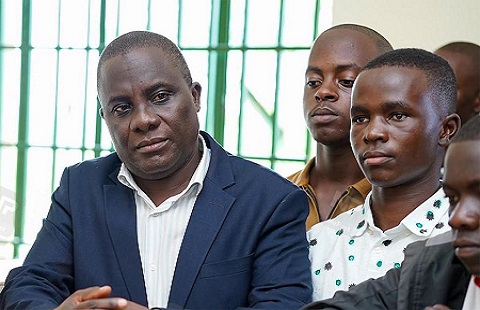
Muwanga Kivumbi and his co-accused
HABARI DAILY I Kampala, Uganda I The 169 days they had spent on remand came to an end with one of the most strict bail terms in the legal fraternity after the International Crimes Division (ICD) of the High Court granted former Butambala County MP Muhammad Muwanga Kivumbi and 16 of his co-accused bail, subjecting them to a series of stringent conditions aimed at ensuring they remain available for trial on terrorism-related charges.
In a ruling delivered by Justice Susan Okalany, Kivumbi was granted a cash bail of Shs10 million, while each of the 16 co-accused who successfully secured release was ordered to pay Shs1 million in cash.
The court also imposed strict obligations on the accused beyond the financial requirements. Kivumbi must immediately surrender his passport to the court registrar and is prohibited from travelling outside Uganda unless he first obtains formal permission from the court.
Justice Okalany further directed that Kivumbi report to the Butambala Chief Magistrate’s Court once every month and, in addition, report to the International Crimes Division of the High Court every last Friday of each month for as long as the criminal proceedings remain active.
According to reports, the monthly reporting requirement before the Butambala Chief Magistrate’s Court will only cease if the Director of Public Prosecutions (DPP) formally commits the case to the High Court for trial.
The court also attached strict conditions to the sureties.
Kivumbi presented three prominent sureties, among them National Unity Platform (NUP) Secretary General David Lewis Rubongoya and Leader of Opposition Joel Ssenyonyi. Each of the sureties was bonded at Shs5 million, non-cash.
Justice Okalany extended the same requirement to the sureties of all the accused persons who secured bail.
“The applicants are prohibited from travelling outside Uganda without prior notice to the court,” the judge ruled while emphasizing the restrictions accompanying their release.
The ruling sparked celebrations outside court, where supporters welcomed the release of Kivumbi and the other accused after nearly six months in detention.
However, not all the applicants walked free.
Although 23 suspects had sought bail, only 17, including Kivumbi, met the court’s requirements. Six others remained on remand after the court found that some of their sureties lacked the necessary documentation required to support the applications.
Defence lawyers nevertheless expressed optimism that the deficiencies would be addressed before the matter returns to court on July 13.
Kivumbi, the NUP deputy president for Central Uganda, was arrested following violent incidents in Butambala District after the January 2026 elections that claimed seven lives.
He was initially arraigned before the Butambala Chief Magistrate’s Court on February 3, 2026, on treason charges before the case was later transferred to the International Crimes Division, where it has since been treated as involving terrorism-related offences.
The prosecution alleges that between January 11 and January 17, 2026, Kivumbi and his co-accused engaged in acts intended to influence or intimidate the government in Gombe and Kibibi Town Council in Butambala District.
The State further alleges that the group attacked Kibibi Police Station and the Electoral Commission tally centre in Butambala during the post-election unrest.
The accused have denied the allegations.
Their application for bail was filed on May 4, with the defence arguing that all legal requirements for temporary release pending trial had been satisfied.
The Director of Public Prosecutions strongly opposed the request.
Assistant Director of Public Prosecutions Thomas Jatiko argued before court that releasing the accused could jeopardize the prosecution’s case because they might interfere with witnesses.
The bail proceedings themselves were characterised by delays and legal arguments over the suitability of sureties and the prosecution’s readiness to proceed.
Throughout the proceedings, the accused were detained in different correctional facilities, including Luzira, Kitalya and Kigo prisons.
Kivumbi’s arrest followed the January 15, 2026 general elections and quickly became one of the country’s most politically sensitive criminal cases. While police accused him of orchestrating violence in Butambala, NUP president Robert Kyagulanyi, popularly known as Bobi Wine, accused the government of targeting opposition leaders in the aftermath of the elections.
Although Kivumbi and the 16 co-accused have regained their freedom, their release remains heavily regulated through substantial cash bonds, travel restrictions, passport surrender, regular reporting obligations and tightly monitored sureties, making it one of the most restrictive bail arrangements imposed in a high-profile political case in recent years as they await trial before the High Court.