

Pearl Bank, Ronalds In Africa Partnership Empowers Over 30 Agribusinesses To Attract Funding
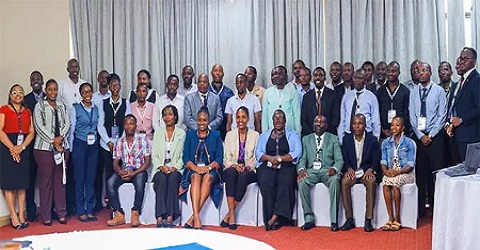
A cross section of Pearl Bank and Ronalds in Africa officials, pose for pictures with some of the trainees from the agribusiness fraternity
HABARI DAILY I Kampala, Uganda I Pearl Bank’s partnership with Ronalds in Africa has strengthened Uganda’s agricultural sector by providing technical assistance training to more than 30 agribusinesses and farmer groups, equipping them with the knowledge and systems needed to become investment-ready and access commercial financing.
The initiative culminated in a three-day Agri-SME Bootcamp that ended on July 10, 2026, at Skyz Hotel in Naguru, Kampala. The intensive programme brought together agricultural entrepreneurs, cooperatives and farmer organisations from across the country to sharpen their business management skills and prepare them for sustainable growth.
The training focused on critical areas that often prevent agricultural businesses from securing financing, including corporate governance, financial management, business growth strategies, record-keeping and preparations for accessing larger credit facilities.
Boosting agricultural value chain
Organised jointly by Pearl Bank and Ronalds in Africa, the bootcamp forms part of a broader effort to strengthen Uganda’s agricultural value chain by helping small and medium-sized enterprises establish strong governance structures, improve financial readiness and attract commercial investment.
Pearl Bank Regional Head for Greater Kampala, Martin Lukyamuzi, said agriculture remains central to Uganda’s economic transformation and that improving farmers’ access to finance is essential for achieving the country’s development ambitions.
“Agriculture continues to play a key role in the growth of our economy. The sector employs over 70% of our population who are directly or indirectly involved, and it forms part of the ATMS (Agro-industrialization, Tourism, Mineral Development, and Science, Technology & Innovation), which are key drivers of the government’s tenfold growth strategy to expand the economy from $50 billion to $500 billion by 2040,” Lukyamuzi said.
Governance systems lacking
He noted that while many farmers have viable enterprises, they often struggle to obtain financing because they lack proper governance systems, financial records and business structures required by commercial lenders.
Through the partnership with Ronalds in Africa, more than 30 agribusinesses have received practical technical assistance to bridge those gaps and position themselves for growth.
“From the bootcamp, where together with Ronalds in Africa we have offered technical assistance training to over 30 Agri-SMEs across the country, we are confident that with the right financing and implementation of what the agri-preneurs were encouraged to do, a tangible impact can be attained and also complement the government’s effort to grow the economy to USD 500 billion by 2040,” Lukyamuzi said.
The programme trained participants on establishing sound governance systems, improving internal controls, maintaining proper financial records and preparing bankable business proposals capable of attracting larger financing facilities.
Participants also gained practical knowledge on scaling agricultural production, embracing value addition and positioning their businesses to tap into growing domestic and regional markets.
The organisers believe strengthening these foundational business systems will enable more agricultural enterprises to graduate from small-scale operations into commercially competitive businesses capable of creating employment and increasing agricultural productivity.
Market surveys crucial
GRO Foundation Chief Executive Officer Laban Musinguzi challenged farmers to first identify reliable markets before investing heavily in expanding production.
He said understanding consumer demand and market requirements is critical to building profitable agribusinesses.
Musinguzi also encouraged participants to invest in value addition rather than selling raw produce, saying processed agricultural products fetch higher prices and are more competitive in both local and export markets.
He noted that Uganda is pursuing access to larger regional and international markets, making it important for farmers to understand customer preferences, quality standards and market requirements.
Machame success story
One of the success stories shared during the bootcamp came from Machame Farm Managing Director Upendo Malikia, who explained how the company had transformed from a modest 40-acre enterprise into a 1,300-acre commercial farming operation.
Malikia attributed the remarkable growth to a combination of mechanisation, disciplined financial management, strong supplier partnerships, proper bookkeeping and access to large-scale financing from Pearl Bank.
The expansion has not only increased agricultural production but has also created employment opportunities and contributed to social and economic transformation in Nwoya District, where the farm operates.
The experience demonstrated how improved financial management and access to credit can accelerate agricultural growth and improve rural livelihoods.
Lukyamuzi reaffirmed Pearl Bank’s commitment to supporting Uganda’s productive sectors by developing financial solutions tailored to the needs of farmers, cooperatives and agribusinesses.
“We commit to continue designing accessible products and services that not only enable participation in critical sectors like agriculture, but also create positive outcomes like employment, financial inclusion, food security, trade opportunities within the country, and across the region, which will enable Uganda’s socio-economic development,” he said.
About the Author