
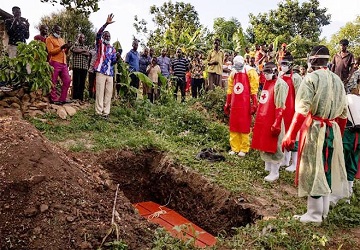
Uganda may as well be seeing it’s last burial ceremony due to the recent Ebola strike
HABARI DAILY I Kampala, Uganda I After the loss of two lives and hospitalisation of tens of Ugandans, the country has finally reached a major milestone in its battle against the latest Ebola outbreak. The latest strike spilled over from the Democratic Republic of Congo (DRC).
Health authorities have now discharged the last remaining patient from the Mulago National Referral Hospital Ebola Isolation Centre.
The symbolic discharge on Thursday marked more than the recovery of a single patient. It officially triggered the World Health Organization’s (WHO) mandatory 42-day countdown before Uganda can once again declare itself Ebola-free, provided no new infections are detected during that period.
Health experts say the development represents a significant victory for Uganda, which has spent the past two months containing the rare Bundibugyo strain of the Ebola virus—a strain for which there are no widely available vaccines or targeted treatments.
DR Congo Link
The latest outbreak was declared on May 15 after a patient who had travelled from the neighbouring eastern Democratic Republic of Congo, the epicentre of the current outbreak, tested positive for Ebola. The cross-border transmission immediately placed Uganda’s health authorities on high alert, with surveillance teams deployed across border districts and major urban centres.
By the time the outbreak was brought under control, Uganda had recorded 20 confirmed cases, comprising 15 Congolese nationals and five Ugandans. Two people succumbed to the disease while the remaining patients recovered following intensive medical treatment and isolation.
At Mulago National Referral Hospital, the last patient underwent a rigorous discharge process that included repeated laboratory testing to confirm that the virus had been completely cleared from the body. After testing negative, the patient received comprehensive supportive treatment before being formally discharged during a ceremony presided over by Health Minister Dr. Chris Baryomunsi.
Discharge certificate issued
During the event, Dr. Baryomunsi handed the recovered patient an official Ebola discharge certificate confirming that he no longer posed any danger of transmitting the virus.
“His current state of health does not constitute a danger to the community and can therefore return to his household and professional environment and continue with his normal activities,” Dr. Baryomunsi said.
He appealed to the public to welcome the recovered patient back into society. “The community and the authorities are requested to accept him in order to promote his social reintegration,” the minister added.
The discharge certificate serves not only as medical clearance but also as an important tool against stigma, which remains one of the biggest challenges during Ebola outbreaks.
Throughout the latest epidemic, health workers and social scientists worked closely with affected families to counter misinformation and discrimination, particularly after some of the first confirmed infections were identified in densely populated areas, including Kampala.
Beyond the health emergency, Uganda’s response was complicated by the nature of the Bundibugyo strain itself.
Unlike the more common Zaire strain, the Bundibugyo variant has no licensed vaccine in widespread use and lacks specific antiviral treatments. This meant health workers had to rely heavily on early detection, strict isolation, supportive treatment and intensive contact tracing to interrupt transmission.
Uganda’s 20 confirmed infections
Cross-border movement between Uganda and the DRC presented another significant challenge. With 15 of the country’s 20 confirmed infections originating from across the border, authorities tightened surveillance at official entry points while increasing screening of travellers.
Some sections of the border experienced temporary restrictions that significantly affected commerce between the two countries.
The outbreak also dealt a blow to Uganda’s tourism industry. International travel advisories and widespread fears about Ebola reportedly resulted in more than 70 percent of expected tourist bookings being cancelled, affecting hotels, tour operators and related businesses that depend heavily on foreign visitors.
At the same time, Uganda faced considerable financial pressure in sustaining the emergency response.
Health authorities estimated that approximately 24 million US dollars would be required for laboratory testing, surveillance, treatment, logistics and community mobilisation, at a time when international humanitarian funding has been declining globally.
Despite these challenges, the World Health Organization praised Uganda’s preparedness and rapid response.
WHO Representative to Uganda, Dr. Kasonde Mwinga, said years of investing in epidemic preparedness enabled the country to respond quickly once the imported case was confirmed.
He noted that emergency response teams remained on high alert throughout the outbreak, helping to detect infections early and limit further spread.
Fatality rate kept below 10 percent
According to Dr. Mwinga, Uganda’s preparedness also contributed to keeping the case fatality rate below 10 percent, making it one of the lowest mortality rates recorded during an Ebola outbreak.
The WHO says an Ebola outbreak can only be declared over after 42 consecutive days without a new confirmed case following the point at which the last patient either recovers and tests negative or dies.
With the final patient now discharged, Uganda has entered that crucial countdown period.
Health officials, however, caution that vigilance must continue until the 42 days are completed. Surveillance teams remain deployed across high-risk areas, particularly districts bordering the Democratic Republic of Congo, where the outbreak continues.
For Uganda, the latest Ebola outbreak has once again demonstrated both the country’s vulnerability to cross-border disease transmission and the importance of sustained investment in public health preparedness.
If no new cases emerge over the coming six weeks, Uganda will once again earn the coveted Ebola-free status—a hard-fought achievement after months of intensive surveillance, treatment, public education and international cooperation in containing one of the world’s deadliest viral diseases.







About the Author