
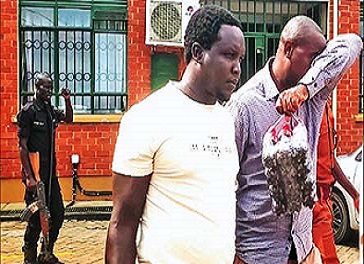
Alinga being escorted to a prisons bus in 2024
HABARI DAILY I Kampala, Uganda I After the Catholic Church had suspended him over embezzlement of Shs6 million, a dejected Catholic priest’s fall from the altar to the dock reached its climax on Thursday when the High Court in Entebbe sentenced him to 21 years in prison for murdering a former Uganda Revenue Authority (URA) employee and attempting to kill another man.
Rev. Fr. Dominic Alinga, who once served under the Moroto Catholic Diocese, pleaded guilty to the murder of John Bosco Ngorok and the attempted murder of Moses Abigaba before Justice Flavia Nabakooza. The judge sentenced him to 21 years’ imprisonment for murder and an additional 10 years for attempted murder. The sentences will run concurrently, meaning Alinga will serve the longer 21-year sentence.
The sentence marks a dramatic end to a criminal case that shocked both the Catholic Church and the public after investigators linked the killing to Alinga’s suspension from priestly duties over allegations that he had mismanaged Shs6 million belonging to the Church.
According to prosecutors, Alinga believed Ngorok had disclosed information to Church authorities that contributed to his suspension. Acting on that suspicion, he allegedly lured Ngorok into a meeting on August 2, 2024, before attacking him with a knife while the two travelled towards Entebbe.
The prosecution described the attack as premeditated and carried out using a dangerous weapon.
Court heard that after being stabbed, Ngorok desperately sought help, attracting the attention of Moses Abigaba, who attempted to intervene. Instead of ending there, the violence escalated as Alinga allegedly turned on Abigaba before knocking both men with his vehicle while trying to flee the scene.
Ngorok later succumbed to the injuries he sustained during the attack, while Abigaba survived.
Investigators further told court that after the incident, Alinga attempted to conceal evidence before travelling to Tororo. While there, he reportedly confessed to a fellow Catholic priest before surrendering himself to police.
Alinga was formally charged in October 2024 with murder and attempted murder. When his trial commenced before Justice Nabakooza, he admitted responsibility for both offences, a move that spared the court the time and expense of conducting a full trial.
In delivering the sentence, Justice Nabakooza considered several mitigating factors, including the period Alinga had already spent on remand since his arrest and his decision to plead guilty.
Under Sections 188 and 189 of Uganda’s Penal Code Act, murder carries the death penalty, although courts retain discretion to impose a lesser punishment after considering the circumstances of each case. Attempted murder, under Section 204, attracts a maximum sentence of life imprisonment.
Entebbe Resident State Attorney Janet Kitimbo argued that Alinga’s position as a Catholic priest should not exempt him from criminal responsibility.
“No one is above the law,” Kitimbo told court, urging that religious office should never become a shield against accountability.
Before his arrest, Alinga, who was about 34 years old at the time, had served in several parishes under the Moroto Catholic Diocese, including Our Lady Queen Parish in Nakapiripirit and Iriiri Catholic Parish. He hails from Alipada Village in Ngoleite Sub-county, Napak District.
The conviction also raises questions about whether Alinga could ever return to priestly ministry after completing his prison sentence.
Rev. Dr. Joseph Ssenyonjo of St. Mbaaga Seminary explained that a priest suspended from ministry is prohibited from celebrating Mass or exercising priestly functions.
“A priest who has been suspended from ministry is not permitted to celebrate Mass,” Ssenyonjo said, adding that Church law bars suspended clerics from officiating until any disciplinary measures are lawfully lifted.
Legal experts, meanwhile, believe Alinga received a relatively light sentence considering the gravity of the offences.
Criminal lawyer Susan Wakabala said although the former priest retains the right to appeal if he considers the sentence excessive, such an appeal would likely have little chance of success.
“In this case, I do not think he would succeed in appealing against the sentence because he got a good deal and was given a lenient sentence,” Wakabala said.







About the Author