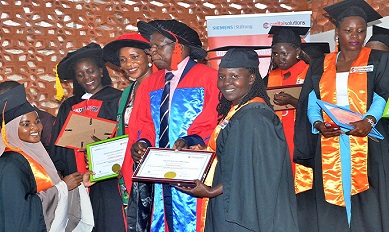

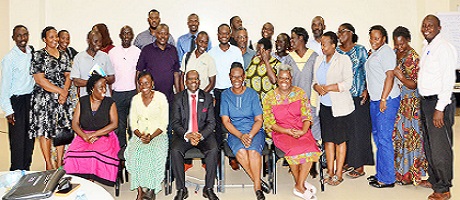
Charles Ocici (2nd Left on front row), with a cross section of individuals who took part in the BEST training at the Enterprise Uganda Center of Excellence in Butabika recently (Photo by John Ricks Kayizzi)
Graduates in the Business and Enterprise Startup Tour (BEST)
HABARI DAILY I Kampala, Uganda I The business acumen of tens of Ugandans was boosted recently as 1,300 participants graduated from Enterprise Uganda’s Business and Enterprise Startup Tour (BEST), an intensive five-day entrepreneurship workshop designed to equip aspiring and existing entrepreneurs with practical skills to start, manage and grow successful businesses.
Held at the Enterprise Uganda Centre of Excellence for Business Development Services (BDS) in Butabika, the programme attracted a diverse mix of participants, including university graduates, small business owners, start-up founders and over 100 officers from the Uganda Prisons Service. The graduation marked one of the largest cohorts since Enterprise Uganda shifted its operations to the Centre of Excellence.
Speaking at the ceremony, Enterprise Uganda Director General Charles Ocici said the training is intended to inspire immediate action rather than simply impart theoretical knowledge.
Business ideas hatched
“The majority of people who come to this training and they don’t have a business, by next month they will have a business. This is what is going to give someone the push to start that business which they have been hesitant to carry out,” Ocici said.
“For those who already have businesses, they will go back and fix mistakes they have been making. There are many common mistakes in business and this training is here to solve that problem.”
Ocici noted that many Ugandan businesses fail before celebrating their fifth anniversary, a trend Enterprise Uganda hopes to reverse through practical entrepreneurship education.
“You have your business and in one year it is already failing. You come to BEST and you go back and fix that problem so that your startup can actually progress beyond that startup and become a lasting business. If you have an idea, it will become a small business. If you have a small business, it will become a larger enterprise,” he said.
He explained that the week-long programme targeted both individuals yet to venture into business and entrepreneurs seeking to scale their enterprises.
“This teaching makes people take action immediately after the training. It is aimed at individuals who have not yet gone into business but know that for their incomes to change, they must start a business. It also attracted people already doing business—micro, small and medium enterprises—that wanted to continue growing.”
From aid to trade
Ocici urged Ugandans to embrace entrepreneurship as global development priorities shift away from aid towards trade and investment.
“The days of depending on donations are behind us. The world is now saying, ‘Let us do business together.’ That means you must come to the table with a solution that can compete in price, quality, service and time management.”
He added that Uganda possesses enormous entrepreneurial potential because of its youthful and educated population.
“We are the youngest population. We are educated. We have good English. Those are the elements that position a nation to compete in the global marketplace while sending competitive solutions to the world.”
Ocici also challenged educated but unemployed youth to channel their energy into enterprise instead of waiting for formal employment.
“The people riding boda bodas and selling fruits on the roadside have degrees. We cannot ignore them. Where you start does not matter. What matters is that yesterday you had two customers, today you have three, tomorrow five, and in a month’s time you have twenty.”
Quarterly engagements
He revealed that Enterprise Uganda plans to conduct the BEST programme every quarter, targeting thousands more Ugandans from across the country.
Early success stories are already emerging. Ocici cited one participant from an earlier intake who started with just 30 local chickens immediately after the training and had expanded the flock to more than 200 within a few months, with ambitions of reaching 800 birds.
“This is what we are teaching—skills to start immediately if you have not started, skills to keep expanding if you have already started, and skills to qualify for bank financing so businesses can continue growing,” he said.
Enterprise Uganda Business Development Officer for Communications and Public Relations, Cynthia Kinyera-Lamaro, described BEST as an intensive five-day workshop that has transformed thousands of aspiring entrepreneurs over the years.
“This is an intensive five-day workshop which we have been conducting for many years. It targets new entrepreneurs, those thinking about starting businesses and those who have recently started new businesses,” she said.
According to Kinyera-Lamaro, the programme focuses first on changing participants’ mindset before introducing practical business management skills.
Mindset change vital
“The whole training is based on mindset change. Participants learn how to identify business opportunities, form partnerships, conduct market research, manage capital and identify different ways of financing their businesses.”
She emphasized that lack of cash should not discourage aspiring entrepreneurs.
“A very common complaint is that people don’t have capital. We show them that business can be started wherever they are. Capital is not only cash or loans. You can start a small business today to finance the larger business you want tomorrow. For example, you can begin by selling groundnuts before eventually opening a boutique.”
Kinyera-Lamaro said the workshop will continue to be organised every few months, enabling more Ugandans to acquire entrepreneurial skills that can help them create sustainable businesses, generate employment and contribute to the country’s economic transformation.