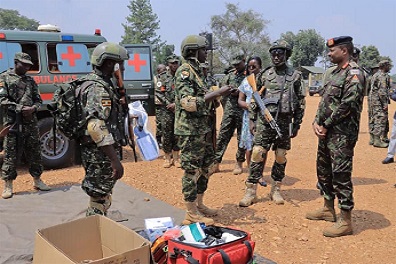
Members of the UPDF showing their tactical readiness
HABARI DAILY I Kampala, Uganda I After spearheading stabilisation missions to several countries in the region, the Ugandan People’s Defence Force (UPDF) has received another endorsement of its operational capabilities after the Eastern Africa Standby Force (EASF) certified it as fully prepared for regional peace support operations.
The certification followed a comprehensive verification exercise conducted at the International Peace Support Operations Training Centre (IPSO-TC) in Singo, where Uganda’s pledged military, police and civilian capabilities were assessed against regional requirements.
The exercise, conducted under the EASF Activity Plan 2026, sought to establish whether Uganda maintains forces that are adequately trained, equipped and capable of rapid deployment whenever conflicts, instability or humanitarian emergencies arise within Eastern Africa.
UPDF Preparedness hailed
Leading the EASF verification team, Force Commander Brigadier General Stephen Maina Huria praised the UPDF for what he described as professionalism, discipline and detailed training.
Huria said the assessment had demonstrated that Uganda’s troops were not only adequately prepared but also motivated and equipped to undertake peace support missions.
“We are really excited and happy that you have joined in this, and we are in this together. When you consider yourself as East Africa’s Standby Force, you are part of it. I am really impressed by the way you conduct your training. It is very detailed,” he said.
The Force Commander said the verification had confirmed the battalion’s operational readiness, giving the regional body confidence in Uganda’s ability to deploy its forces when called upon.
“The troops are mission-ready and highly motivated, well equipped for the task. I can assure you, I am fully satisfied that your forces are ready,” Huria affirmed.
The assessment is significant because standby forces are expected to respond quickly to emerging crises, requiring personnel to maintain high levels of combat preparedness even when they are not actively deployed.
Real-World Operations
The Commandant of IPSO-TC, Colonel Moses Nabaasa, said the training centre remains central to Uganda’s preparation for both regional and international peace support missions.
Nabaasa pointed to Uganda’s longstanding involvement in operations in Somalia, South Sudan, the Central African Republic and the Democratic Republic of Congo as evidence of the UPDF’s contribution to regional and international security.
“Our commitment has been demonstrated through our contributions to global peace and security through active participation in peace support operations in various regional countries,” he said.
According to Nabaasa, the EASF standby force has undergone rigorous individual and collective training based on both EASF and United Nations standards.
The training is designed to improve operational effectiveness, discipline and interoperability, allowing Ugandan troops to work alongside forces from other countries under potentially complex operational environments.
“We have no doubt that our Standby Force has all the attributes required. Once given an opportunity at short notice to operate in any environment, we are always ready for the cause,” he said.
The contingent has also completed collective exercises intended to test how effectively its personnel can operate together while responding to different security scenarios.
Beyond Military Capability
The verification exercise did not focus solely on the UPDF’s military component. Uganda’s police and civilian capabilities were also assessed, reflecting the increasingly multidimensional nature of modern peace support operations.
The inclusion of civilian and police personnel is intended to ensure that regional interventions can address security, humanitarian and governance challenges rather than relying exclusively on military force.
The EASF brings together Burundi, Comoros, Djibouti, Ethiopia, Kenya, Rwanda, Somalia, Sudan and Uganda under a common regional mechanism designed to strengthen collective responses to conflicts, instability and humanitarian emergencies.







About the Author