

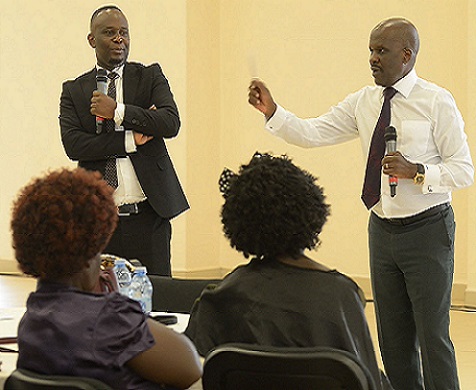
Charles Ocici, the Enterprise Uganda Director General, speaking during the graduation of the first cohort of the Kampala traders
HABARI DAILY I Kampala, Uganda I Enterprise Uganda and the Kampala Capital City Authority (KCCA) have partnered to help Kampala-based entrepreneurs formalise their businesses, improve financial management and enter the tax bracket as part of efforts to broaden the city’s revenue base.
The partnership seeks to encourage small and informal businesses to move beyond operating without registration and embrace formal business practices that can improve their access to finance, markets and other opportunities.
Speaking during a one-day Mindset Change, Entrepreneurship and Financial Literacy Training held on September 8 at the Enterprise Uganda Business Training Centre in Butabika, Enterprise Uganda Director General Charles Ocici said many entrepreneurs participating in the programme were operating businesses that were not formally registered.
“Many of the participants actually are not registered, don’t have registered companies,” Ocici said, stressing the need for government to develop incentives and mechanisms that encourage such enterprises to formalise.
He suggested that KCCA could link access to trading spaces to business registration, particularly in markets and other designated commercial areas.
“For you to continue to operate in places that we have allowed you to come into, for example you are in Wandegea market, we will not allow you to continue occupying this space unless you are registered,” he said.
Formalisation beyond paperwork
Ocici, however, cautioned that formalisation should not be viewed simply as obtaining a certificate of incorporation or registering a business name.
He said genuine formalisation should involve entrepreneurs adopting proper financial and business management systems that enable them to distinguish their personal affairs from those of their enterprises.
“Formalization goes beyond paperwork,” Ocici said, explaining that businesses should maintain records not merely to satisfy tax requirements but to understand their performance.
Proper records, he said, enable entrepreneurs to determine their profits, identify customers who owe them money, establish when debts should be collected and understand the cost of financing their businesses.
According to Ocici, this approach can transform small enterprises into sustainable businesses capable of growing and contributing more meaningfully to government revenues.
He said the ultimate objective was not to collect small amounts of money from struggling entrepreneurs, but to help them grow businesses from which significant taxes can eventually be collected.
Subsidised training
The training is part of Enterprise Uganda’s broader entrepreneurship development programmes aimed at equipping business owners with practical skills.
Kasirye, from KCCA said that city authorities cover participants’ expenses, including meals, making the programme more affordable while encouraging entrepreneurs to commit to improving their businesses.







About the Author