

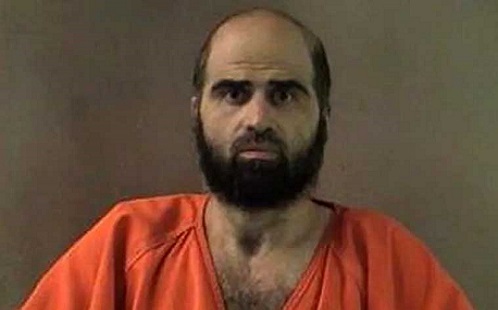
Nidal Hasan
HABARI DAILY I Kampala, Uganda I Hardened by military experiences that made him suicidal, former US Army Major Nidal Hasan is now facing execution by firing squad, more than 16 years after he opened fire on fellow soldiers at Fort Hood, Texas, killing 13 people and wounding 32 others.
The Pentagon has announced that Hasan could be executed in the coming months after President Donald Trump approved the recommendation by Defence Secretary Pete Hegseth for the former Army psychiatrist to be put to death by an Army firing squad.
If carried out, the execution would mark the first time in more than 60 years that the US military has executed a service member. It would also be the first military firing-squad execution since the end of World War Two.
Pentagon spokesperson Sean Parnell announced the decision on Monday, saying Hegseth had recommended the execution and Trump had approved it.
“The Secretary of the Army will set the time and place of the execution,” Parnell said in a post on X, adding: “Judgement day for Hasan has finally come.”
Deadly attack at Fort Hood
Hasan, an Army psychiatrist from Virginia, carried out the November 5, 2009 attack inside a crowded medical facility at Fort Hood, where soldiers were preparing to deploy and undergoing medical checks and vaccinations.
The shooting killed 12 active-duty soldiers and one retired serviceman and wounded 32 others, making it the deadliest non-combat attack on an American military base at the time. Hasan was shot and wounded by responding police before being arrested.
The attack occurred shortly before Hasan was due to deploy to Afghanistan.
During his 2013 court-martial, Hasan acknowledged that he was the gunman and argued that he had acted to prevent US soldiers from going to Afghanistan and harming Muslims. He made little effort to defend himself and was subsequently convicted of 13 counts of premeditated murder and 32 counts of attempted murder. A military jury sentenced him to death in August 2013.
First military execution since 1961
Hasan’s execution would represent a major development in the rarely used US military death-penalty system.
The US military has not carried out an execution since 1961, when Army soldier John A. Bennett was hanged after being convicted of rape and attempted murder. The last known US military execution by firing squad was carried out by musketry in 1945.
Hasan is currently among four prisoners on US military death row.
Military executions differ from executions conducted by individual states. Under military law, a death sentence requires presidential approval, in addition to the completion of the applicable appellate and legal review processes.
The Pentagon’s announcement therefore begins another stage in Hasan’s long-running death-penalty case rather than necessarily meaning that the execution will occur immediately. Hasan has previously pursued appeals challenging aspects of his conviction and proceedings.
Why firing squad?
Firing squads remain an exceptionally rare method of execution in the United States. The method has received renewed attention as authorities have struggled with the availability of lethal-injection drugs. In recent years, some states have revived or expanded firing-squad laws as an alternative execution method.
South Carolina carried out a firing-squad execution last year, the state’s first use of the method. Idaho, Mississippi, Oklahoma and Utah also permit firing squads under specified circumstances.
The Trump administration also added firing squads, electrocution and gas asphyxiation to federally authorised execution methods in April.
Death penalty returns
Hasan’s impending execution comes amid a broader revival of capital punishment under Trump’s administration. Trump has strongly supported the death penalty and, on the first day of his administration in January 2025, signed an executive order directing the federal government to pursue capital punishment more aggressively.
The order described the death penalty as an important tool for deterring and punishing what it characterised as the most serious acts of lethal violence against Americans.
That approach contrasts with former President Joe Biden’s administration, under which the Justice Department imposed a moratorium on federal executions.
While most US executions occur under state rather than military or federal authority, capital punishment remains legally available in 27 states, as well as under federal and military law.







About the Author