

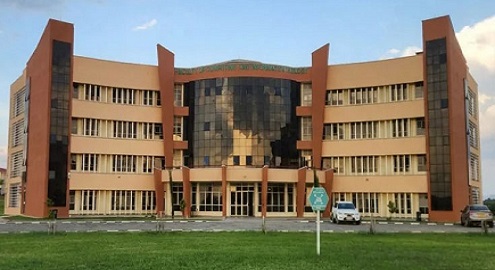
Mbarara University of Science and Technology (MUST) main campus
HABARI DAILY I Kampala, Uganda I Academic excellency has earned Mbarara University of Science and Technology (MUST) international recognition after the institution made its historic debut in the Times Higher Education (THE) World University Rankings for the 2027 edition, placing in the 1,601–1,800 band globally.
The rankings, released on September 30, 2026, provide the western Uganda-based public university with an international benchmark against which to assess its teaching, research output, innovation and engagement with industry.
MUST is among 69 universities from 16 sub-Saharan African countries included in this edition, which assessed 2,297 institutions across 118 countries and territories, making it the largest edition of the rankings to date.
The entry marks a significant milestone for the university, giving it greater visibility in an internationally recognised assessment of higher education institutions and an opportunity to identify areas requiring improvement.
International outlook
MUST’s strongest performance was in international outlook, where it scored 51.4 points. This was followed by research quality at 30.6, research environment at 24.5, industry at 16.8 and teaching at 16.3.
The scores provide an indication of the university’s performance across the five pillars used by THE to assess institutions. Its international outlook score stands out, while the lower scores in teaching and industry highlight areas the institution could examine as it works to strengthen its global competitiveness.
However, the university’s placement in the 1,601–1,800 band should not be interpreted as an exact global position. Institutions within a band are grouped together because differences in their scores are not considered statistically significant enough to establish a precise ranking order.
THE expanded its ranking bands in the 2027 edition to allow more detailed comparisons among universities.
Research carries the greatest weight
The THE World University Rankings use 17 performance indicators grouped into five broad areas: teaching, research environment, research quality, international outlook and industry.
Research quality carries the largest weighting, accounting for 30 per cent of the overall assessment. Teaching contributes 29.5 per cent, while research environment accounts for 29 per cent. International outlook contributes 7.5 per cent, and industry accounts for the remaining four per cent.
The methodology places substantial emphasis on the quality, influence and reach of university research. It examines how frequently other scholars cite a university’s published work, alongside indicators of research strength, excellence and influence.
For the 2027 edition, the research assessment draws on publications produced between 2021 and 2025, with citations tracked through 2026.
Universities must also meet eligibility requirements to receive a ranking. These include teaching undergraduates and producing at least 1,000 relevant research publications during the five-year assessment period, with a minimum of 100 publications in each year.
The requirements are intended to ensure that institutions included in the rankings have sufficient teaching and research activity to be assessed meaningfully.
A benchmark for institutional improvement
MUST said its first appearance in the rankings provides a reference point for strengthening research, teaching, innovation and international collaboration.
The recognition also offers the university an opportunity to review its performance against international standards and identify areas where investment, institutional reforms and partnerships could improve its standing.
Improving research output and influence could be particularly important because research-related indicators collectively account for 59 per cent of the rankings’ overall weighting. Strengthening teaching quality and the research environment would also address two pillars that together contribute more than half of the total score.
The industry pillar presents another opportunity for development through stronger partnerships with businesses, collaboration on practical research and improved links between academic work and economic needs.
Meanwhile, the university’s international outlook score provides a foundation on which it could build through research partnerships, international engagement and greater participation in global academic networks.
MUST’s debut does not place it among the world’s highest-ranked institutions, but it establishes a measurable starting point for future progress. Its inclusion also adds to the international visibility of Uganda’s higher education sector.







About the Author