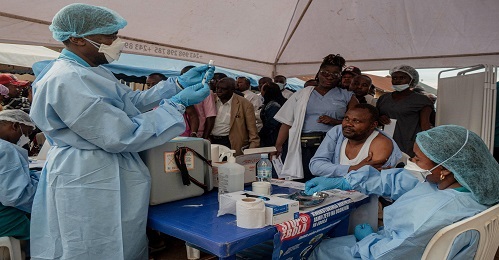
HABARI DAILY I Kampala, Uganda I Kenya’s Ebola outbreak has grown to eight confirmed cases, raising concerns about the spread of the deadly Bundibugyo virus across East and Central Africa, although health authorities say there is no evidence of community transmission within the country.
The latest infection was confirmed on Sunday, October 18, bringing the cumulative number of cases to eight, including the initial patient who died earlier this month. The Ministry of Health said the new patient was among 38 people tested, with one returning a positive result.
Director-General for Health Dr Patrick Amoth said the latest patient was a 49-year-old man who worked as a patient attendant, cleaning utensils and linens used by the first Ebola patient at a Nairobi hospital.
“He is a 49-year-old man who is not a healthcare worker. He developed fever, headache and muscle pain,” Amoth said.
The man developed symptoms on Saturday and was isolated before samples were collected for testing. Health authorities believe he was exposed to the initial patient, who died at The Nairobi Hospital on October 5.
DRC link
Kenya’s outbreak began with a citizen who had been living in the Democratic Republic of the Congo (DRC), where the regional epidemic is centred.
The patient travelled overland from the DRC through Uganda before boarding a flight to Nairobi on October 3. Upon arrival, he was taken to The Nairobi Hospital, where he was isolated and treated. Laboratory tests confirmed infection with the Bundibugyo virus, but he died on October 5.
The subsequent cases have been linked to people who came into contact with the deceased patient, including relatives and health workers who attended to him in hospital.
The second and third cases involved close family members who had already been placed under quarantine when they developed symptoms. Three healthcare workers who treated the initial patient subsequently tested positive, alongside another male relative.
The eighth case involving the patient attendant has further highlighted the risk of infection among people handling items used by Ebola patients, particularly when appropriate infection prevention and control measures are not followed.
Contact tracing intensified
Kenyan health authorities have identified 130 people who had contact with the initial patient. By the weekend, 128 had been traced and placed under quarantine, while efforts continued to locate the remaining two.
The identification of new infections among people already being monitored has allowed health teams to isolate suspected cases and test them without waiting for wider signs of transmission.
The government has maintained heightened surveillance, including screening at high-risk points of entry, contact tracing and public communication on the symptoms of Ebola and the importance of seeking medical attention.
The World Health Organization (WHO) is supporting Kenya’s response, with efforts focused on identifying infections early, monitoring contacts and preventing further spread.
DRC outbreak fuels regional concern
Kenya’s rising case count comes as the DRC continues to battle a severe outbreak that has spread to eight provinces, including North Ubangi, which borders the Central African Republic.
By mid-October, the DRC had reported more than 9,400 cases and over 4,500 deaths, according to figures cited in regional reporting. The expansion into another province has complicated containment efforts and increased concerns about cross-border transmission.
Uganda, which also recorded infections linked to the same regional outbreak, reported 20 confirmed cases, including imported infections, before the WHO declared its outbreak over in August 2026.
The current outbreak involves the Bundibugyo strain, a form of Ebola for which there is no approved vaccine or specific treatment. Patients require close medical monitoring and supportive care, while health workers rely on infection prevention measures to reduce transmission.
Kenya’s health authorities are currently relying on quarantine, contact tracing and rapid isolation to contain the outbreak.







About the Author