
HABARI DAILY I Kampala, Uganda I Uganda’s Prime Minister Robinah Nabbanja has challenged Ugandans to rethink how they manage urban sanitation, warning that cleaning exercises alone cannot resolve persistent garbage and drainage problems in areas such as Kalerwe, Kampala.
Nabbanja said addressing the country’s growing urban sanitation challenges required a coordinated approach involving government agencies, local authorities, landlords, traders and residents, with particular attention to inadequate drainage systems, poor market infrastructure and land-related constraints.
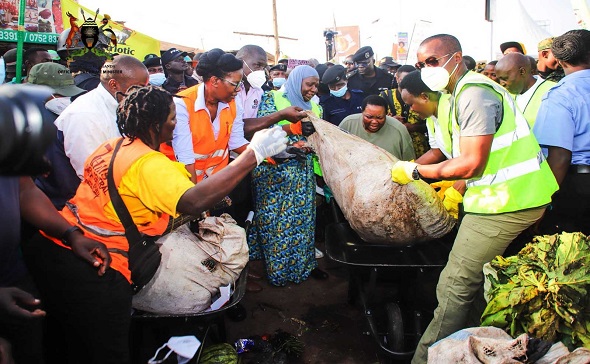
She made the remarks on Saturday while presiding over the fifth National Cleaning Day in Kalerwe, Kawempe Division, where she called for sustained community participation in keeping urban centres clean and adopting better waste management practices.
The Prime Minister said Kalerwe’s sanitation challenges were deeply rooted in structural and infrastructure deficiencies that required deliberate government intervention rather than relying exclusively on periodic cleaning exercises.

She called for improvements to drainage systems and market infrastructure, noting that addressing these shortcomings would help tackle some of the underlying factors contributing to poor sanitation in the busy commercial neighbourhood.
Waste Sorting as an Income Opportunity
Beyond improving sanitation infrastructure, Nabbanja urged residents, traders and businesses to embrace waste sorting and recycling, saying garbage should be viewed as a potential source of income rather than simply unwanted material.
She observed that plastics, metals and organic waste have different commercial values and can generate economic opportunities when properly separated, collected and channelled to recycling businesses.
“Let us develop a culture of sorting waste,” Nabbanja said, urging residents to adopt the use of separate containers for different categories of rubbish to facilitate recycling and proper disposal.
The Prime Minister explained that mixing all forms of waste makes collection, processing and recycling more difficult, while separating materials at the source would improve waste management and create opportunities for businesses operating in the recycling value chain.
For example, plastics and metals can be collected and supplied to recycling enterprises, while organic waste can be channelled into activities such as compost production.
Such an approach, she said, would help reduce the volume of garbage accumulating in urban communities while creating opportunities for residents and young people to earn incomes from waste collection and recycling.
Her message reflects the growing importance of treating waste management as both an environmental responsibility and an economic activity, particularly in densely populated urban settlements where garbage disposal remains a persistent challenge.
Infrastructure and Land Constraints
Nabbanja also acknowledged that Kalerwe’s sanitation problems could not be resolved without addressing the infrastructure and land-related challenges affecting the area.
She called for improvements in drainage systems, which are essential in managing wastewater and preventing the accumulation of stagnant water and waste in public spaces.
The Prime Minister further emphasised the need to improve market infrastructure to support better sanitation practices among traders and other businesses operating in the area.
She proposed engaging landlords to find solutions to land-related constraints, suggesting that direct discussions with property owners could help establish workable arrangements that would allow necessary improvements to be undertaken.
The proposal highlights the importance of involving private property owners in urban sanitation initiatives, particularly in areas where land ownership and access can complicate infrastructure development.
Her remarks pointed to the need for cooperation between government and property owners to ensure that sanitation improvements are sustainable and do not depend solely on temporary community interventions.
Government Promises Modern Equipment
The Prime Minister also disclosed that government was working with relevant institutions and urban authorities to provide modern equipment to improve garbage collection and management.
The planned improvements are intended to strengthen the capacity of urban authorities to collect and handle waste more efficiently, particularly in busy commercial areas where large volumes of rubbish are generated daily.
Modern equipment, combined with improved infrastructure and responsible waste disposal practices, could help reduce the accumulation of garbage and improve the general cleanliness of urban communities.
However, Nabbanja stressed the importance of public cooperation, noting that government interventions would achieve limited results without residents, traders and businesses taking responsibility for their surroundings.
National Cleaning Campaign
The fifth National Cleaning Day brought together residents and other stakeholders in Kalerwe for a community cleaning exercise aimed at promoting collective responsibility for sanitation.
Nabbanja used the occasion to encourage Ugandans to make cleanliness a daily practice rather than an activity undertaken only during organised national cleaning campaigns.
Her message was that lasting improvements in urban sanitation would require a combination of behavioural change, better infrastructure, effective waste collection systems and cooperation among all stakeholders.







About the Author