
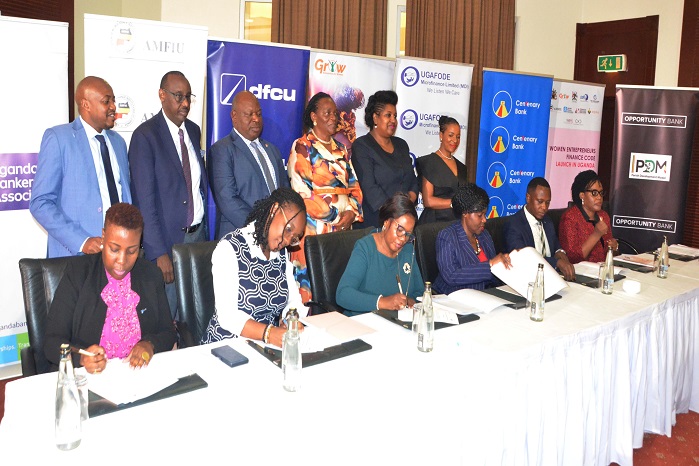
Managers of financial institutions append their signatures on the WE Code pact, while (R-L standing) Dr Ruth Aisha Biyinzika Kasolo, the GROW Project Coordinator at PSFU, Sarah Kagingo, the Deputy Chairperson, PSFU, Peace Mutuuzo, the minister of State for Gender, Richard Byarugaba, Acting Executive Director for Finance at Bank of Uganda, Stephen Asiimwe, the PSFU CEO and another official look on
HABARI DAILY I Kampala, Uganda I Despite making up a large portion of the population, women are sidelined when it comes to obtaining funding for their projects.
It’s upon this background that the World Bank pledged to fund the implementation of the women entrepreneurs (WE) Finance Code, which was designed to address women’s access to finance.
Launched by a coalition that includes the Ministry of Gender, the Bank of Uganda (BoU), the Uganda Bankers Association (UBA), and key development partners, the WE Finance Code will guide institutions to improve leadership on gender financing, adopt sex-disaggregated data systems, and design products tailored to the real needs of women entrepreneurs.
Banks, microfinance institutions, SACCOs, and other financial service providers pledged to embed gender-responsive financing into their core operations, marking a shift toward more inclusive lending practices across the sector.
Francisca Ayodeji Akala, World Bank Country Manager in Uganda, said that the WE Finance Code, which is a global, data-driven initiative, brings together financial service providers, regulators, policymakers, and development partners to collect, analyse, and act on sex-disaggregated data.
“Such data helps us understand how women are being served and where the gaps remain,” she said, adding that Uganda has every reason to lead in this space, since women are at the heart of the country’s entrepreneurial energy—owning or leading more than half of Uganda’s 2.5 million enterprises.
“This is among the highest rates in Africa. However, only about one in four of these businesses currently has access to formal credit,” she said, adding that many women entrepreneurs rely on personal savings, informal borrowing, or short-term, high-interest loans.
Akala further noted that the average loan size for women-led MSMEs in Uganda ranges between $280 and $2,800, often at interest rates as high as 22 percent.
Speaking during the launch of the WE Finance Code at Serena Hotel in Kampala recently, she said that these numbers tell a powerful story—not of weakness, but of untapped potential.
She said that if Uganda manages to close this gender finance gap, the financial sector could generate an additional $277 million in revenue, 90 percent of which would come directly from women-led enterprises,” she said.
Akala added that the agreement represents a major step toward closing the persistent credit gap faced by women-led micro, small, and medium enterprises (WMSMEs).
She said that the launch marks Uganda’s adoption of a global framework already in use in more than 30 countries, aligning the domestic financial sector with international best practices.
“More than 350 financial service providers around the world have endorsed the WE Finance Code, underscoring the urgency and scale of the challenge.”
Richard Byarugaba, Acting Executive Director of the Bank of Uganda, said that women constitute a significant share of Uganda’s entrepreneurial base, yet face barriers such as lack of collateral, limited financial literacy, and cultural constraints,” he said.
He noted that in sub-Saharan Africa, women are more likely to be entrepreneurs than men, yet their businesses earn less, not because of ability, but because of gender-specific constraints that limit their ability to start, sustain, and grow enterprises.
“Closing this gap will boost micro, small, and medium enterprise growth, create jobs, and strengthen household resilience.”
Uganda has made significant progress under the National Financial Inclusion Strategy, to introduce gender inclusion as a strategic priority aimed at reducing access barriers, deepening the use of affordable financial products, promoting gender-inclusive finance, and strengthening consumer protection and financial literacy.
Byarugaba, who represented the Deputy Governor, said that under government interventions such as the Agricultural Credit Facility Bridge, the Small Business Recovery Fund, and the Parish Development Model, “women already account for 22% of access under the Bridge Facility, and many only need small amounts to grow their businesses, such as for seeds and pest control.”
He welcomed the launch of the National Gender and Financial Inclusion Dashboard, calling it “a game changer for evidence-based, inclusive financing” that will support policy, regulation, and targeted interventions for women entrepreneurs.
Peace Mutuuzo, the State Minister for Gender and Culture Affairs noted that the Ministry of Gender, has long championed programmes to enhance the resilience and productivity of women, saying that access to finance is one of the most powerful tools for empowerment, and transforms livelihoods, strengthens families, and uplifts communities.
She said that the Government is already seeing progress under the Generating Growth Opportunities and Productivity for Women Enterprises (GROW) Project, implemented with the Private Sector Foundation Uganda (PSFU) and supported by the World Bank.
Wendy Teleki, the Head of the Women Entrepreneurs Finance Initiative (We-Fi) Secretariat, called the occurrence a truly special moment.
“Because of this, Uganda is joining a growing global movement that is changing how financial systems work for women,” she said.
She noted that the Code is now being implemented in 31 countries with over 400 financial institutions as signatories.
“The goal of the Code is simple, systemic change,” she said. “It embeds gender-smart finance into the core strategies of banks, microfinance institutions, fintechs and other financial actors.”
Teleki added that Uganda’s launch “adds powerful momentum to a global effort” and signals that investing in women entrepreneurs drives inclusive growth, job creation and resilience.
Dr Ruth Aisha Biyinzika Kasolo, the GROW Project Coordinator at PSFU, hailed the World Bank for spearheading the initiative, adding that women who had been treated unjustly by financial institutions due to lack of collateral when they are in need of loans to boost their businesses.
“At long last, we will get data on women enterprises and businesses, which will influence decision making in boardrooms when it comes to allocating finances to women founded businesses. This will be a game changer,” she said.
The We Code compels financial institutions, regulators, and other stakeholders to increase financing for women-led micro, small, and medium enterprises (WMSMEs).
It was launched in 2023 by the World Bank Group and the Women Entrepreneurs Finance Initiative (We-Fi).
Over the years, it has removed systemic barriers to capital for women entrepreneurs. Through it, participants commit to leadership, data collection, and new initiatives to support women-led businesses.







About the Author