
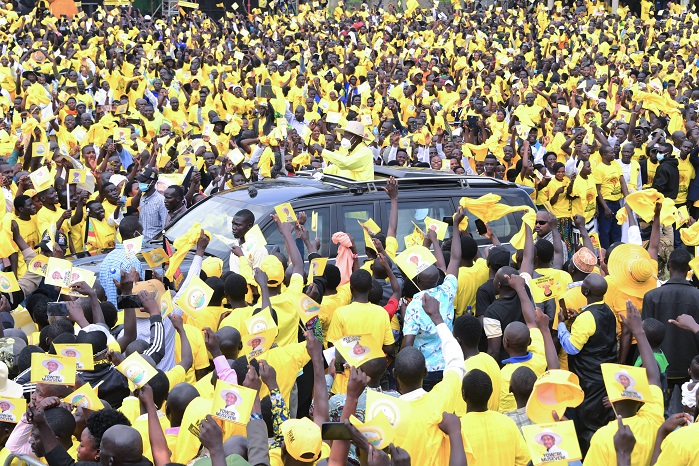
President Museveni campaigning in Bundibugyo today, 5th December 2025
HABARI DAILY I Kampala, Uganda I Government will set up a cocoa processing factory in Bundibugyo, in a project will transform the district’s agricultural potential into industrial wealth and create thousands of jobs.
“We’re going to establish a cocoa factory. I went to America long ago and asked them to come and make chocolate here, but they refused. Now we have serious investors and we shall have our own factory,” said President Yoweri Museveni on Friday, 5th December, 2025. This was during a campaign rally ahead of the 2026 general elections.
He further noted that the government has secured committed investors and that the project will mark a turning point for Uganda’s biggest cocoa-producing district.
Bundibugyo accounts for over 70% of Uganda’s cocoa exports, making it a critical source of foreign exchange.
Museveni said the factory will not only add value to cocoa but also anchor a broader industrial ecosystem.
“We shall not put only one factory but a town of factories like Namanve and Mbale,” the President said, referring to Namanve Industrial Park, which employs 24,000 workers, and the Sino-Mbale Industrial Park which hosts 75 factories and employs 12,000 people.
The NRM candidate reiterated his long-standing argument that Uganda’s job creation capacity lies in commercial agriculture, manufacturing, services, and ICT—not the public sector.
“There are only 480,000 government jobs yet we are 50 million Ugandans. How will those jobs sustain us all?” he asked, giving examples of successful private-sector entrepreneurs like Johnson Basangwa of Kamuli whose poultry business employs 300 workers.
He urged youth to embrace skills development and enterprise, praising testimonies from Ntoroko Industrial Hub graduates now running successful tailoring and carpentry businesses.
The President also delivered his message around the NRM’s seven contributions to Uganda, beginning with peace.
“Uganda had become ungovernable. People died, properties were destroyed. But when NRM came, peace returned,” he said, contrasting Uganda’s stability with security turbulence in neighbouring DR Congo.
The second contribution, he noted, is development, recalling how Uganda once exchanged maize for road construction with Yugoslavia. He promised to rehabilitate the aging Mubende–Fort Portal–Bundibugyo road, now riddled with potholes.
However, Museveni warned against “misplaced prioritization,” taking a swipe at public servants who demand salary increments before critical infrastructure is completed.
“Teachers strike, wanting more salaries now. But what do I do first—fix the road for Bamba and Bakonjo or increase salaries? We must prioritize,” he said.
On education, he said Bundibugyo currently has 107 government primary schools and 12 secondary schools. Under the NRM plan, every parish should have a primary school and every sub-county a secondary school.
Turning to health, the President gave a detailed breakdown which included one government hospital, two HCIVs (Bwamba and Bughendera), each with two doctors, 14 HCIIIs and 10 sub-counties without a single HCIII or HCIV.
He announced upgrades and new HCIII constructions in Ngite, Bundingoma, Busoru, Bulyambwa, Mabere, Mbatya, Ndugutu, Kagugu, Ntoroko, and Buganikere Town Council. Ongoing projects include Ntotoro HCIII, Kyondo HCIII, and a maternity complex at Nyahuka HCIV.
Museveni repeated his long-standing message that prevention remains Uganda’s strongest health pillar.
“You see me, I’m 81 years old and have spent two months campaigning, but I’ve not been to hospital. Prevention is better than cure,” he said, urging citizens to embrace immunization, clean water, and healthy lifestyles.
He criticized theft of medicines in health centres, saying local leaders and elected representatives must take responsibility:
“I have given you the gun to shoot the thief, but you don’t know how to use it. Elect serious leaders who will supervise your interests.”
Regarding wealth creation, the President revisited his hallmark distinction between development and wealth, urging residents to embrace commercial agriculture.
He cited Bundibugyo cocoa farmer Benard Kacuro, who earns up to Shs 75 million per month during peak harvesting, which is proof that wealth can grow even before infrastructure arrives.
He also mentioned a cattle farmer – George Matongo of Nakaseke, who milks 900 litres daily and earns about Shs 250 million annually, despite living 70 miles off a tarmac road.







About the Author