
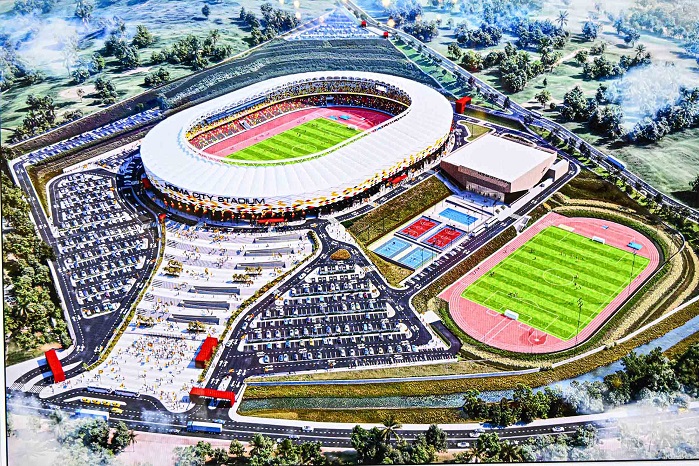
The layout of the Hoima stadium
HABARI DAILY I Kampala, Uganda I The Uganda Government has revealed a deeper plan to construct 10 sports stadia in the coming 18 months, in a bid to boost sports tourism and sporting activities around the country.
Speaking during the commissioning of the Hoima Sports Stadium recently, Mrs Janet Museveni, the minister of Education and Sports, said that Hoima was the harbinger of better things to come.
“Hoima City Stadium is part of a broader plan to construct at least ten sports facilities within 18 months, by June 2027, to support AFCON hosting and long-term sports development,” she said.
She added that additional training and competition grounds will be developed at Hoima Boma Grounds, Masindi Stadium, and Sir Tito Winyi Senior Secondary School.
“Akii-Bua Olympic Stadium in Lira City is progressing well and will be supported by training fields at Gulu University, Lira University, and Pece Stadium,”further said the First Lady, adding that other facilities under development include Kyambogo University, Makerere University, and FUFA Kadiba Stadium to support Mandela National Stadium, Namboole.
“All these facilities are being fully funded by the Government of Uganda. This demonstrates that our economic fundamentals are strong,” she said.
The First Lady emphasised that such large-scale infrastructure development would not be possible without sustained peace and security.
“Younger generations who have known only peace must not take it for granted. These developments are possible only in a stable and secure nation,” she said.
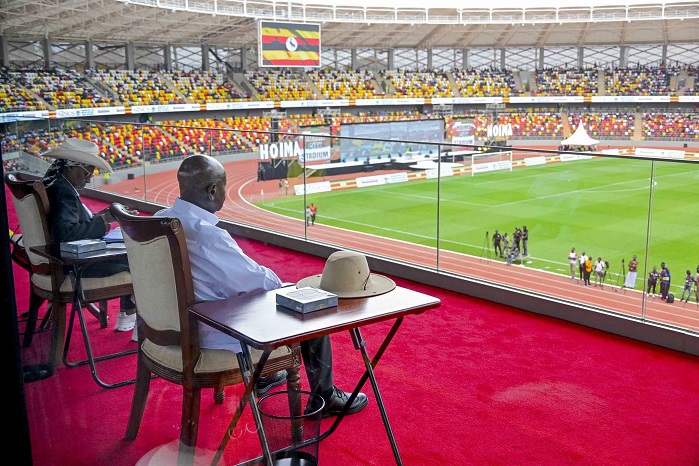
President Museveni and the First Lady presiding over the launch of the stadium
She thanked the Federation of Uganda Football Association (FUFA) for initiating the AFCON 2027 bid, describing it as “positive pressure” that accelerated government action.
She assured Ugandans that the government would take concrete steps to ensure the stadium is well-maintained and operates as a revenue-generating facility.
“The National Council of Sports will ensure this facility is professionally managed so that it maintains itself,” she said.
She also encouraged young people across the country to use the stadium as a platform for talent development.
“We shall rejoice when we see more medals being won by our young people because of facilities like Hoima City Stadium,” she said.
Shs463 billion sports facility
Constructed by Turkish firm Summa International Construction Company Inc, the Hoima City Stadium is a $129 million (Shs463 billion) multi-sports complex that was completed in a record 12 months, four months ahead of schedule. The Government of Uganda signed the construction contract with Summa in June 2024 as part of preparations for AFCON 2027, which Uganda will co-host under the “Pamoja Bid” with Kenya and Tanzania.
Built on a 34-acre piece of land on the outskirts of Hoima City, the stadium complex comprises a 20,000-seater outdoor stadium designed to host football, rugby, and athletics, as well as a 2,000-seater indoor arena for indoor sports such as basketball, netball, volleyball, and other disciplines.
The facility meets international and FIFA-compliant standards, making it suitable for hosting continental and international competitions beyond AFCON 2027. In addition to the main stadium, the complex includes training areas, athlete facilities, administrative blocks, media zones, parking areas, and modern security and safety installations.
President Yoweri Museveni, who was the guest of honor during the unveiling of the new stadium, praised Summa for what he described as exceptional workmanship and efficiency, noting that the project stood as evidence of what Uganda can achieve with proper planning, discipline, and prioritisation.
“I want to thank the Turkish company for the good work. I have seen the stadium, and I have also seen some of the roads they have constructed. They are very good workers, and we are going to do more with them,” he said.
To symbolically launch the stadium, the President stepped onto the pitch and juggled a football three times at the centre circle, amid ululations and applause from thousands of football fans who had packed the stands.
Museveni commended the family of the late Dr. Rujumba, who donated 10 acres of land towards the project.
He also clarified public concerns regarding the financing of the stadium, stressing that the project was fully funded by the Government of Uganda, following a strategic decision to avoid high-interest pre-financing arrangements.
“Initially, the Summa company was supposed to pre-finance the project, but we found that their money came with a lot of interest. So, we said no — let us fund the project ourselves,” the President explained.
He used the occasion to address public debate around government spending on sports infrastructure, arguing that Uganda’s ability to undertake such projects was anchored in the country’s strong economic fundamentals.
“I have been seeing people in the media talking about this and that — things they are not sure about. The truth is that we have constructed this stadium with our own money in the shortest time possible because we have the money,” President Museveni said.
“Uganda has the money, but we cannot do everything at once. Development requires prioritisation.”
Peter Ogwang described Hoima City Stadium as one of the best-executed government projects in recent years.
He traced the project’s origins to early 2023, when President Museveni introduced Summa to the Ministry of Education and Sports to plan phased sports infrastructure development, initially focusing on Lugogo Sports Complex.
“However, when CAF announced in September 2023 that Uganda, Kenya, and Tanzania had won the AFCON hosting rights, priorities shifted, and Hoima City Stadium became the starting point,” Hon. Ogwang said.
He noted that public feedback on the project had been overwhelmingly positive, attributing this to transparency and regular public access to the construction site.
Thousands of Ugandans got jobs
Mehmet Fatih, the Turkish Ambassador to Uganda, described the stadium as a symbol of ambition, partnership, and shared belief in the future.
“This stadium is more than steel and concrete. It reflects the strength of Turkish-Ugandan relations and the professionalism of Turkish construction companies,” he said.
He revealed that thousands of Ugandans were employed during construction, working alongside Turkish engineers in a process that ensured skills and technology transfer.
Summa Construction Chairman, Selim Bora said the stadium’s completion in 12 months was achieved through disciplined planning and extraordinary commitment, despite over 150 days of heavy rainfall during construction.
“More than 2,500 people worked on this project, 80 percent of them Ugandans. This is not just infrastructure — it is capacity building and human capital development,” said Bora.







About the Author