

HABARI DAILY I Kampala, Uganda I Uganda went to the polls today, Thursday, the 15th of January 2026, in an election that, despite a tense buildup and heavy security deployment. The voting process unfolded in a largely peaceful environment across the country, with no reports of election-day protests as voting closed and ballot counting began.
Polling stations officially closed after 5 p.m., with the Electoral Commission extending voting by one hour in areas where biometric voter verification machines failed to function on time. As counting commenced, authorities confirmed that results are expected within 48 hours. By the close of voting, security agencies reported calm across major towns and rural districts alike, underscoring what officials described as a stable election day atmosphere.
President Yoweri Museveni, Africa’s third-longest-serving leader, had earlier warned that security forces would deal firmly with any election-day disturbances. However, the anticipated protests did not materialise, and the day passed without significant incidents. The voting took place under a heavy police and military presence, which authorities said was aimed at preventing violence and safeguarding voters, electoral officials, and materials.

A presiding officer delivering a ballot box earlier today
Although some polling stations opened late due to technical challenges with biometric machines, voters queued patiently as electoral officials worked to resolve the issues. The extension of voting hours helped ensure that eligible voters were not disenfranchised, contributing to an orderly conclusion of the process.
The election was conducted under an internet blackout imposed earlier in the week, a measure the government said was intended to curb misinformation and preserve public order. While the shutdown disrupted online communication, it did not translate into unrest. Many Ugandans adapted by using offline messaging applications, allowing communication to continue without public disturbances.
President Museveni cast his ballot in western Uganda and expressed confidence about extending his rule into a fifth decade. He told reporters he expected to secure a decisive victory, arguing that his long-standing message of stability and development continued to resonate with voters. Museveni has campaigned on the theme of “protecting the gains,” pledging to maintain peace and guide Uganda toward middle-income status.
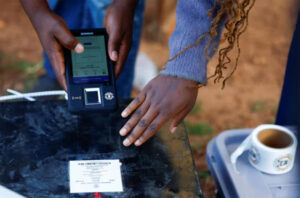
A presiding officer trying out a biometric machine. Most of these machines mul-functioned and never served the purpose
The contest also featured seven opposition candidates, including popular musician-turned-politician Bobi Wine, who has drawn strong support from young voters frustrated by unemployment and limited economic opportunities. Wine later alleged irregularities on social media, including claims of ballot stuffing. Despite such allegations, election day itself remained calm, with no outbreaks of violence reported.
The peaceful conduct of the polls has been closely watched by regional and international observers, given Uganda’s history of politically charged elections and unrest in neighbouring countries. The East African Community (EAC) deployed a 61-member Election Observation Mission to assess the entire electoral process, including the pre-election period, polling day, and post-election phase.
The EAC mission, led by Ambassador Edda Mukabagwiza, comprises observers drawn from partner states and the EAC Secretariat. The team is mandated to provide an independent and impartial assessment in line with Uganda’s electoral laws, EAC principles, and international democratic standards. As voting concluded peacefully, attention turned to the observers’ assessment of transparency, professionalism, and adherence to procedures.
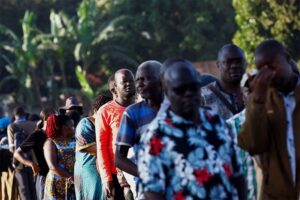
People lining up for the election
EAC Secretary General Veronica Nduva said the mission’s final report would not only evaluate the conduct of the elections but also offer practical recommendations. “The report will include practical recommendations aimed at strengthening future electoral processes and enhancing democratic governance within the EAC,” she said.
In parallel, a joint African Union–Common Market for Eastern and Southern Africa–Inter-Governmental Authority on Development (AU–COMESA–IGAD) Election Observation Mission is also on the ground in Uganda. The mission, deployed at the invitation of the Ugandan government and the Electoral Commission, is led by former Nigerian President Goodluck Jonathan.
Supported by COMESA Committee of Elders member Shemsudin Ahmed Roble and IGAD’s Commander Abebe Muluneh Beyene, the AU–COMESA–IGAD mission includes 84 short-term observers from across the continent. These observers have been deployed in all regions to monitor polling procedures, vote counting, and the overall electoral environment.
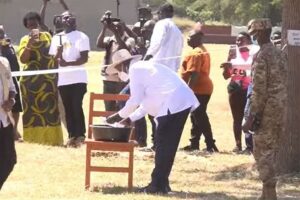
President Museveni casting his vote in Rwakitura today
Their presence, alongside that of the EAC observers, has been cited by officials as contributing to public confidence and calm. A preliminary statement from the AU–COMESA–IGAD mission is expected on January 17, with a final report to follow within a month of the declaration of results.
The Eastern Africa Standby Force (EASF) has also played a role, deploying a 19-member Election Observer Mission to support transparency, peace, and democratic governance. The combined regional observation efforts have underscored the importance placed on stability during the electoral process.
As Uganda awaits the official results, the absence of election-day violence has been highlighted as a notable outcome. While political tensions and legal challenges may still emerge, Thursday’s largely peaceful polling has set a calm tone for the critical post-election period, reinforcing the country’s emphasis on order and stability during a pivotal national vote.







About the Author