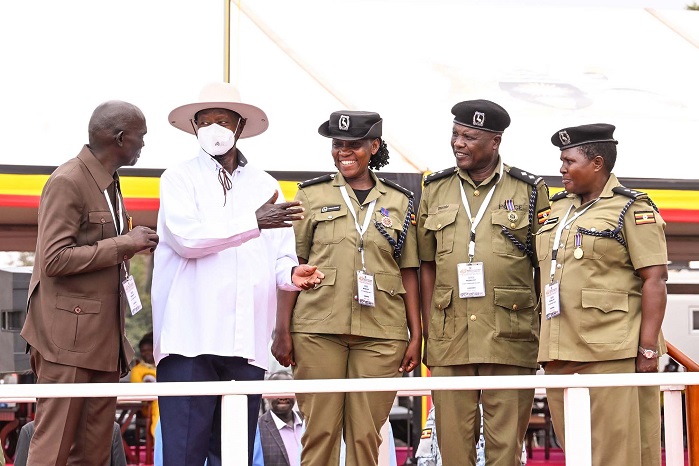
President Museveni shares a light moment with some of the officers who were awarded medal during the NRM Liberation day celebrations at Kololo on today, Monday, January 26th 2026
HABARI DAILY I Kampala, Uganda I President Yoweri Kaguta Museveni has said that 70 percent of Ugandans are now participating in the money economy, marking a major shift from subsistence livelihoods and underscoring what he described as steady improvements in the standard of living during four decades of National Resistance Movement (NRM) governance.
Speaking at the 40th Liberation Day celebrations held at the Kololo National Ceremonial Grounds on January 26, 2026, President Museveni traced Uganda’s socio-economic journey from the devastation of war and economic collapse in the early 1980s to a more diversified, productive and increasingly knowledge-driven economy.
The national celebrations, held under the theme “Tribute to the Patriots who ushered in a fundamental change,” came shortly after President Museveni secured another term in office in the recently concluded presidential elections, in which he was declared winner with 71 percent of the vote. The President used the occasion to reflect on how economic reforms, wealth creation programmes and infrastructure investments have translated into tangible improvements in household incomes, access to services and overall living conditions for millions of Ugandans.
“I thank God for having seen us through this big exercise of elections. Secondly, I salute all Ugandans for participating in the elections,” President Museveni said, while thanking NRM supporters for backing the party and its candidates.
Beyond politics, the President placed strong emphasis on the economy, arguing that sustained growth has been the foundation for rising living standards. He said Uganda’s economy is currently growing at about seven percent annually, with prospects of even faster growth once oil production begins.
“The economy is moving very fast, growing at seven percent now, and with the oil, we are going to go into double digits,” he said. “This year, your oil will start flowing.”
According to President Museveni, growth alone is not the ultimate goal; what matters is how many Ugandans are meaningfully participating in wealth creation. He noted that at independence in 1962, only about nine percent of Ugandans were involved in the money economy, with the vast majority trapped in subsistence agriculture and informal survival activities.
“That colonial economy was small and excluded Africans,” he said, explaining that the structure limited income generation, access to markets and accumulation of assets for most households.
While participation in the money economy gradually increased over the years, progress remained slow until the NRM deliberately introduced targeted wealth creation programmes. Early initiatives such as Entandikwa sought to provide micro-credit to small entrepreneurs, laying the groundwork for household income growth.
By 2013, however, only about 32 percent of Ugandan households were in the money economy, with 68 percent still producing mainly for subsistence. This gap, President Museveni said, prompted the launch of Operation Wealth Creation (OWC), under which the Uganda People’s Defence Forces distributed seedlings and agricultural inputs nationwide to stimulate commercial production.
“When we checked in 2019, 61 percent of Ugandans were in the money economy, while 39 percent were still in the subsistence economy,” he said.
To further accelerate inclusion and directly raise household incomes, the government later rolled out the Parish Development Model (PDM), which channels funds straight to communities at the parish level. The President said this approach was designed to overcome elite capture—locally referred to as “beegabira bokka”—where previous programmes were sometimes monopolised by a few individuals.
According to the latest assessments, President Museveni said, 70 percent of Ugandans are now participating in the money economy, leaving about 30 percent still outside.
“We don’t want a country of 70 percent rich people while 30 percent are poor,” he said, stressing that the government’s focus remains on lifting the remaining households into productive, income-generating activities.
He issued a stern warning against misuse of PDM funds, citing cases where parish chiefs and committee members diverted resources for personal gain. President Museveni said government would amend guidelines, strengthen accountability and increase funding—particularly in urban parishes with large populations.
“We may have to put 300 or 400 million shillings per parish in towns because the homes there are many,” he said, adding that with proper use of funds, rural households could be fully covered within three years.
The President said parish chiefs who violate PDM rules would face arrest, noting that officials in Buwambo, Maracha and Iganga had already been apprehended following complaints from residents. Those who improperly formed committees would be barred from leadership and required to refund money, while individuals who extorted funds would face prosecution.
Beyond PDM, President Museveni said the government is supporting specific groups whose livelihoods directly affect household welfare, including boda boda riders, ghetto youth, cultural and religious leaders, unemployed university graduates and political leaders at parish level. The aim, he said, is to ensure that every Ugandan has a pathway into wealth creation.
“This will be emphasis number one,” he said.
As household incomes improve, President Museveni said the government will intensify investment in education and health, arguing that better incomes enable families to keep children in school and access quality healthcare. He noted that preventive health programmes such as immunisation have performed well, while more resources will be directed toward curative care as fiscal space expands.
Infrastructure development has also been central to improving living standards. President Museveni said the government will prioritise maintenance of both tarmac and marram roads, particularly in rural areas, to ease access to markets, schools and health facilities.
“We don’t want any unrepaired roads, whether tarmac or marram,” he said.
Addressing governance, President Museveni said the fight against corruption—often cited as a drag on service delivery and household welfare—will extend to all sectors, including the judiciary. He praised the new Chief Justice, Dr Flavian Zeija, for taking a firm stance.
“We don’t want corruption in the courts. The new Chief Justice is very active on that,” he said.
The President also dismissed claims by some opposition figures and media outlets that Uganda has not changed over the last 40 years. Referring to a headline that read “No change for 40 years,” he said such narratives ignore the structural transformation that has taken place.
To illustrate the point, President Museveni outlined what he described as five phases of Uganda’s recovery and transformation since 1986: minimum economic recovery after years of instability, expansion of the small colonial economy, diversification, value addition, and the current transition into a knowledge-based economy.
He showcased video footage highlighting four sectors he said now define Uganda’s modern economy: commercial agriculture, manufacturing, services and Information and Communication Technology (ICT). The footage featured large-scale sugarcane plantations, coffee and cocoa farms, palm oil estates, livestock projects and industrial parks such as Namanve, Mbale-Sino, Kapeka and Mukono–Mbalala.
“That’s why somebody told me that when you go to the supermarkets now, 65 percent of the products are made in Uganda. In the past, it was 100 percent imported,” he said, arguing that local production has reduced prices, created jobs and improved consumer access.
President Museveni also reflected on Uganda’s troubled economic past, recalling the 1972 expulsion of Asians by former president Idi Amin.
“At that time, there were only about 4,000 properties owned by Asians in the whole of Uganda. Now we have millions of properties owned by Ugandans,” he said, pointing to the growth of domestic ownership and asset accumulation.
On industrialisation, he cited progress on the Kiira Motors project, noting that locally assembled vehicles had recently completed a return journey to South Africa—an achievement he said symbolised Uganda’s growing technical capacity.
The Minister for the Presidency, Hon. Babirye Milly Babalanda, congratulated President Museveni on his re-election, describing the NRM’s 40-year journey as transformative.
“Today’s commemoration is a reflection on four decades that have profoundly reshaped the destiny of our nation,” she said, thanking God for President Museveni’s leadership and resilience.
She said the election victory reflected continued public confidence in President Museveni and the NRM, and called for unity now that the polls are over.
“Now that the elections are behind us, we face the greater responsibility of building Uganda. Let us move forward in unity, mutual respect and shared national purpose,” she said.
During the ceremony, government awarded national medals to 33 distinguished Ugandans in recognition of their contribution to the liberation struggle and national development.
January 26 marks the day in 1986 when National Resistance Army fighters captured Kampala, ending the rule of the UNLA junta led by the late Gen Tito Okello Lutwa. President Museveni, who led the NRA, was subsequently sworn in as Uganda’s ninth President—ushering in an era that, four decades later, the NRM says has fundamentally transformed livelihoods and improved the standard of living for the majority of Ugandans.







About the Author