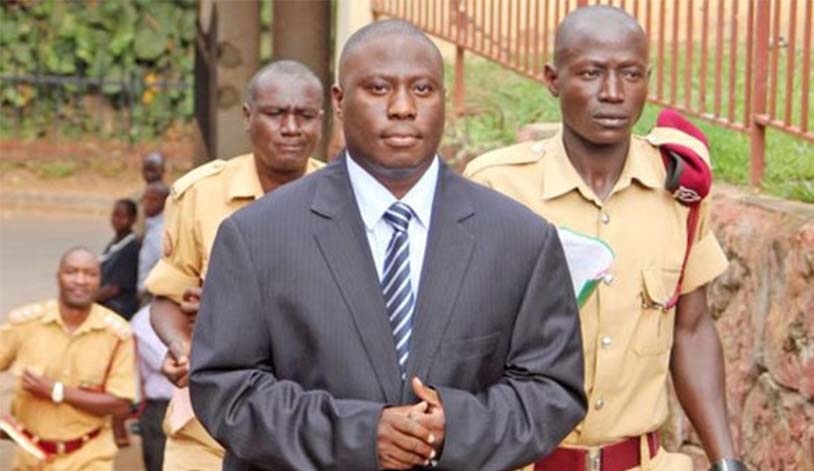
Geoffrey Kazinda heads for a court hearing recently
HABARI DAILY I Kampala, Uganda I Former Office of the Prime Minister (OPM) principal accountant Geoffrey Kazinda has spent nearly five years on remand following a Constitutional Court judgment that ordered his immediate release, a situation his lawyers now say exposes deep flaws in Uganda’s criminal justice and appellate processes.
At the centre of the prolonged incarceration is a disputed appeal by the Attorney General against a 2020 Constitutional Court decision which ruled that Kazinda’s continued prosecution amounted to double jeopardy and violated his constitutional rights.
In submissions filed before the Supreme Court on January 28 through his lawyer Richard Omongole, Kazinda argues that the Attorney General failed to lodge a valid appeal within the timelines directed by the Constitutional Court, rendering the appeal legally ineffective and incapable of suspending the release order.
The Constitutional Court delivered its landmark ruling on August 7, 2020, ordering a permanent stay of proceedings in all pending criminal cases against Kazinda and directing his immediate release. The court held that repeated prosecutions arising from the same facts and transactions violated protections against double jeopardy.
However, instead of being released, Kazinda remained in custody after the Attorney General filed an appeal to the Supreme Court. The apex court subsequently issued interim orders staying execution of the Constitutional Court judgment pending determination of the appeal — a move Kazinda now challenges as having been founded on a defective process.
According to his submissions, the Attorney General took approximately 210 days to appeal the decision, despite being directed to do so “without delay.” Kazinda contends that the memorandum of appeal was only filed on November 20, 2021, long after the constitutional timelines had lapsed and during proceedings meant to determine whether the appeal had already been withdrawn.
“The Attorney General has no valid appeal in this court against the judgment and orders of the Constitutional Court,” Kazinda argues, maintaining that the delayed filing cannot legally suspend the effect of the 2020 ruling.
As a result of the stay of execution issued by the Supreme Court, Kazinda has remained in prison for close to five years awaiting a final determination — a delay his lawyers say amounts to punishment without lawful basis.
Kazinda is further seeking a declaration that the Director of Public Prosecutions’ continued reliance on the Supreme Court’s interim stay orders is erroneous, unlawful and undermines the integrity of the judicial process.
Complicating the matter is a separate legal issue the Supreme Court is also set to resolve: whether the Constitutional Court judgment is invalid because one of the judges who heard the case, Justice Ezekiel Muhanguzi, did not sign the decision before his retirement from the Judiciary.
The Supreme Court is expected to deliver its ruling on February 12, addressing both the validity of the appeal and the effect of the missing judicial signature. The panel hearing the case comprises Justices Lillian Tibatemwa-Ekirikubinza, Alfonse Owiny-Dollo, Percy Night Tuhaise, Elizabeth Musoke, Catherine Bamugemereire, Christopher Madrama and Anna Mugenyi.
Kazinda’s legal troubles date back more than a decade. Before his interdiction in August 2012, he had served as a civil servant for 18 years under the Ministry of Finance and spent five years as principal accountant in the OPM.
He was first convicted in 2013 on three counts of illicit enrichment by the Anti-Corruption Court and sentenced to 15 years’ imprisonment. That sentence was later reduced to seven years by the Court of Appeal.
Despite serving part of his sentence, Kazinda says he was subjected to repeated prosecutions by state agencies over the same set of facts for more than 14 years, prompting his 2014 petition to the Constitutional Court.
Legal analysts say the case has become a test of judicial finality, prosecutorial restraint and the consequences of delayed appeals. At stake is not only Kazinda’s liberty, but also broader questions about whether release orders can be effectively neutralised by procedural delays — leaving accused persons in prolonged detention despite favourable judgments.
As the Supreme Court prepares to rule, the case continues to highlight tensions between anti-corruption enforcement and constitutional protections, with far-reaching implications for Uganda’s justice system.







About the Author