
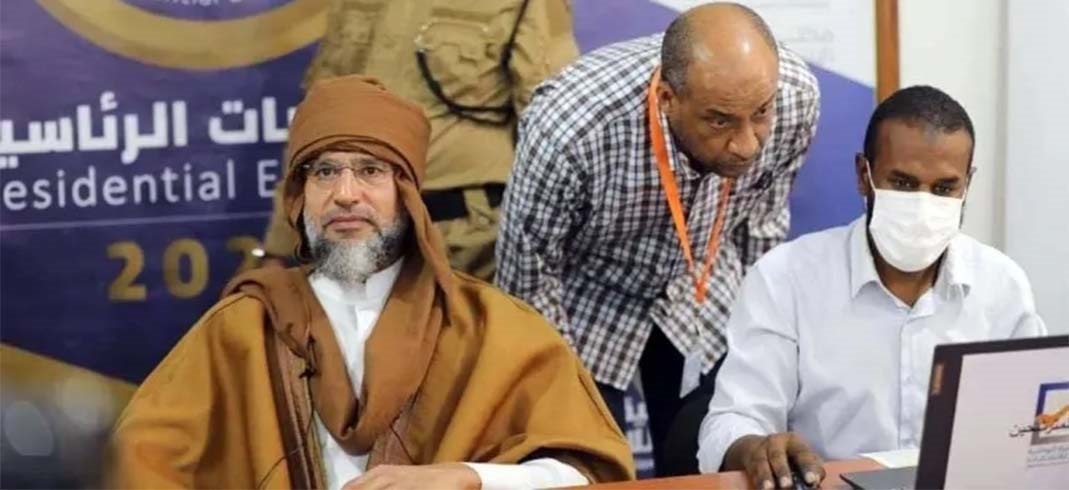
Saif al-Islam Gaddafi (left), son of former Libyan leader Muammar Gaddafi, registers to run in presidential elections in 2021. Many say he was slain due to his political ambitions
HABARI DAILY I Kampala, Uganda I The killing of Saif al-Islam Gaddafi in the western Libyan city of Zintan has once again thrust the shadow of the late Libyan leader Muammar Gaddafi over a country that has never fully escaped his long and turbulent rule. For supporters of the former strongman, Saif al-Islam was more than a political figure; he was the final bridge to a past they believe offered stability, sovereignty and national pride under Gaddafi’s four-decade leadership.
Libyan prosecutors on Wednesday announced an investigation into the death of Saif al-Islam, the most prominent son of Muammar Gaddafi, who was shot dead in his home on Tuesday night. The public prosecutor’s office said forensic experts had been dispatched to Zintan to establish the circumstances of the killing and identify those responsible.
“The victim died from wounds caused by gunfire,” the prosecutor’s statement said, adding that investigators were seeking witnesses and anyone who could “shed light on the incident”.
Saif al-Islam’s lawyer, Marcel Ceccaldi, described the attack as a targeted assassination carried out by an unidentified “four-man commando” that stormed his residence. A statement later released by his political team said the attackers were masked and deliberately disabled security cameras in what it called a “cowardly and treacherous assassination”.
Divided country
The killing has drawn muted official reaction from Libya’s rival authorities, reflecting the country’s fractured political landscape. Libya remains divided between a UN-backed government based in Tripoli and an eastern administration aligned with military commander Khalifa Haftar. Neither side issued an immediate statement.
The only senior official to comment publicly was Moussa al-Kouni, vice-president of the Presidential Council, who condemned the killing as political violence. “No to political assassinations, no to achieving demands by force, and no to violence as a language or a means of expression,” he wrote on social media.
For many Libyans, however, Saif al-Islam’s death cannot be separated from the unresolved question of Muammar Gaddafi’s rule and its violent end. Gaddafi was overthrown and killed in October 2011 during a NATO-backed uprising that ended his 42 years in power but plunged Libya into chronic instability.
Heir apparent to Muammar Gaddafi
Under Muammar Gaddafi, Libya was governed without formal state institutions, yet maintained a strong central authority built around his ideology, oil wealth and anti-Western nationalism. While critics accused him of repression and authoritarianism, his supporters argue that Libya was more united, secure and independent before 2011.
Saif al-Islam was widely seen as the man who could revive that legacy. Although he never held an official government position, he emerged in the early 2000s as his father’s heir-apparent, combining loyalty to the Gaddafi system with rhetoric about reform and elections. By the time of the Arab Spring, he was regarded as the second-most powerful figure in Libya.
During the 2011 uprising, Saif al-Islam became one of the most visible defenders of his father’s rule, appearing on state television and vowing resistance. He was later accused of ordering violence against protesters, placed under UN sanctions and targeted by an International Criminal Court arrest warrant.
Captured in Zintan in late 2011 while attempting to flee the country, he spent years in detention before being released in 2017 under an amnesty issued by eastern authorities. From Zintan, he quietly rebuilt networks among tribes, former regime loyalists and Libyans disillusioned by a decade of chaos.
Shot at Presidency
In July 2021, Saif al-Islam re-emerged in a rare interview with The New York Times, accusing Libya’s ruling elites of fearing elections. Months later, he filed papers to run for president, a move widely seen as an attempt to restore the Gaddafi political project through the ballot box.
His candidacy electrified Libya’s political debate. For his supporters, electing Saif al-Islam would have symbolised a return to the era of Muammar Gaddafi — not necessarily to resurrect the man himself, but to reclaim the sovereignty, order and national unity they associate with his rule. For his opponents, it represented a dangerous revival of a regime they believed Libyans had rejected in blood.
The presidential election never took place, stalled by legal disputes and Libya’s ongoing power struggle. Saif al-Islam remained in political limbo, still wanted by the ICC, yet increasingly influential among communities nostalgic for his father’s leadership.
His assassination now removes the most potent symbol of Gaddafi’s possible political resurrection. Analysts say it may deepen divisions and reinforce the belief among his supporters that the post-2011 order has systematically excluded them — by law, by force, and now by violence.
As Libya’s prosecutors begin their investigation, many Libyans are asking whether the country will ever confront its past honestly. More than a decade after Muammar Gaddafi’s death, his legacy continues to shape Libya’s conflicts, loyalties and fears. With Saif al-Islam gone, the question remains whether Gaddafi’s vision dies with him — or whether it will continue to haunt a nation still searching for a president, a state and a future.







About the Author