
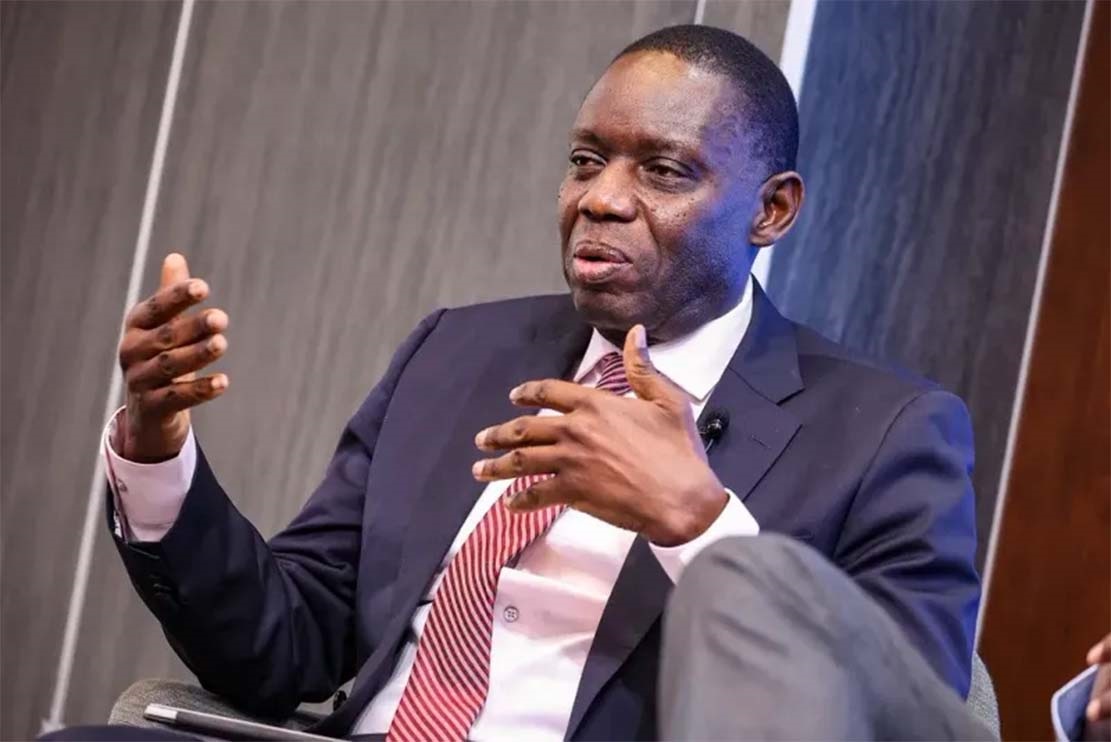
Michael Atingi-Ego
HABARI DAILY I Kampala, Uganda I Uganda’s economy is set for a strong acceleration, with key drivers including public investment, oil and gas development, infrastructure expansion and rising private sector activity expected to push gross domestic product (GDP) growth to an average of about 8% in the medium term, Bank of Uganda (BoU) Governor Michael Atingi-Ego has said.
Uganda’s medium-term GDP growth prospects are strongly positive, with projections indicating an acceleration from the 6.3%–6.4% range in FY2024/25 to 6.5%–7% in 2026.
The ministry of Finance, Planning and Economic Development projects that the economy will reach double-digit growth (specifically targeting over 10%) in the subsequent period, driven by the anticipated commencement of commercial oil production, with GDP potentially increasing from $59.3 billion to $66 billion by 2026.
In the Monetary Policy Statement for February 2026, released on Monday, Atingi-Ego said Uganda’s growth outlook remains robust, supported by stable macroeconomic conditions, prudent monetary policy and a steadily improving global environment.
“Over the medium term, economic growth is expected to strengthen further, rising to an average of around 8%,” Atingi-Ego said. “This outlook is underpinned by accelerated public investment, oil-related and infrastructure developments, government initiatives, continued improvement in the global economic environment, prudent monetary policy, and increased private sector activity.”
CBR remains at 9.75%
The central bank’s Monetary Policy Committee (MPC) maintained the Central Bank Rate (CBR) at 9.75%, arguing that the prevailing policy stance remains supportive of economic activity while ensuring inflation remains anchored around the 5% target.
“The Committee assessed that the prevailing policy stance remains appropriate to support economic activity while ensuring that inflation stabilises around the target over the medium to long term, amid persistent global economic uncertainty,” Atingi-Ego said.
Uganda’s recent economic performance has been steady. During the first three quarters of 2025, economic growth averaged 6.3%, driven mainly by strong domestic demand. Final consumption expenditure expanded by 14.7%, largely reflecting robust government consumption growth of 22.8%, alongside household consumption growth of 14.2%.
“The growth was largely driven by final consumption expenditure, which expanded by 14.7%, mainly reflecting strong government consumption growth of 22.8%, compared to growth of 14.2% in household consumption,” Atingi-Ego noted.
Economic rebound
Despite a moderation in growth during the two quarters to September 2025, high-frequency indicators suggest a rebound. “High-frequency indicators and forecasts point to higher economic activity in the quarter to December 2025 and in the second half of the financial year,” the governor said, adding that economic growth in FY2025/26 is projected at between 6.5% and 7.0%.
Central to the medium-term growth outlook is the expected boost from Uganda’s oil and gas sector, alongside large-scale public investments in transport, energy and industrial infrastructure. According to Atingi-Ego, these investments are already stimulating related sectors, including construction, logistics, manufacturing and services.
“This outlook is underpinned by accelerated public investment, oil-related and infrastructure developments, government initiatives, and increased private sector activity,” he said, adding that improvements in the global economy are also expected to support exports and capital inflows.
Inflation holds at 3.3%
Macroeconomic stability remains a key pillar of Uganda’s growth strategy. Inflation has stayed below the BoU’s medium-term target of 5%, providing room for growth-supportive policies. Over the 12 months to January 2026, headline inflation averaged 3.5%, while core inflation averaged 3.8%.
“Inflation has remained below the medium-term target of 5%, reflecting the impact of prudent monetary policy complemented by coordination with fiscal policy, a stable exchange rate, declining global inflation, and favourable food and energy prices,” Atingi-Ego said.
Headline inflation rose slightly to 3.2% in January 2026 from 3.1% in December 2025, while core inflation increased to 3.3% from 3.1%, mainly driven by higher services inflation, particularly in passenger air transport. However, food crop inflation moderated to 3.0% from 4.4%, supported by favourable weather conditions, while Energy, Fuel and Utilities inflation rose marginally to 1.7% from 1.4%.
Looking ahead, Atingi-Ego said inflation is projected to remain slightly below target in 2026, within a range of 3.8% to 4.3%, before stabilising around 5% in the medium to long term. “This outlook is supported by continued prudent monetary policy, stable exchange rate conditions, and moderating global commodity prices,” he said.
The downside
However, the governor warned that risks to both inflation and growth remain elevated. Upside risks include stronger-than-expected domestic demand driven by expansionary fiscal policy, a persistently depreciated exchange rate, geopolitical tensions disrupting global supply chains, and adverse weather affecting agricultural output.
On the downside, Atingi-Ego cited the possibility of a sharper-than-projected slowdown in domestic economic activity, weaker global growth due to trade-related shocks, and declining commodity prices.
Ten-fold growth
“Notwithstanding the favourable outlook, risks to the growth projection are tilted to the downside,” he said, adding that evolving geopolitical tensions could dampen global growth, disrupt trade routes and supply chains, and exert upward pressure on oil prices.
The Uganda government is implementing the “Tenfold Growth Strategy” under the Fourth National Development Plan (NDPIV) to move from a $ 50 billion economy to a $ 500 billion economy by 2040.







About the Author