
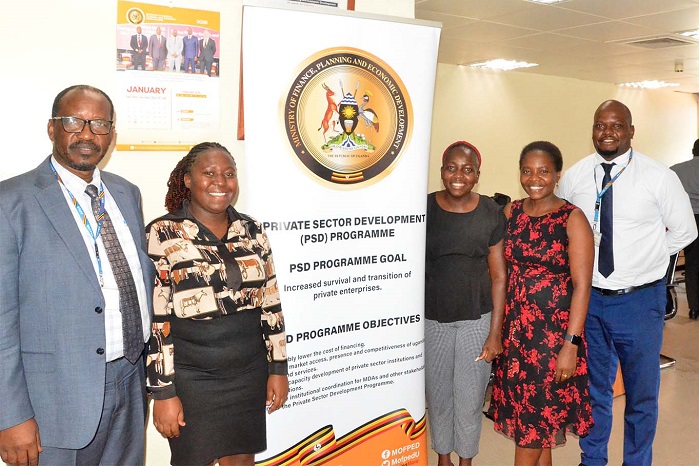
Officials of the Private Sector Development (PSD) Secretariat: Anthony Kintu Mwanje (L), Gorret Kajumba, the PSD Program Officer (2nd R), and Patricia Nabigala Ekeesit, the PSD Sub Program Assistant (3rd R), among other officials after a press briefing today, February 11th 2026
HABARI DAILY I Kampala, Uganda I Government officials, development partners and private sector leaders will this Thursday, February 12th 2026 converge at Mestil Hotel, Kampala, for the Private Sector Development (PSD) Programme Annual Review, a high-level meeting aimed at confronting the persistent challenges undermining business growth and accelerating formalization under the Fourth National Development Plan (NDP IV).
Held under the theme, “Strengthening formalization under the NDP IV,” the review will be officiated by the Rt. Hon. Speaker of Parliament and is expected to draw more than 250 participants, including ministers, permanent secretaries, local government leaders, business associations, civil society organizations and senior media personnel.
The meeting comes at a time when Uganda’s private sector continues to grapple with structural bottlenecks, including low survival and transition rates of micro, small and medium enterprises (MSMEs), a high cost of doing business, limited access to markets, a large informal sector, mounting domestic arrears, and weak institutional capacity.
Anthony Kintu Mwanje, Head of the Private Sector Development Secretariat at the Ministry of Finance, Planning and Economic Development, said the annual review provides a critical opportunity to reflect on these constraints and craft solutions that will unlock sustainable growth.
Engine of growth
“The private sector is the engine of our economy, but it is operating under enormous pressure,” Mwanje said. “Low MSME survival, persistent informality, high costs of finance and energy, and delayed government payments are choking enterprise growth. This annual review allows us to take stock of what has worked under NDP III and what must change as we implement NDP IV.”
He noted that FY2024/25, the final year of NDP III, reflected both gains and missed targets. “We registered progress in some areas such as business development services and incubation, but performance indicators like reducing informality and increasing local content delivered mixed results. Under NDP IV, we must be more deliberate, coordinated and results-oriented,” Mwanje added.
Gorret Kajumba, the PSD Programme Officer, said the review will focus on evidence-based policymaking, anchored in the Programme Annual Performance Report (PAPR) for 2024/25 and the Assessment of the Informal Sector in Uganda Report 2025.
Access to finance crucial
“The data clearly shows that informality remains one of the biggest drags on productivity, access to finance and market expansion,” Kajumba said. “Our goal is to use this review to agree on concrete, actionable interventions that lower the cost of compliance, simplify business registration, and incentivize enterprises to formalize and grow.”
She added that the high cost of doing business, particularly in energy, transport and financing, continues to erode competitiveness. “Without addressing these structural costs, our MSMEs will struggle to survive, let alone scale up and access regional and global markets,” Kajumba said.
Patricia Nabilagala, the PSD Sub Committee Assistant, emphasized the importance of stakeholder dialogue and accountability. “This review brings everyone to the table — policymakers, implementers and beneficiaries. It gives the private sector space to speak openly about challenges such as domestic arrears, regulatory bottlenecks and weak institutional support,” she said.
Nabilagala noted that delayed government payments have strained cash flows for many suppliers, undermining confidence and investment. “When arrears accumulate, businesses cannot pay workers, service loans or invest in expansion. Addressing this issue is central to restoring trust between government and the private sector,” she added.
Private Sector Enterprise Survey launch
The one-day conference will feature presentations of the PSD PAPR 2024/25, dissemination of the Informality Report and the Private Sector Enterprise Survey, panel discussions on informality, and the launch of the PSD Programme Implementation Action Plan under NDP IV. Exhibitions by member ministries and agencies will showcase ongoing interventions.
Participants are expected to agree on priorities and undertakings for the next financial year, culminating in a conference report that will guide implementation and monitoring.
“As we pursue the ten-fold growth agenda, we must build a resilient, competitive and formal private sector,” Mwanje said. “This annual review is about forging consensus and taking collective responsibility for Uganda’s economic transformation.”







About the Author