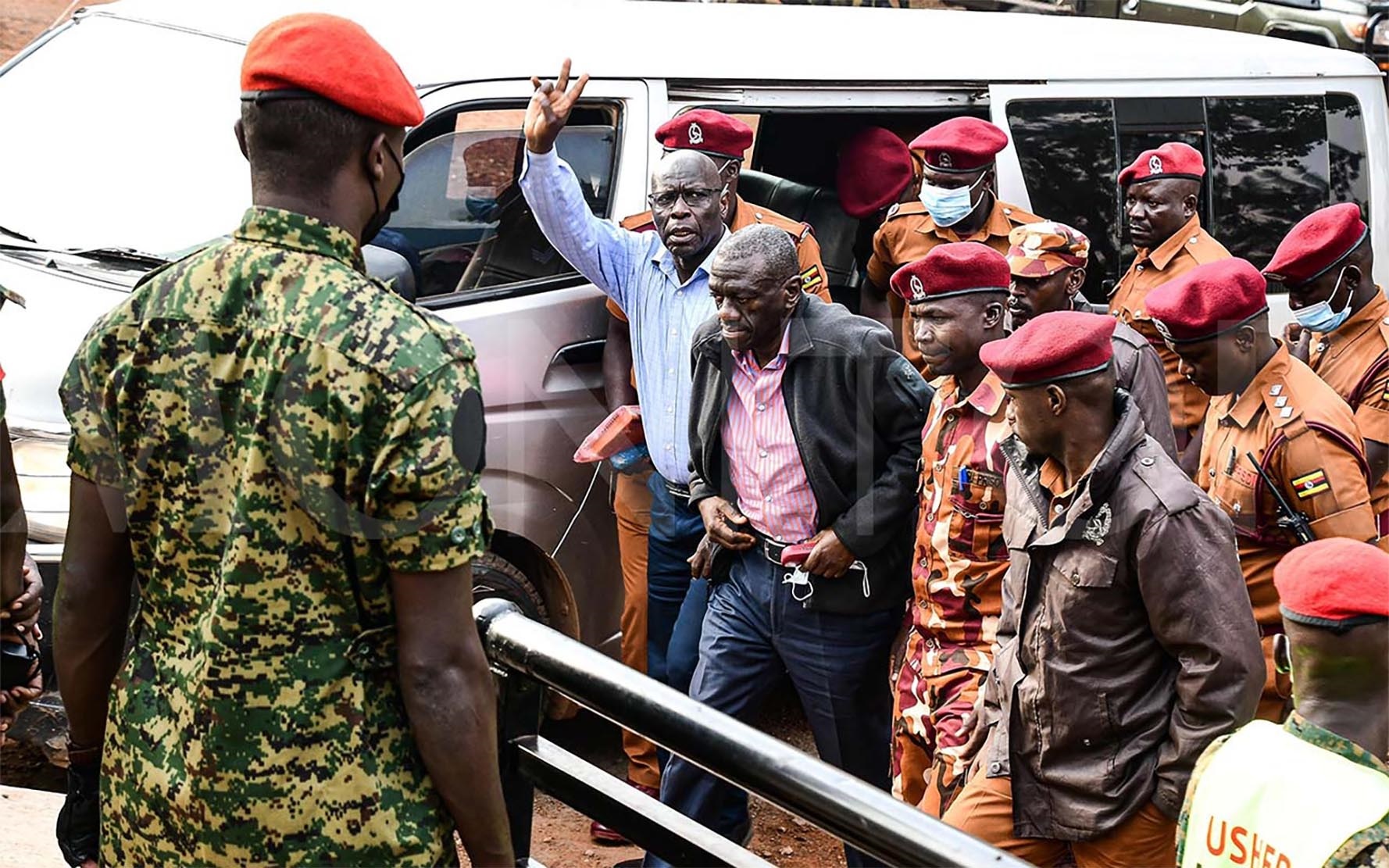
Kiiza Besigye faced the Military Court Martial in the past when he and his partner, Obed Lutale were dragged to the court
HABARI DAILY I Kampala, Uganda I Despite a landmark Supreme Court ruling that declared the trial of civilians in military courts unconstitutional, Ugandan civilians, including prominent opposition figure Rtd Col Dr Kizza Besigye, continue to face prosecution before the General Court Martial following sweeping legal amendments passed by Parliament.
On January 31, 2025, the Supreme Court, in the case of Attorney General v Michael Kabaziguruka, ruled that trying civilians in military courts violated the Constitution, reaffirming that military justice should primarily serve members of the armed forces. The ruling was widely hailed as a victory for constitutionalism and civil liberties.
However, in a controversial move, Parliament enacted the Uganda Peoples’ Defence Forces (UPDF) Amendment Act 2025, effectively restoring the power of military courts to try civilians under specified circumstances. The law now provides fresh legal grounds under which civilians can be subjected to military jurisdiction, re-opening a long-standing debate on the scope of military justice.
The amended law permits civilians to be tried by the General Court Martial if they are accused of acting in concert with serving UPDF personnel in the commission of crimes. Section 117(1)(a) of the Act states that any civilian who voluntarily acts as an accomplice to an offence committed by a member of the defence forces falls under military law.
This provision has become one of the most significant gateways through which civilians are drawn into the military justice system. Legal analysts argue that its broad wording makes it easy for prosecutors to frame charges linking civilians to military officers, thereby transferring jurisdiction from civilian courts to military tribunals.
The amendments followed the Supreme Court’s directive to clarify the mandate and jurisdiction of the General Court Martial. While lawmakers aligned parts of the Act with the ruling, they also went further to restructure the military justice system, a move critics say diluted the spirit of the court’s decision.
Among the key reforms was the reconstitution of the Army General Court Martial, which resumed operations after new members were sworn in under a revamped legal framework. Under Section 195(2) of the amended Act, officers of the court are now appointed by the Commander-in-Chief on the advice of the Judicial Service Commission, and are required to take a judicial oath.
The amendments also established the Directorate of Military Prosecutions, mandated to prosecute cases before the Court Martial, mirroring the functions of the civilian Director of Public Prosecutions.
Following the restructuring, 10 members of the General Court Martial were appointed, led by Brigadier General Richard Tukachungurwa, replacing Brigadier General Robert Freeman Mugabe.
On its first day back in session, the court began hearing a case involving 12 accused persons — one UPDF officer and 11 civilians — charged with murder, aggravated robbery and kidnap with intent to murder. Prosecutors invoked Section 117 to justify the trial of civilians in a military forum.
This framework explains how civilians, including high-profile political figures like Dr Besigye, remain exposed to military trials. Security agencies often argue that cases involving firearms, military equipment, or collaboration with soldiers automatically invoke military jurisdiction.
Human rights groups and legal scholars warn that this approach undermines constitutional safeguards, weakens civilian courts, and risks politicising military justice. They argue that trying civilians in courts presided over by serving officers compromises judicial independence and fairness.
As Uganda continues to grapple with the balance between national security and constitutional rights, the expanded jurisdiction of the Court Martial remains one of the most contentious legal battlegrounds, with civilians increasingly finding themselves entangled in a justice system originally designed exclusively for soldiers.