
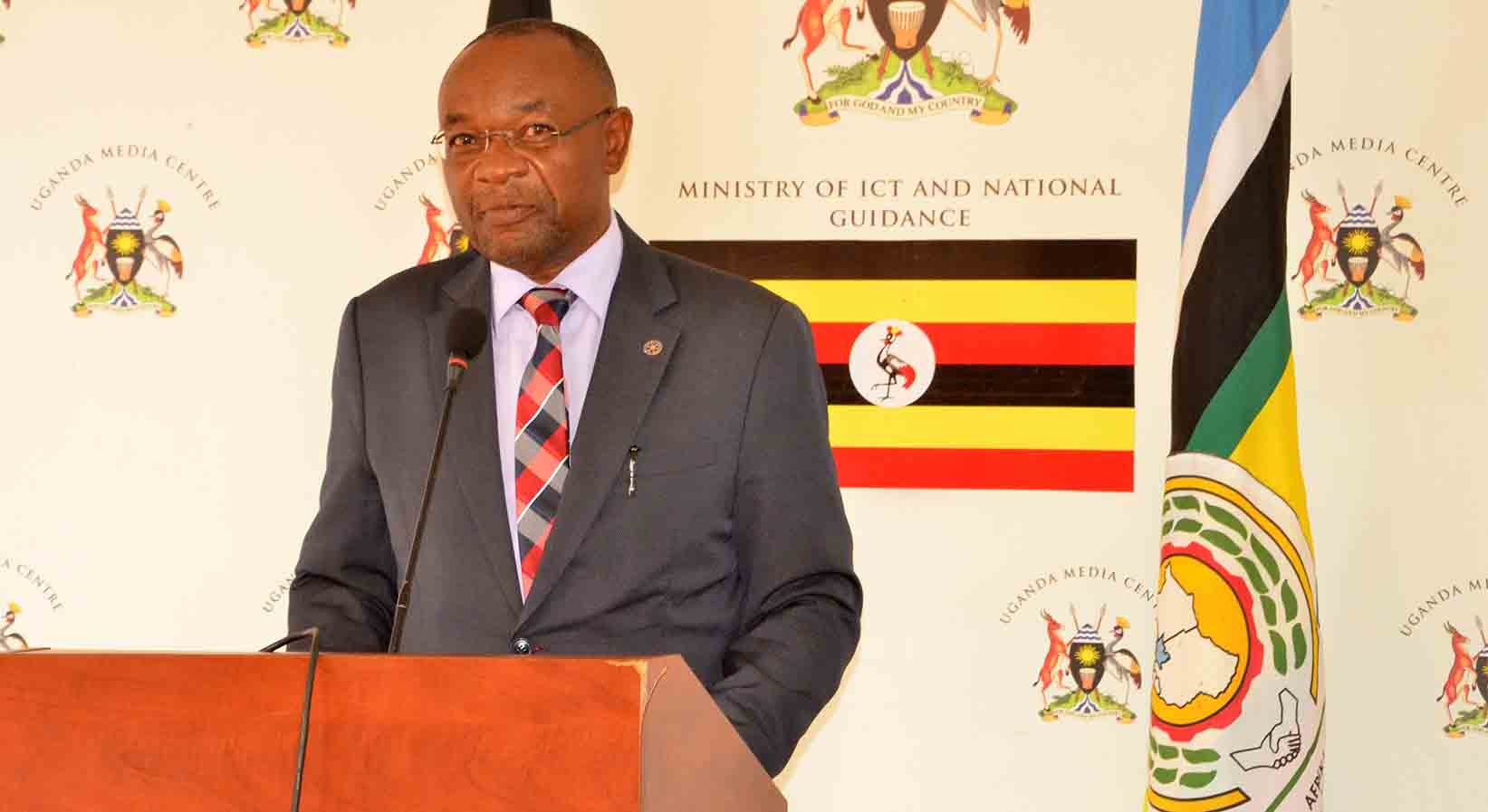
Raphael Magyezi, the Minister of Local Government speaking at the Uganda Media Center today
HABARI DAILY I Kampala, Uganda I The Government has allocated Shs56.94 billion to organize Local Council (LC) elections in March and April 2026, in a move aimed at restoring grassroots governance, strengthening service delivery, and aligning Uganda’s electoral cycle from the village to the national level.
The decision, approved by Cabinet on Monday, underscores the central role that local leadership plays in the country’s political administration and socio-economic transformation.
Speaking at the Uganda Media Center earlier today, the Minister of Local Government, Raphael Magyezi, said the funds will facilitate the long-overdue elections of LC1 (village), LC2 (parish) leaders, and women councils and committees across the country. He noted that the elective term of these grassroots leaders expired in July 2023, but elections could not be held due to financial constraints faced by the Electoral Commission.
Cabinet approval
“I am here to inform the country that yesterday Cabinet received and approved the proposal to conduct the LC elections and the elections of women councils and committees,” Magyezi said. “The proposal is jointly by the Ministry of Local Government and the Ministry of Gender, Labour and Social Development, chaired and coordinated by the Right Honourable Prime Minister.”
Following the expiry of the term in July 2023, the government sought parliamentary approval to amend the Local Government Act to allow for extensions. “Parliament approved that amendment, giving us the authority to extend the term of office of those councils with Cabinet approval,” he said, adding: “Since July 2023, we have extended the term of office six times, each extension lasting 180 days. The last one was in December, and it expires in June this year.”
With the constitutional and administrative limits now reached, government resolved that elections must be conducted. “Yesterday, government decided that this time we are going to have the elections. They will take place in March and April, in any case before the swearing-in of the newly elected government in May,” Magyezi said.
Local Government Act directive
The elections will be conducted by lining up, in accordance with the Local Government Act. The scale of the exercise is vast, covering 71,230 villages and 10,717 parishes nationwide, which explains the sizeable budget. “The LC1, or village, becomes the polling station. The Electoral Commission will gazette the polling stations and provide the register of voters,” the minister said.
Beyond the legal obligation, Magyezi emphasized that the elections are critical to ensuring continuity in grassroots governance. “Without LC1 and LC2 in place, the governing structure has a vacuum,” he said. “His Excellency the President guided that this time we should have all the elections in one electoral cycle.”
He added: “Previously, these elections would come mid-term, but the President insisted that we align them in one cycle. So we started with the presidential and parliamentary elections, followed by district chairpersons, mayors, councillors, sub-county and town council leaders. The next set is LC1 and LC2.”
The elections will also include women councils and committees, from village to national level. “At the same time, we are going to have elections of women councils and committees, starting at the village, the parish, the sub-county, the district, and ending at the national women’s committee,” Magyezi said.
Cornerstone of service delivery
The minister stressed that the LC system is a cornerstone of service delivery, security, and community administration. “These leaders are administrators at the village level. They ensure environment, cleanliness, orderliness, and security. They also run the LC courts. So it is extremely important that people take part in electing their leaders.”
He further highlighted the strategic role of LC leaders in the Parish Development Model (PDM), government’s flagship poverty eradication programme. “When you talk about PDM, the chairperson of the parish development committee is the elected LC2 chairperson. Without these leaders, the government wealth creation agenda cannot effectively continue.”
Magyezi revealed that government had received complaints from communities about absentee leaders. “Some chairpersons had abandoned office, others had left their villages. The community was complaining that we are delaying in having new office bearers. That is why I am happy that government has decided to conduct these elections.”
He also noted the broader implications for national administration. “If your son or daughter wants to join the armed forces, it is the LC1 chairperson to provide the recommendation. These leaders are critical and part and parcel of the government structure.”
Voter mobilisation costs
The Shs56.94 billion budget will cover logistics, training of election officials, voter mobilization, polling materials, and deployment of security personnel to ensure peaceful polls. With millions of Ugandans expected to participate, the government views the expenditure as a necessary investment in democracy, stability, and effective governance.
Magyezi called on citizens to prepare for the exercise. “I am here to inform the country and to mobilize the community so that we start preparing for the elections. We want credible leaders who will serve their people.”
As Uganda enters a decisive phase of governance renewal, the upcoming LC elections are expected to reinvigorate grassroots leadership, strengthen accountability, and ensure that development programs reach the intended beneficiaries. In the government’s view, the Shs56.94 billion allocation is not merely an electoral expense, but a strategic investment in the country’s administrative foundation.







About the Author