
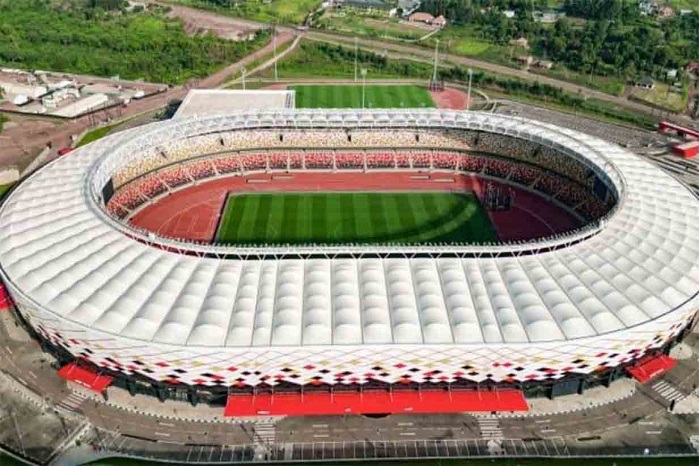
The Hoima City Stadium was completed at the end of 2025 and will be one of the main venues for AFCON
HABARI DAILY I Kampala, Uganda I The Uganda Government has set its sights on an unprecedented investment of more than Shs1.5 trillion in the sports subsector as preparations intensify for the 2027 Africa Cup of Nations (AFCON), which the country will co-host with Kenya and Tanzania.
State Minister for Sports Peter Ogwang said the massive funding commitment underscores government’s determination to deliver world-class facilities and leave a lasting legacy for sports development.
“Our target is to invest over Shs1.5 trillion in sports infrastructure and related preparations for AFCON 2027. This is not just about hosting a tournament; it is about transforming Uganda’s sports landscape and positioning the country as a regional hub for international competitions,” Ogwang said.
The investment spans the construction of new stadiums, renovation of existing facilities, and upgrading of training grounds across the country, with funding drawn largely from the Petroleum Fund and supplementary government budgets. The total expenditure for major projects and associated preparations runs into hundreds of millions of dollars.
At the centre of the infrastructure drive is the newly built Hoima City Stadium, a 20,000-capacity facility complemented by a 2,000-seat indoor arena. The flagship project was completed at a cost of between $130 million and $135 million, equivalent to about Shs484 billion, making it the most expensive sports facility ever built in Uganda.
Akii Bua Olympic Stadium
Another major undertaking is the construction of the 30,000-seat Akii Bua Olympic Stadium in Lira City, projected to cost approximately $129 million (about Shs470 billion). The stadium is expected to play a pivotal role in hosting group matches and training sessions during the tournament.
Meanwhile, the iconic Mandela National Stadium in Kampala is undergoing extensive Phase Two renovations. A supplementary budget passed in March 2025 allocated Shs87.845 billion for upgrades, adding to an earlier Shs97.90 billion, bringing the total investment at Namboole to over Shs185 billion.
Beyond the main match venues, government has prioritised the development of training facilities, with seven grounds selected for major upgrades. These include Makerere University, Pece Stadium in Gulu City, Lira University, Gulu University, Hoima Booma Grounds, Masindi Municipal Council Stadium, and Phase Two works at Kyambogo University.
The upgrade programme officially kicked off early this year with a handover ceremony at Makerere University, where the Uganda People’s Defence Forces Engineering Brigade began construction works. Representing Education and Sports Minister Janet Museveni, Ogwang said the Makerere project will create a modern multi-sport complex.
“In addition to a football pitch, the Makerere facility will have an athletics track, and courts for volleyball, netball and basketball. We want facilities that serve both AFCON and long-term community sports development,” Ogwang said.
Seven venues under construction
Similar groundbreaking ceremonies have been held at Lira University, Pece Stadium, Kyambogo University, Hoima Booma Grounds and Masindi Municipal Council Stadium. The projects, supervised by Lt. Col. Peter Sseku Kidemuka, are expected to be completed within eight months.
Under the funding plan, Kyambogo University’s Phase Two upgrade, which will include tennis and basketball courts as well as a pavilion, has been allocated Shs19 billion. Each of the facilities in Hoima, Gulu, Lira and Pece is budgeted at Shs13.2 billion, while Masindi Municipal Council Stadium, which will also feature an athletics track, will cost Shs20.2 billion.
In line with Confederation of African Football standards, all designated training grounds will be fitted with hybrid turf, the same advanced playing surface used at Namboole and Kyambogo University. Officials say this will ensure consistent pitch quality and reduce maintenance costs.
Beyond infrastructure, the National Council of Sports (NCS) has received substantial funding for operational preparations. In the 2025/26 budget framework, government approved over Shs345 billion for various AFCON-related works and more than Shs379 billion for overall tournament preparations, including logistics, security, accommodation and transport.
Taken together, the cumulative investment places Uganda’s total AFCON spending well beyond the Shs1.5 trillion mark, reflecting one of the largest single-sector infrastructure drives in the country’s history.
AFCON, a catalyst for bigger things
Ogwang said the benefits of this investment will extend far beyond the tournament. “These facilities will serve our athletes, schools and communities for decades. AFCON is a catalyst, but the legacy will be improved sports development, tourism growth, job creation and national pride,” he said.
Uganda will co-host AFCON 2027 with Kenya and Tanzania in June and July, following confirmation by the Confederation of African Football that the tournament will return to its traditional mid-year schedule. The event will also mark the final edition under the current biennial format, with AFCON shifting to a four-year cycle starting in 2028.
As construction cranes dot skylines from Hoima to Lira and Gulu, the scale of Uganda’s ambition is unmistakable. With more than Shs1.5 trillion committed, government is betting that AFCON 2027 will not only showcase the nation to the continent but also redefine its sporting future.







About the Author