
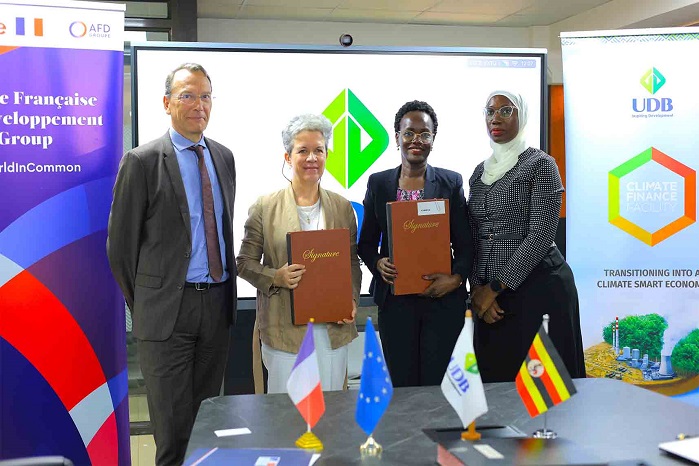
Dr. Patricia Ojangole (2nd R), the Managing Director of UDB, Virginie Leroy (2nd L), the French Ambassador to Uganda, and other officials after the signing ceremony in Kampala on February 23, 2026
HABARI DAILY I Kampala, Uganda I Uganda has received a major financial boost after the French Development Agency (AFD) and the Uganda Development Bank (UDB) signed a landmark partnership agreement that will inject EUR 40 million (about Shs169 billion) into the country’s development financing pipeline, complemented by EUR 800,000 (about Shs3.38 billion) in technical assistance.
The agreement, signed on February 23, 2026, at UDB Tower in Kampala, marks one of the most significant bilateral development finance commitments to Uganda in recent years. It was executed by Marc Trouyet, AFD’s Country Director, and Dr. Patricia Ojangole, the Managing Director of UDB, in the presence of Virginie Leroy, the French Ambassador to Uganda.
The Shs169 billion credit line is aimed at strengthening UDB’s capacity to provide long-term, patient capital to critical sectors of the economy, while the technical assistance package will enhance project preparation, risk management, and institutional capacity. The funding is expected to unlock transformative investments, drive inclusive growth, and deepen Uganda’s industrialization agenda.
Inclusive economic development
Speaking during the signing ceremony, Dr. Ojangole said the funding would significantly bolster UDB’s ability to catalyze sustainable and inclusive economic development. “This partnership will enable us to address Uganda’s environmental and social challenges in a structured and measurable way, particularly by expanding access to finance for traditionally underserved groups, especially women and youth,” she said. “By doing so, we are strengthening social inclusion, broadening economic participation, and contributing to the reduction of structural inequalities.”
The financing aligns with the priorities of Uganda’s National Development Plan IV (NDP IV), which emphasizes enterprise growth, competitiveness, and expanded access to economic resources. Agriculture, agro-industry, manufacturing, services, and infrastructure remain central to UDB’s lending strategy, with agriculture and manufacturing accounting for about 75 percent of its portfolio.
Dr. Ojangole noted that the partnership comes at a strategic moment, as UDB enters the second year of implementing a new institutional strategy that expands its role beyond traditional lending.
“For us as a development finance institution, access to concessional and strategic funding is not merely about liquidity. It is about leverage — leveraging mobilized resources into measurable economic impact,” she said.
Infrastructure development crucial
The Shs169 billion facility will allow UDB to finance large-scale projects that generate employment, deepen industrialization, support small and medium enterprises, advance infrastructure development, and promote climate-resilient growth. The funding is also expected to crowd in additional resources from both local and international development partners.
Ambassador Virginie Leroy said the partnership reflects France’s commitment to Uganda’s long-term development ambitions, particularly under the country’s Tenth Fold Growth Strategy. “France supports Uganda’s aspiration to become a Middle-Income Country by harnessing the full potential of its agriculture and agribusiness sectors,” she said, adding that the collaboration prioritizes high-impact sectors including agriculture, green industrialization, energy, logistics, the digital economy, and health.
She further announced that Uganda would benefit from enhanced business and investment engagement through an upcoming Africa Forward Summit to be held in Nairobi in May, aimed at mobilizing international capital and promoting Africa’s innovation capacity.
Women- and youth-led enterprises
AFD Country Director Marc Trouyet emphasized that the partnership would deliver strong social, economic, and climate outcomes. He said the funds would target women- and youth-led enterprises to enhance financial inclusion, strengthen agricultural actors such as SACCOs and agrobusinesses, and promote climate-smart agriculture and resilient infrastructure.
The agreement cements UDB’s position as Uganda’s principal development finance institution and underscores growing international confidence in the country’s economic trajectory. With Shs169 billion now available for long-term development financing, Uganda is poised to accelerate progress toward inclusive growth, industrial transformation, and sustainable development.







About the Author