

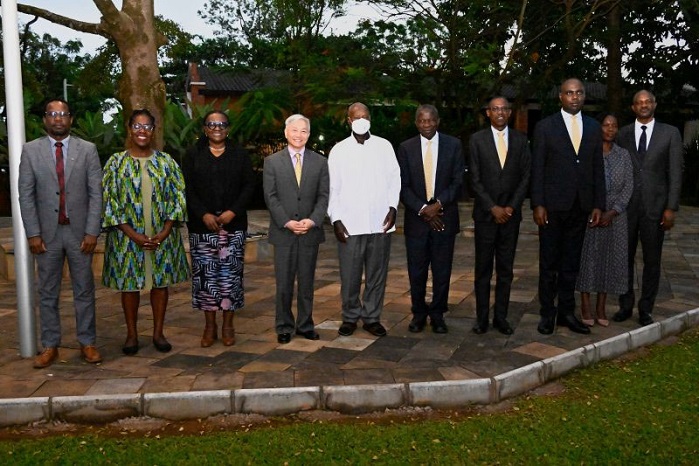
A team from the Word Bank and ministry of finance pose for pictures after a meeting with President Museveni at State House Nakasero today
HABARI DAILY I Kampala, Uganda I Uganda now stands a chance to obtain access all the way to the Indian Ocean, following renewed commitment by the World Bank to finance the country’s long-delayed Standard Gauge Railway (SGR), a project seen as critical to lowering transport costs, boosting exports and transforming Uganda’s economy.
The pledge was made after a high-level meeting at State Lodge Nakasero between President Yoweri Kaguta Museveni and a World Bank delegation led by Qimiao Fan. The discussions brought together key government officials, including Finance Minister Matia Kasaija, Attorney General Kiryowa Kiwanuka and Permanent Secretary/Secretary to the Treasury Ramathan Ggoobi, signalling the urgency attached to securing financing for the project.
At the centre of the discussions is the 273-kilometre Malaba–Kampala SGR line, which will link Uganda to Kenya’s railway network and ultimately to the port of Mombasa on the Indian Ocean. For a landlocked country, this connection is expected to significantly reduce the cost and time of moving goods to and from global markets.
The World Bank’s decision to back the SGR is largely driven by Uganda’s high transport costs, which have long undermined competitiveness. Currently, about 90% of cargo is transported by road, leading to congestion, high fuel consumption and rapid deterioration of infrastructure.
Museveni emphasised that the railway is central to addressing these inefficiencies.
“These are the funds I want. I want funds for capacity building and to give the basics for production at lower costs,” he said.
He added that the SGR is part of a broader plan to reorganise the country’s logistics system by assigning different roles to various transport modes.
“That’s why we are saying the railway should be for heavy cargo, the pipeline for petroleum products. The railway and water transport for cargo whereas roads will remain for passengers and light cargo,” Museveni added.
Experts say this shift reflects global best practice, where rail systems are used to move bulk goods over long distances more cheaply and efficiently than road transport. The SGR is expected to cut freight costs by between 30% and 40%, while reducing transit times from days to hours for key imports and exports.
For the World Bank, such gains align with its broader mission of supporting infrastructure that drives sustainable economic growth. Fan confirmed the lender’s readiness to support Uganda’s ambitions.
“I’m happy to say that I have the documents and the World Bank seriously pledges to support you financially,” he said, noting that investments in transport and energy are key pillars for development.
Another major reason behind the World Bank’s backing is Uganda’s push for agro-industrialisation. The government is increasingly focusing on value addition, moving away from exporting raw agricultural products to processed goods with higher returns.
“I’m also happy with the proposal to support agricultural industrialisation and agro-processing,” Museveni said.
By linking agro-processing zones to efficient rail transport, the SGR is expected to improve market access for farmers, reduce post-harvest losses and increase export volumes. Faster and cheaper transport will also encourage private sector investment in manufacturing and processing industries.
The financing structure itself is also a critical factor. Unlike previous negotiations with Chinese lenders that stalled over concerns about cost and debt sustainability, the World Bank is expected to provide concessional and blended financing. This approach combines low-interest loans with other funding mechanisms, making the project more affordable for Uganda while reducing fiscal risks.
Regional developments have further strengthened the case for investment. Kenya is already extending its SGR from Naivasha toward Kisumu and Malaba, bringing the railway closer to Uganda’s border. Once completed, the line is expected to handle over 30 million tonnes of cargo annually along the Northern Corridor.
For Uganda, connecting to this network is essential to remain competitive in regional trade. Failure to do so could isolate the country from emerging supply chains, while successful integration would position it as a key transit hub for neighbouring markets such as Rwanda, South Sudan and eastern Democratic Republic of Congo.
The World Bank’s involvement also brings technical expertise in project design, procurement and implementation, areas that have previously contributed to delays. By supporting both financing and institutional capacity, the lender aims to ensure that the SGR is delivered efficiently and sustainably.
Ultimately, the decision to finance Uganda’s SGR reflects a convergence of economic priorities: reducing the cost of doing business, boosting exports, supporting industrialisation and enhancing regional integration.
If successfully implemented, the railway could mark a turning point for Uganda—unlocking access to the Indian Ocean, easing pressure on road infrastructure and positioning the country as a competitive player in regional and global trade.







About the Author