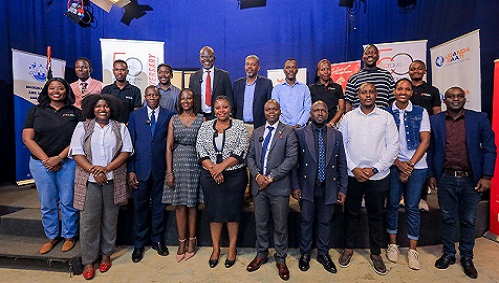

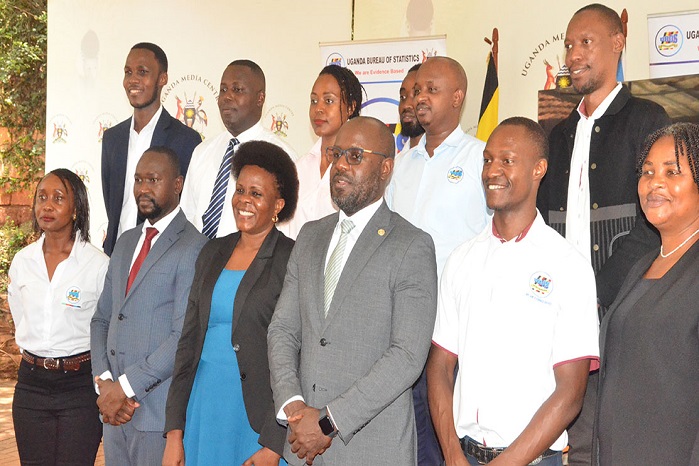
The UBOS team pose for photos after releasing the roadmap at the Uganda Media Center on Thursday, April 2nd 2026. Among these are Nancy Anyango, the UBOS, Public and Media Relations Officer (L front row), Diducus Okoth (2nd L front row), Atwine (2nd L 2nd row), among others
HABARI DAILY I Kampala, Uganda I Officials of the Uganda Bureau of Statistics (UBOS) have urged members of the public to utilise research findings released by the agency. They sounded the appeal as they unveiled a revised release calendar for key national surveys and census reports.
The call was made on Thursday at the Uganda Media Centre, where UBOS officials emphasized that timely access and use of data is critical for informed decision-making across government, business and academia.
Speaking on behalf of Executive Director Dr. Chris Mukiza, Didacus Okoth underscored the importance of public engagement with official statistics.
“We encourage members of the public, researchers and all stakeholders to utilise our research and follow the updated release calendar and access the reports as they are published,” he said.
Okoth explained that the revised schedule replaces an earlier timeline issued in March and is intended to provide clarity on when key data sets will be available. According to the new calendar, the National Population and Housing Census 2024 Community Module (Volume 6) will be released on April 9, followed by the Labour Market Survey Report 2025 on April 16.
Other reports lined up for release include the National Human Resource Survey on April 23 and the Uganda Aquaculture Census Report 2025 on April 30. In May, UBOS will publish the Uganda Harmonized Indicator Survey reports on May 7, the Baseline Education Census Report 2025 on May 14, and the Uganda Business Inquiry 2019/2020 on May 21.

Diducus Okoth, UBOS’s Principle Public Relations Officer and Nancy Anyango, a Public and Media Relations Officer at UBOS
Okoth noted that these reports are not merely statistical outputs but vital planning tools. “It will encompass statistics to do with consumption, value addition and sales. These are aspects that affect Ugandans and need to be aware of,” he said, referring to the upcoming Business Inquiry report.
He also addressed concerns over delays in the release of certain reports, particularly the Baseline Education Census. “Education affects us all. We have to make sure it is of substantial quality,” he explained, stressing the need for thorough verification before publication.
Emerging sectors such as aquaculture are also receiving increased attention. Okoth observed that fish farming is rapidly gaining traction and requires deeper analysis due to its growing contribution to Uganda’s economy.
UBOS further confirmed that several reports, including the 2025 Malaria Indicator Survey and census monographs on vulnerable children and poverty, have already been published and are accessible online.
Meanwhile, Ivan Atwiine highlighted the agency’s shift toward digital platforms to enhance accessibility. “The information can even be broken down to Parish level up from district. It is as specific as possible,” he said.
Atwiine added that UBOS has introduced an artificial intelligence-powered chatbot on its platform to enable users to access statistics in real time.
With these innovations, officials say the responsibility now lies with the public to actively utilise the data, ensuring it informs policy, investment decisions and national development planning.







About the Author