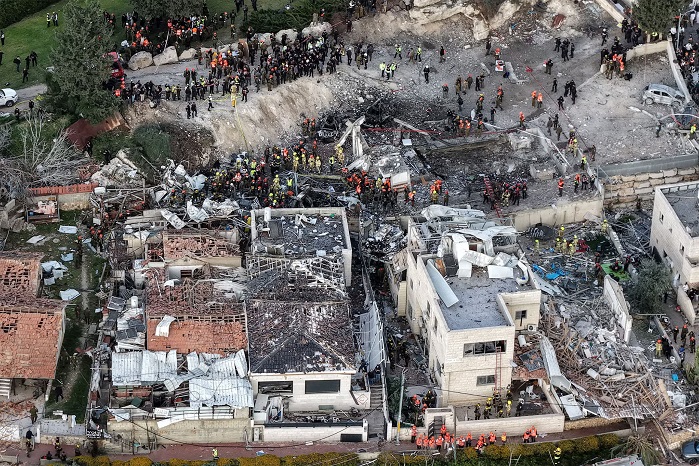
Such scenes of destruction will be common as the world drifts into a posible nuclear war
HABARI DAILY I Kampala, Uganda I The world seems to be drifting closer to World War III as tensions between the United States, Israel, and Iran intensify, raising alarm among global leaders, analysts, and humanitarian organisations.
At the centre of this stalemate is President Donald Trump, who has issued stark warnings that the United States could destroy Iran’s “civilisation” if Tehran refuses to reopen the Strait of Hormuz and comply with Washington’s demands.
About 12 hours before the Tuesday night deadline he set for Iranian Authorities, Trump shared a social media post threatening to irreversibly obliterate Iran.
Watchers have pointed out that his threats, which include targeting bridges, power plants, and other civilian infrastructure, have been widely condemned as potentially constituting war crimes under international law.
Experts have further warned that such actions could trigger a catastrophic chain reaction.
By targeting infrastructure essential for civilian survival, the United States risks provoking retaliation not just within the Middle East, but globally.
Iran’s Islamic Revolutionary Guard Corps has already signaled that any such attack would be met with measures aimed at “depriving the US and its allies of oil and gas” and striking their interests worldwide.
The critical waterway
The Strait of Hormuz, a narrow but critical waterway, carries roughly one-fifth of the world’s oil supply. Iran’s blockade has already caused oil prices to surge by more than 50 percent, sending shockwaves through global markets.
A full-scale destruction of Iran’s energy infrastructure could trigger an unprecedented economic crisis, disrupting supply chains and destabilising economies far beyond the region.
Compounding these fears, say experts, is the risk of nuclear catastrophe. Repeated strikes near the Bushehr nuclear facility have heightened concerns that a direct hit could release radioactive material, affecting multiple countries and escalating the conflict beyond control.
“Such an act would almost certainly draw in additional global powers, transforming a regional war into a broader international crisis,” said US Senators, warning Trump of the catastrophic outcome.
The involvement of alliances and proxies further increases the likelihood of escalation. The conflict has already seen coordinated US-Israeli strikes against Iran, with Tehran retaliating through missile and drone attacks targeting Israel, Saudi Arabia, and US assets across the region.
“As alliances harden, the possibility of other major powers being drawn into direct confrontation becomes increasingly likely.”
Opposition in the US
Hakeem Jeffries, House minority leader and leader of the House of Representatives Democratic Caucus, said that equally troubling is the apparent collapse of diplomatic avenues.
This rejection of negotiation removes critical off-ramps that could otherwise de-escalate tensions.
Despite acknowledging Iran’s 10-point proposal as a “significant step,” Trump dismissed it as insufficient, opting instead to escalate military pressure.
Jeffries further warns that the conflict risks plunging the world into a global war, urging lawmakers to act. “Congress must immediately end this reckless war of choice in Iran before Donald Trump plunges us into World War III,” he said.
Other Democrats have been even more critical. Rashida Tlaib called for the invocation of the 25th Amendment to remove Trump from office, while Jim McGovern described the president’s threats as illegal and immoral. Chuck Schumer labelled Trump an “extremely sick person,” reflecting growing alarm among opposition leaders.
Republicans supportive
Despite this, many Republicans have rallied behind the president. Mike Lawler defended the strategy, arguing that targeting infrastructure would cripple Iran’s economy and force compliance, insisting that Trump is acting within his authority as commander-in-chief.
The rhetoric from Washington has grown increasingly intense. In a social media post issued just hours before a self-imposed deadline, Trump warned that “a whole civilisation will die tonight,” underscoring the severity of the moment. Although he later hinted at the possibility of a diplomatic breakthrough, the dominant tone has remained one of угроз and confrontation.
Meanwhile, Iran has shown no signs of backing down. Despite heavy losses, including the killing of top leadership figures, the government in Tehran remains intact, with the Islamic Revolutionary Guard Corps leading its military response.
Retaliatory strikes have already targeted both military and civilian infrastructure across the region, while the blockade of the Strait of Hormuz continues to disrupt global energy flows.
2,000 dead
The human cost of the conflict is mounting rapidly. More than 2,000 people have reportedly been killed, with schools, hospitals, and residential areas among the sites hit. Such widespread destruction further fuels fears that the conflict is spiraling beyond the bounds of conventional warfare.
Analysts warn that the combination of military escalation, economic turmoil, and collapsing diplomacy creates a volatile environment in which a single miscalculation could ignite a broader war.
“The involvement of nuclear facilities, global energy routes, and multiple allied nations significantly raises the stakes.”
While it is not yet inevitable that the conflict will escalate into World War III, the current trajectory is deeply concerning. The convergence of aggressive rhetoric, military and geopolitical rivalries suggests that the margin for error is rapidly shrinking.
US Vice President JD Vance has thrown his weight behind his boss by issuing a warning to Iran, saying that the US wants oil and gas to flow freely.
“They’ve got to know, we’ve got tools in our toolkit that we so far haven’t decided to use,” he said during a speech in Hungary.
He added that the president of the United States can decide to use them, and he will decide to use them if the Iranians do not change their course of conduct.
Unless urgent diplomatic efforts are revived, the world may find itself confronting a conflict of unprecedented scale—one that could reshape the global order and leave lasting consequences for generations to come.







About the Author