
Why Court Slapped 4-Year Prison Sentence Upon Agnes Nandutu Over Abuse Of Public Resources

Agnes Nandutu
HABARI DAILY I Kampala, Uganda I Uganda’s Anti-Corruption Division of the High Court has laid bare a combination of strong evidence, abuse of public trust, and the gravity of the offence in sentencing Agnes Nandutu to four years in prison over the Karamoja iron sheets scandal.
From the outset, prosecutors argued that the offence was not accidental but deliberate. The prosecution opposed a lighter sentence, urging court to impose a penalty of not less than five years.
It argued that the iron sheets remained in Nandutu’s possession for nine months, indicating that the offence was premeditated. The prosecution further contended that the return of the iron sheets only came after police intervention.
After hearing submissions from both sides, the court adjourned earlier in the day before delivering the final sentence in the afternoon.
Trial judge Jane Okuo Kajuga ruled that the evidence presented left little doubt about Nandutu’s culpability. On April 8, 2026, she had already been convicted of dealing with suspect property contrary to Section 21A(1) of the Anti-Corruption Act, following prosecution by the Office of the Director of Public Prosecutions.
“The prosecution proved all the elements of the offence,” Kajuga said in her judgment.
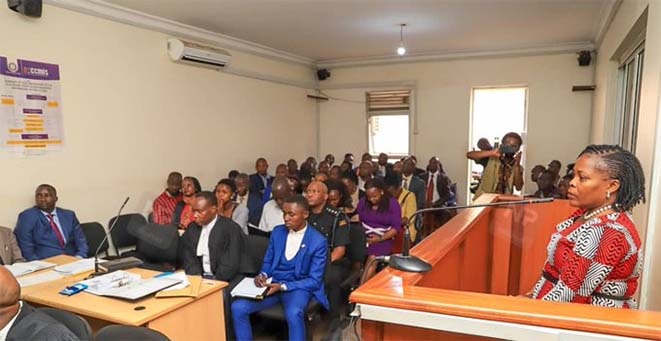
Court in session
Court heard that between June and July 2022, Nandutu received and retained 2,000 pre-painted iron sheets marked “Office of the Prime Minister,” knowing or having reason to believe they had been irregularly obtained.
The said iron sheets were part of a wider consignment procured under a supplementary budget of approximately Shs39.94 billion for the 2021/2022 financial year to support disarmament and community empowerment in the Karamoja sub-region.
Evidence showed that out of 95,044 iron sheets procured and stored in Namanve, 10,000 were requisitioned for a presidential launch in Moroto District, but only 1,000 were officially issued. The rest were diverted, with 2,000 ending up in Nandutu’s possession.
According to prosecutors, she accepted the allocation under the guise that the materials were for landslide victims in Bududa and facilitated their collection. On June 23, 2022, she provided transport funds and instructed her political assistant to pick the iron sheets from the Office of the Prime Minister stores.
The consignment was first delivered to a private residence in Wakiso before being transferred to her home in Seeta, Mukono District—far from the intended beneficiaries in Karamoja.
Investigations later revealed that 1,617 iron sheets were recovered from her farm, while 383 remained unaccounted for.
In one of the strongest condemnations, Justice Kajuga faulted the manner in which the former minister handled public property.
“It is shocking how casually the accused received the 2,000 iron sheets,” she said, citing the absence of any requisition, allocation record, or authority to reassign the materials.
The court also dismissed Nandutu’s defence that the iron sheets were intended for landslide victims, noting that there was no documentary evidence or communication with local authorities to support her claim.
Judges further concluded that, given her senior government position, she either knew or had reason to believe the iron sheets had been unlawfully diverted from a programme meant for vulnerable communities.
Although Nandutu made an emotional plea for leniency, the court found it insufficient to outweigh the seriousness of the offence.
“I would like to express my remorse to the people of Karamoja and the appointing authority. Please forgive me,” Nandutu told court.
She prayed for a non-custodial sentence, citing her deteriorating health condition, saying she has lumps in her lungs that occasionally cause her to lose consciousness. She also said she is a single mother of seven children and the sole caregiver to her 81-year-old mother.
In mitigation, she argued that she had returned the iron sheets and paid in cash for those that were missing.
However, the court held that restitution made after detection does not erase criminal liability, especially in cases involving abuse of public office and loss of government resources.
In sentencing, the court emphasized the wider impact of the offence. The diversion of iron sheets deprived vulnerable Karamoja communities—particularly women, the elderly, and reformed youth warriors—of critical support under a government programme.
As a result, Nandutu was sentenced to four years in prison, with time spent on remand to be deducted. The court also ordered that all recovered iron sheets be returned and barred her from holding public office for ten years, citing the gravity and nature of the offence and findings from the offence impact assessment report.
The ruling is widely seen as a landmark in Uganda’s fight against corruption, reinforcing judicial resolve to hold public officials accountable and restore public trust in government programmes.
About the Author