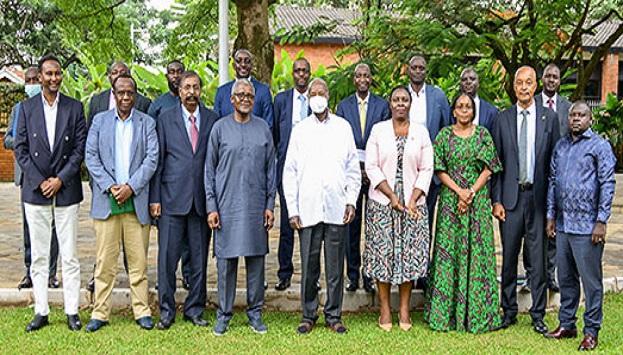

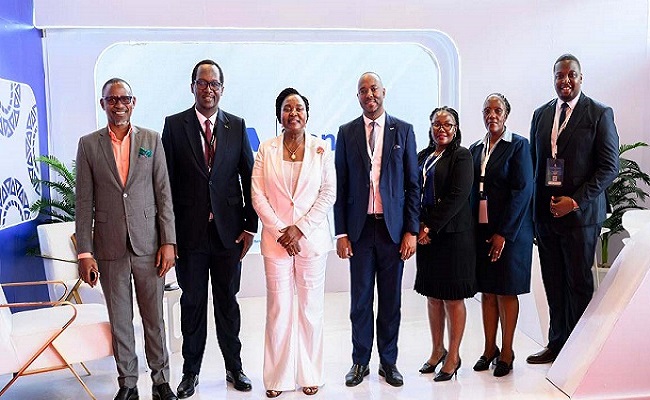
Dr Ruth Nankabirwa Ssentamu, Uganda’s minister of Energy and Mineral Development (3rd Left), with other officials at the 2026 Oil and Gas Convention in Munyonyo, Kampala
HABARI DAILY I Kampala, Uganda I Uganda’s readiness to achieve its long-awaited First Oil milestone took centre stage at the 11th Oil and Gas Convention 2026, held at the Speke Resort Convention Centre, where government officials, industry leaders and investors expressed growing confidence in the country’s preparedness.
The two-day convention, organised by the Uganda Chamber of Energy and Minerals in partnership with the Uganda National Oil Company and the Ministry of Energy and Mineral Development, is being held under the theme ‘First Oil: Fulfilling the Promise, Forging the Future’. It comes at a pivotal moment as Uganda transitions from years of planning and infrastructure development into full-scale oil production.
Delivering the keynote address, Deputy Speaker Thomas Tayebwa underscored the transformative potential of the petroleum sector. “Oil production will no doubt unlock Uganda’s full economic potential. The petroleum sector is a strategic catalyst for our tenfold growth ambition from a $50 billion economy to $500 billion by 2040 anchored in agro-industrialization, tourism, mineral-based industrialization, and science and innovation,” he said.
Tayebwa reaffirmed Parliament’s role in ensuring the sector delivers tangible benefits. “The Parliament of Uganda remains fully committed to providing the necessary legislative support and oversight to ensure this sector delivers real value to Ugandans. We must prioritise transparency, strong local content participation, and meaningful investment opportunities for our people, especially in high-value segments of the industry,” he added.
Uganda has set July this year as the target for First Oil, and significant progress has already been registered. At the Kingfisher Development Area, operated by CNOOC, 18 out of 31 wells have been drilled, with peak production expected to reach 40,000 barrels per day. This milestone reflects the country’s growing technical and operational readiness.
Energy Minister Ruth Nankabirwa highlighted the journey so far and the urgency of the next phase. “Uganda’s oil and gas story is one of patience, resilience and determination. We have come a long way, but the most important phase lies ahead,” she said. She added, “The promise is clear. The future is within reach. Together, let us fulfill the promise of First Oil on time, efficiently and responsibly. Let us forge a future where Uganda’s natural resources become a foundation for prosperity, dignity and transformation for all our people.”
The launch of the National Petroleum Policy 2025 during the convention further signals institutional readiness. The policy provides a comprehensive framework across the petroleum value chain, updating the 2008 policy to reflect the realities of imminent production.
Private sector confidence is also playing a critical role. Stanbic Bank Uganda, a Platinum Sponsor of the convention, has positioned itself as a key financial partner in the transition. Its Chief Executive, Mumba Kalifungwa, emphasised the broader economic linkages.
“We’re not just banking on the oil sector. We’re leveraging this sector to build a bridge for farmers, youth and women entrepreneurs. We believe in a transition using the revenues from our fossil resources today to finance the green energy grid of 2050,” he said.
Kalifungwa added, “The reality is that oil remains deeply embedded in the architecture of global growth. It is within this context that Uganda’s path must be understood and we can assert with confidence that Uganda’s first oil will not be the world’s last.”
Echoing this optimism, Stanbic Board Chairman Damoni Kitabire described the moment as a turning point. “For over a decade, this convention has been a forum for planning and projection. Today, as we stand on the precipice of First Oil, we transition from the architecture of possibility to the mechanics of production,” he said.
As stakeholders convene to chart the final stretch, the message is clear: Uganda is no longer preparing for First Oil—it is on the brink of delivering it.