
Fabian Kasi
HABARI DAILY I Kampala, Uganda I Centenary Bank re-confirmed it’s position as one of Uganda’s most profitable and resilient financial institutions in 2025 by registering a profit position, achieved through sustained growth and a deliberate focus on financial inclusion.
In 2025, that conviction was vindicated again. With assets exceeding Shs 8.6 trillion, over 3.4 million active customers, a network of 81 branches, 214 ATMs and more than 9,000 agent banking points, the bank has steadily expanded its footprint while maintaining strong financial performance.
According to the bank’s latest results, Centenary Bank posted a 23.9 percent increase in profit after tax to Shs 424.2 billion in 2025, up from Shs 342.3 billion the previous year. This marks a continuation of a consistent upward trajectory in profitability over recent years, underlining the lender’s ability to grow earnings even amid market pressures.
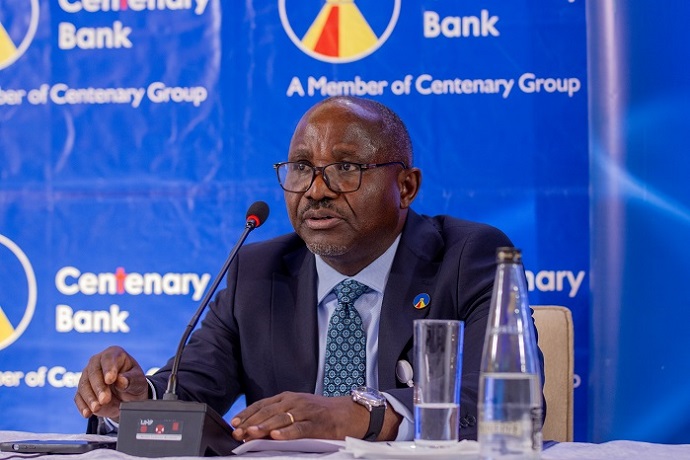
The bank’s Managing Director, Fabian Kasi, attributed the strong performance to a strategy anchored on sustainability and inclusive growth.
“Our solid performance in 2025 reflects the depth of our ESG integration and alignment with national and international priorities for sustainable development, right from managing our carbon footprint, offsetting our emissions to responsibly driving social economic inclusion and wellbeing,” Kasi said.
Shs 281.7 billion for Green projects
He added that this intentionality enabled the bank to directly invest Shs 281.7 billion in sustainable finance toward green and social impact projects, directly benefiting more than 180,000 Ugandans.”
The bank’s balance sheet growth has been equally impressive. Total assets rose to Shs 8.6 trillion, while customer deposits increased by 25.1 percent to Shs 5.2 trillion, reflecting growing trust among customers. The loan book expanded to Shs 4.1 trillion, largely driven by lending to agriculture, micro, small and medium enterprises (MSMEs), and rural communities.
Over the years, Centenary Bank has built its profitability model around serving the “real economy,” focusing on underserved populations often overlooked by traditional banking systems. By the end of 2025, more than 2.3 million of its customers came from these segments, including smallholder farmers, women, youth and refugees.
“For over four decades, we have served Uganda’s most underserved communities not as a concession to mission, but as the very engine of our business model,” Kasi noted. “A bank that serves Uganda’s most underserved communities with excellence is, ultimately, the most resilient bank of all.”
Financial inclusion crucial
Financial inclusion remains at the core of the bank’s growth story. Through its extensive agent banking network, which now exceeds 9,000 touchpoints, the bank has been able to reach remote communities, significantly reducing barriers to access. Agent banking alone accounted for 49 percent of total transactions in 2025, demonstrating its importance in bridging the urban-rural divide.
The bank’s mission-critical portfolio, valued at Ushs 1.76 trillion, has played a central role in expanding access to finance. In 2025 alone, Centenary Bank disbursed Ushs 281.7 billion in sustainable finance, supporting over 180,000 beneficiaries across agriculture, women-led enterprises and youth initiatives.
Women-focused lending has been particularly impactful, with 118,766 loans extended to women entrepreneurs—representing nearly 39 percent of total borrowers. These efforts have been complemented by targeted programmes such as Grow, Supawoman and youth financing initiatives, which aim to empower marginalized groups.
Agricultural financing also remains a cornerstone of the bank’s inclusion agenda. During the year, more than 58,000 smallholder farmers accessed credit, despite limited collateral, helping to boost productivity, improve household incomes and enhance food security.
122,000 clients countrywide
Microfinance services reached over 122,000 clients, while digital lending continued to expand, offering more affordable and convenient access to credit for low-income households. Community-based financing through SACCOs and Village Savings and Loan Associations (VSLAs) further extended the bank’s reach, serving nearly 90,000 clients.
Beyond profitability, Centenary Bank has integrated environmental and social considerations into its operations. The bank recorded a 6.3 percent reduction in operational carbon emissions, partly due to the transition of 10 branches to solar energy. Additionally, more than 69,000 trees were planted as part of its environmental restoration efforts.
Corporate social responsibility gets Shs 4.9 billion
The bank also invested Shs 4.9 billion in corporate social responsibility initiatives, supporting over 1,100 community projects in health, financial literacy and stakeholder engagement. Its long-standing partnership with Rotary International has contributed to major health campaigns, including cancer awareness and malaria prevention.
Despite operating in a challenging environment marked by rising fraud risks and increased competition, Centenary Bank maintained strong asset quality, with a non-performing loan ratio of 2.94 percent. It also contributed Shs 246.75 billion in taxes to the government, underscoring its role in supporting Uganda’s economic development.
Kasi said the bank will focus on sustaining growth while enhancing operational efficiency, including the rollout of a new core banking system in 2026.
“Our priorities are aligned to expanding access to finance, strengthening enterprise development, and supporting productivity in agriculture, microfinance and SMEs,” he said.







About the Author