

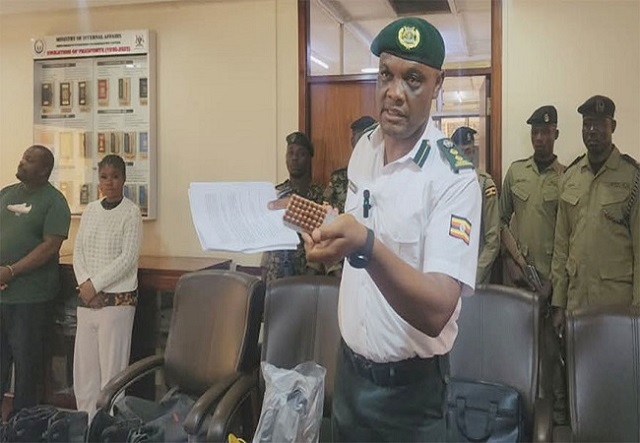
Mugisha (extreme left), is now in Uganda Police Force custody
HABARI DAILY I Kampala, Uganda I Facts have emerged on Keith Mugisha, alias King Keith, a suspected transnational criminal whose recent arrest by Ugandan security agencies has shed light on an alleged web of international crime, intelligence coordination, and public vigilance.
Mugisha was apprehended in an intelligence-led operation backed by Interpol, marking a significant breakthrough in efforts to clamp down on cross-border criminal networks. Authorities say the arrest followed multiple tip-offs from members of the public, some of whom reported suspicious behavior while others claimed to have fallen victim to his alleged activities.
According to Ministry of Internal Affairs spokesperson Simon Peter Mundeyi, the operation was largely driven by community intelligence. “This was intelligence we normally rely on—from the public, from people who have been observing him, and even those who have been victims,” Mundeyi said. “We acted on that intelligence to arrest this gentleman.”
Preliminary investigations suggest that Mugisha may have deep-rooted connections to international criminal syndicates, particularly those linked to drug trafficking. Information shared through Interpol indicates that he had previously been arrested in Brazil over alleged drug-related offenses. At the time, authorities say he was using a Ugandan passport but is believed to have later acquired Brazilian documentation, which he allegedly used to evade law enforcement.
Following his latest arrest in Uganda, Interpol reportedly confirmed that Mugisha is listed among wanted suspects tied to international drug trafficking networks. Mundeyi further revealed that a suspected Nigerian associate connected to the same case remains in custody in Brazil, highlighting the transnational scope of the investigation.
The Ugandan authorities are now working closely with international partners to piece together Mugisha’s movements and activities, both within Uganda and abroad. Investigators are particularly focused on establishing whether he had operational links to organized crime networks in the region and whether his alleged activities extended beyond drug trafficking into other criminal enterprises.
During the arrest, security operatives recovered a firearm described by officials as “very serious,” raising immediate concerns about the suspect’s potential for violence. Mugisha reportedly claimed that the weapon was legally owned and that he possessed a valid firearm license. However, authorities have since launched a verification process to confirm the legitimacy of that claim.
In addition to the firearm, investigators recovered an unidentified liquid substance suspected to be highly toxic. The substance is currently undergoing forensic analysis to determine its composition and possible use. Mundeyi noted that authorities are exploring the possibility that it could be a potent poison.
“We are not yet sure what it is, but it could be a very effective poison,” Mundeyi said. “We don’t know whether some people may have died as a result of his activities, but these are lines of inquiry we are pursuing.”
Further complicating the case are discrepancies in the ammunition recovered during the arrest. Authorities reported that some rounds appear to be missing, raising fears that they may have already been used in criminal acts. Investigators are now working to trace the missing ammunition and determine whether it could be linked to unresolved crimes within Uganda or elsewhere.
The case remains active, with officials cautioning that more revelations are expected as investigations deepen. Mundeyi emphasized that the public will be updated as new information becomes available. “We shall be able to furnish the public with more details as soon as investigations progress,” he said.
The arrest of Mugisha underscores the growing importance of collaboration between local and international law enforcement agencies in tackling transnational crime. It also highlights the critical role played by ordinary citizens in reporting suspicious activities, which can often serve as the first line of defense against complex criminal operations.
As Ugandan authorities continue to unravel the full extent of Mugisha’s alleged criminal network, the case stands as a stark reminder of the evolving nature of global crime—and the necessity of coordinated, intelligence-driven responses to combat it.