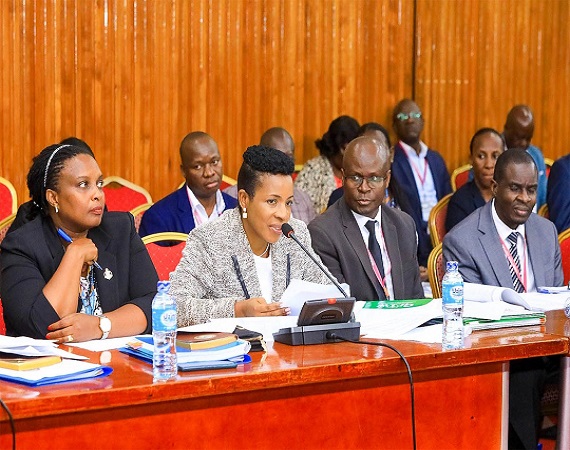
A cross section of GROW Project managers during their visit to Parliament recently
HABARI DAILY I Kampala, Uganda I Managers of the Generating Growth Opportunities and Productivity for Women Enterprises (GROW) Project have renewed their commitment to address persistent barriers limiting women’s access to financing, following concerns highlighted in the latest implementation report.
According to the GROW Project Quarterly Report for October–December 2025, issued by Private Sector Foundation Uganda in February 2026, misinformation remains one of the biggest obstacles preventing women from accessing the fund. The report notes “continued misinformation about the GROW Project, including how to access the loans,” adding that a strengthened communication strategy is now being deployed to address the gaps.
Project managers say they are prioritising awareness campaigns across the country to ensure women entrepreneurs clearly understand how the programme works. This includes simplified messaging on eligibility, loan application processes and available financial products.
Beyond misinformation, access to collateral continues to be a major challenge. The report highlights “continued concerns about the women lack collaterals for accessing the GROW Loan,” despite participating financial institutions offering alternative products. Data shows that 74.8 percent of women accessing the loans still had to present collateral, an indication that financial institutions are yet to fully embrace unsecured lending options.
In response, managers are working closely with banks and other participating financial institutions to design more flexible products that do not overly depend on traditional collateral such as land titles. This is particularly critical in regions where land ownership systems disadvantage women.
The report points to customary land tenure in parts of northern Uganda as a key structural barrier, limiting women’s ability to access larger loans. Managers say they are engaging stakeholders to explore innovative solutions that can enable women without formal land ownership to qualify for financing.
Social barriers have also emerged as a significant concern. The report notes that only 3.1 percent of borrowers reported receiving spousal guarantees, reflecting limited support from partners. In some regions, women face resistance and discouragement from men and even religious leaders, who perceive borrowing as risky.
To address this, project managers are rolling out targeted sensitisation programmes aimed at men, community leaders and religious institutions to build trust and support for women entrepreneurs. These engagements are expected to play a critical role in shifting attitudes and encouraging more women to participate.
Additionally, the report highlights low participation among refugees and women in remote districts, a gap managers attribute to limited outreach and access challenges. New participating financial institutions are expected to expand coverage into underserved areas to ensure broader inclusion.
Delays in disbursement of funds to financial institutions have also affected access, with some women reporting frustrations during the application process. Managers have acknowledged these bottlenecks and pledged to streamline procedures to ensure timely release of funds.
The GROW Project, implemented by the Ministry of Gender, Labour and Social Development in collaboration with PSFU on behalf of the Ministry of Finance, is supported by a World Bank grant aimed at boosting women-led enterprises.
Despite the challenges, managers remain resolute that the programme can deliver transformative impact. By addressing misinformation, reforming lending practices and tackling social barriers, they say the GROW fund will become more accessible, empowering thousands of Ugandan women to expand their businesses and improve their livelihoods.