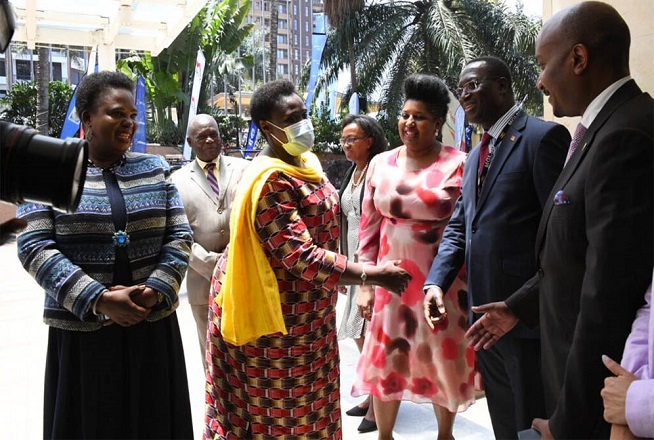
Jenifer Alupo, Uganda’s Vice President (3rd left), accamonied by Betty Amongi, the Gender minister (left) greets the top managers of PSFU after a recent workshop
HABARI DAILY I Kampala, Uganda I The GROW project is tackling one of the biggest barriers to credit access—poor financial record-keeping. This is delivered by Business Development Service (BDS) advisors who provide hands-on support to beneficiaries, guiding them through documentation.
According to the GROW Project Quarterly Report for the period October–December 2025, issued in February 2026 by the Private Sector Foundation Uganda (PSFU), they focus on preparation of financial records. The report emphasizes that the initiative is “strengthening the financial management capacity of women entrepreneurs by supporting the preparation of basic financial records required to access credit.”
This support is particularly targeted at women entrepreneurs who have undergone core training, as well as refugees and women in refugee-hosting districts.
“The support aims at enhancing women entrepreneurs’ eligibility and readiness to access GROW loans or other financial services,” the report explains, adding that beneficiaries are also assisted to open bank accounts and prepare loan applications.
Stay Updated by Clicking on Our Social Media Channels above:
This support is particularly targeted at women entrepreneurs who have undergone core training, as well as refugees and women in refugee-hosting districts.
“The support aims at enhancing women entrepreneurs’ eligibility and readiness to access GROW loans or other financial services,” the report explains, adding that beneficiaries are also assisted to open bank accounts and prepare loan applications.
During the reporting period, the project made notable strides in this area. “The Project engaged sixty-three (63) women entrepreneurs, with hands-on support to prepare or improve record-keeping practices, financial documentation needed by commercial banks,” the report states.
These beneficiaries were drawn from districts such as Masaka, Kampala, Kiryandongo, Zombo, Adjumani, Koboko and Yumbe.
The report further highlights the inclusion of vulnerable groups within the programme. “Of those supported, fourteen (14) are refugees from West Nile region and Kiryandongo,” it notes, underscoring the project’s commitment to inclusive economic empowerment.
By helping women organise their books of accounts, the GROW project is addressing two critical prerequisites for accessing finance. Without proper registration and credible financial records, many small businesses—especially those run by women—remain locked out of formal lending systems.
PSFU’s findings suggest that while progress is still at an early stage, the foundation is being laid for a more inclusive financial ecosystem. As more women adopt better financial management practices, their chances of accessing affordable credit—and scaling their enterprises—are expected to improve significantly.