

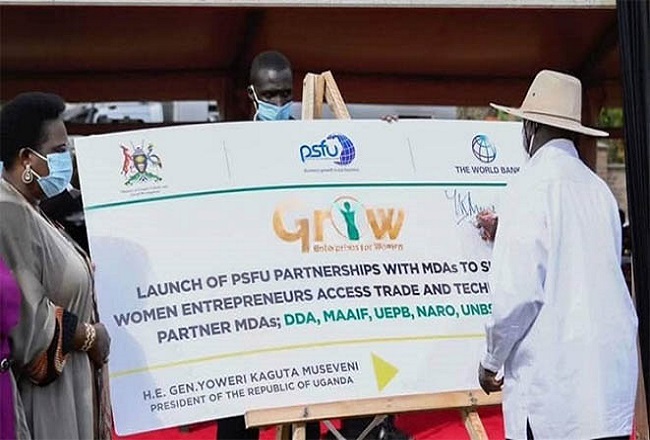
President Museveni signs on the lauch pad of the GROW Project in 2023, as Betty Amongi (left), the Gender minister looks on
HABARI DAILY I Kampala, Uganda I The Generating Growth Opportunities and Productivity for Women Enterprises (GROW) Project continues to make significant strides in empowering women entrepreneurs across Uganda, with new data highlighting the scale of digital training, borrower engagement, and tailored technical support delivered in late 2025.
According to the GROW Project Quarterly Report for October – December 2025, issued by the Private Sector Foundation Uganda (PSFU) in February 2026, the initiative has placed strong emphasis on equipping women with digitisation skills to enhance their competitiveness and expand market access.
“The project focuses on strengthening the digital presence, visibility, and market reach of women-led enterprises to enhance competitiveness and access to markets for GROW loan beneficiaries,” the report states. It adds that this support is “designed to support adoption of digital tools and platforms, websites and e-commerce setups, business branding and use of Google Maps that enable enterprises to operate more efficiently and expand their customer base.”
During the reporting period, at least 35 women entrepreneurs from districts including Kampala, Wakiso, Jinja, Kayunga and Mukono began the process of onboarding onto digital platforms. This included integration into social media channels, development of business websites, and adoption of e-commerce solutions.
The report notes that these efforts were complemented by branding support aimed at improving both physical and online visibility. “The onboarding onto digital platforms… was complemented by business branding support to improve physical and online visibility and customer accessibility. Two of these now have functional websites,” the report highlights.
Beyond digitisation, the GROW Project also prioritised direct engagement with beneficiaries through large-scale borrower meetings designed to deepen understanding of participant needs and improve service delivery.
“A large-scale engagement meeting involving GROW loan borrowers and non-borrowers/potential borrowers was organized in Iganga on 31st October 2025, involving more than 500 participants,” the report reveals.
Participants were drawn from multiple districts in the Busoga sub-region, including Bugiri, Bugweri, Buyende, Iganga, Jinja, Jinja City, Kamuli, Luuka, Mayuge, Namayingo and Namutumba. The objective, according to the report, was to foster stronger interaction between the project and its beneficiaries.
“The objective of the meeting was to have deeper engagement with the GROW women borrowers, provide updates on other GROW services and undertake a needs assessment to link them to other project support,” the report states.
Such forums also created space for peer learning and advocacy. “The engagement meeting provided a platform for women to share concerns, share experiences, and collectively advocate for effective changes in the program,” the report adds.
In terms of technical capacity building, the GROW Project has reached even larger numbers. The report indicates that a total of 1,723 women entrepreneurs were supported through tailored technical skills training under Subcomponent 1C of the project.
“A total of 1,723 women entrepreneurs were supported through provision of tailored technical skills training,” the report states, underscoring the scale of intervention.
Of these participants, 1,212—representing 70 percent—were refugees, while 2,141 (72 percent) were women in Refugee Hosting Districts (RHDs), reflecting the project’s deliberate focus on vulnerable and underserved populations.
Additionally, 141 women entrepreneurs have fully received targeted Business Development Services (BDS) during the pilot phase of the GROW Skills and BDS subcomponent. These services are aimed at strengthening enterprise performance, promoting formalisation, and improving access to finance.
The report emphasises that the combination of digital skills training, engagement forums, and tailored technical support is critical in addressing systemic barriers that women entrepreneurs face.
By integrating digital tools, facilitating direct dialogue with beneficiaries, and offering customised training, the GROW Project is not only enhancing business capacity but also laying the foundation for sustainable enterprise growth.