
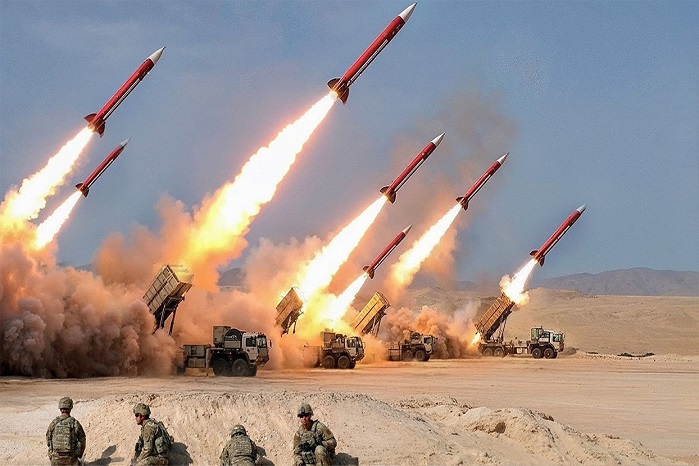
Iran sets off a barrage of intercontinental misiles towards the invading powers
HABARI DAILY I Kampala, Uganda I As the clock ticks towards President’s Donald Trumps deadline for the Iranian authorities to vacate and open the Strait of Hormuz, which will most likely lead to an escalation in the ongoing Middle East War, Habari Daily brings you an analysis on the readiness of the country to beat off a foreign aggressor.
Iranian military officials, particularly from the Khatam al-Anbiya Central Headquarters, have expressed defiance against US-Israeli strikes, boasting readiness to counter superior American firepower with undisclosed missile sites and advanced drones. Tehran warns that any U.S. “mischief” is being met with a strong response
Iran’s war machine can stand against the superior US fire power, analysts say, not because of conventional military strength but due to a carefully built strategy designed to fight a prolonged and costly war of attrition.
Defence doctrine at play
As the 2026 conflict intensifies, military experts point to Tehran’s long-standing asymmetric “mosaic” defence doctrine as the backbone of its resilience against the United States. The strategy emphasises survival, decentralisation and the ability to inflict sustained damage rather than outright battlefield dominance.
Officials from the Islamic Revolutionary Guard Corps (IRGC) have repeatedly signaled confidence in this approach. In recent statements, Iranian commanders stressed that the country is prepared “for a long war” and will respond to any escalation by targeting US and allied interests both within and beyond the Middle East.
At the core of Iran’s capability is its vast missile and drone arsenal—the largest in the region. These include short- and medium-range ballistic missiles such as the Fateh series, Zolfaghar and Kheibar Shekan. Military analysts note that these weapons are deployed in coordinated, high-volume barrages intended to overwhelm advanced defence systems like Patriot and THAAD.
Iran displays its assembly line for intercontinental misiles
“Iran’s response will not be limited or predictable,” an IRGC-linked statement warned, adding that any attack on its infrastructure would be met with measures designed to “exhaust the enemy and deny them security.”
Resilient command structure
Equally critical is Iran’s decentralised command structure. Unlike traditional militaries, its forces operate in semi-independent regional units, making it difficult for adversaries to cripple operations through targeted strikes. Much of its arsenal is also stored in hardened underground facilities, often beneath mountainous terrain, ensuring survivability even under sustained bombardment.
Iranian officials describe this as a “survival and leverage” model. “We do not seek a short war,” a senior Iranian defence official said in state media. “We are prepared to endure and impose costs until the aggressor retreats.”
Tehran’s strategy also extends beyond its borders. Through allied groups across the region, Iran maintains the ability to engage in what it calls “indirect resistance,” targeting US interests without direct confrontation. This network significantly expands the battlefield and complicates US military planning.
Decisive Strait of Hormuz
A key pressure point remains the Strait of Hormuz, through which a significant portion of the world’s oil supply passes. Iranian forces have demonstrated their capacity to disrupt shipping lanes, a move that can trigger global economic shockwaves.
By combining low-cost drone warfare with high-impact strikes on critical infrastructure, Iran aims to make any prolonged conflict economically unsustainable for its adversaries.
Ultimately, Iran’s war doctrine is built on endurance. While the United States retains overwhelming conventional superiority, Tehran is betting that its ability to absorb damage and prolong the conflict could redefine the balance of power in one of the world’s most volatile regions.







About the Author