
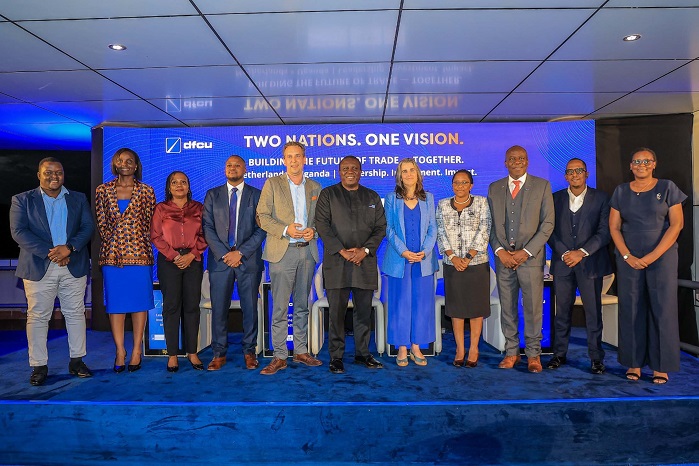
dfcu Bank officials accompanied by those from Bank of Uganda and the Netherlands embassy
HABARI DAILY I Kampala, Uganda I dfcu Bank is positioning itself at the centre of efforts to expand trade and investment between Uganda and the Netherlands, as the two countries strengthen economic ties built largely on agriculture, innovation, and cross-border enterprise.
The bank recently hosted members of the Netherlands–Uganda Trade and Investment Platform (NUTIP), alongside representatives from the Embassy of the Kingdom of the Netherlands and Rabobank, at its head office in Nakasero. The engagement, held under the theme “Building the Future of Trade, Together,” brought together financiers, business leaders and policymakers to explore practical ways of enhancing trade and investment collaboration.
The discussions come at a time when Uganda’s commercial relationship with the Netherlands continues to grow steadily. Uganda exports goods worth about $184 million to the Netherlands annually, while imports from the European nation stand at approximately $ 289 million, reflecting a strong two-way trade relationship.
Beyond direct trade, the Netherlands also serves as a key European distribution hub, providing Ugandan exporters with a strategic gateway into the wider European Union market.
Speaking during the engagement, Kate Kiiza, Executive Director and Chief Corporate and Institutional Banking Officer at dfcu, emphasised the value of learning from the Netherlands’ success in transforming agriculture into a highly productive and globally competitive sector.
“The Kingdom of the Netherlands has earned global respect for how it has transformed agriculture into a high-value, innovation-driven sector. For a country of its size to be the world’s second largest exporter of agricultural products speaks to discipline, coordination and long-term thinking,” Kiiza said.
Agriculture remains the backbone of Uganda’s economy, contributing roughly 24 percent of Gross Domestic Product and employing more than 65 percent of the population. The sector also accounts for a large share of the country’s export earnings, making improvements in agricultural productivity and value addition critical to economic growth.
Kiiza noted that Uganda’s ambition to modernise agricultural production and expand export capacity will depend on strong partnerships that bring together capital, expertise, technology and market access.
“Agriculture remains central to our economy, not only as a source of livelihood but as a foundation for growth. As we modernise production, strengthen value chains and expand export capacity, partnerships that combine capital, technology and market access will shape how quickly we move and how sustainably we grow,” she said.
Within this growing trade corridor, dfcu has built collaborations with Dutch institutions such as Rabobank and FMO, the Dutch entrepreneurial development bank. These partnerships have helped strengthen agricultural financing and enterprise development in Uganda.
Through initiatives like the Best Farmers programme and its broader agricultural financing portfolio, the partnerships have facilitated knowledge transfer, improved farm management practices and strengthened governance among agribusiness enterprises.
According to Kiiza, these initiatives have contributed to increased productivity and improved export readiness among Ugandan agricultural businesses.
Looking ahead, she said the next phase of collaboration between Ugandan and Dutch enterprises must focus on scaling businesses and strengthening agricultural value chains.
“The next phase is about scale, strengthening value chains, supporting larger enterprises, and ensuring that promising businesses have the financial structures required to compete regionally and globally,” she said.
She added that this growth will require responsive banking systems, structured trade finance solutions and financial institutions capable of navigating the realities of cross-border commerce.
“For Dutch businesses operating in, or considering entry into Uganda, dfcu offers that local anchor, with dedicated relationship management, strong capital backing, and practical market insight,” Kiiza said.
Corrine Abbas, First Secretary for Economic Cooperation at the Embassy of the Kingdom of the Netherlands, highlighted the Embassy’s partnership with dfcu and Rabobank in supporting NUTIP members through FMO.
She noted that FMO currently holds a portfolio exceeding USD 205 million in Uganda, with investments spread across financial institutions, renewable energy and the agricultural sector.
Abbas said the Embassy is committed to working with financial institutions and development partners to improve access to finance along the agricultural value chain.
She explained that this support includes collaborations with institutions that provide bank guarantees and work closely with the Bank of Uganda and dfcu to support farmers and agribusiness enterprises.
The focus, she added, is not only on large-scale commercial farming but also on helping smallholder farmers transition into viable commercial enterprises.
“We are working with partners across the ecosystem to ensure that farmers can grow from small-scale operations into commercially sustainable businesses,” Abbas said.
Lukia Otema, Country Director for KLM, noted that the Netherlands–Uganda Trade and Investment Platform aims to go beyond dialogue by generating actionable ideas that strengthen trade and unlock investment opportunities.
The engagement also featured a macroeconomic outlook by Dr Adam Mugume, Executive Director for Research and Policy at the Bank of Uganda, who emphasised that maintaining price stability remains essential for investor confidence.
He said inflation is expected to remain within the mid-single-digit range over the medium term, supported by prudent monetary policy and stable macroeconomic management.
However, Mugume cautioned that global geopolitical tensions, rising fuel prices and higher shipping costs remain external risks that could affect trade-dependent sectors.
The discussions concluded with participants examining financing structures, trade facilitation mechanisms and investment opportunities across agriculture, manufacturing and related value chains.
Kiiza said Uganda offers scale, entrepreneurial energy and growing market opportunities, while the Netherlands brings innovation, systems thinking and global integration.
“With the right financial architecture and clear execution, this partnership can deliver outcomes that are both commercially sound and sustainable,” she said.
Through platforms such as NUTIP, dfcu Bank continues to strengthen its role as a financial partner supporting enterprises operating along the Uganda–Netherlands trade corridor, helping translate dialogue into concrete investment and long-term economic growth.







About the Author