

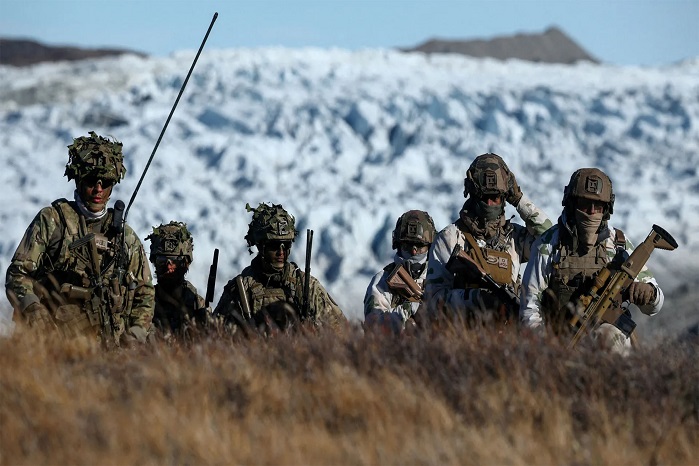
NATO forces dig in in Greenland
HABARI DAILY I Kampala, Uganda I President Donald Trump’s renewed push for the United States to purchase Greenland has triggered a sharp escalation in diplomatic and military tensions between Washington and its European allies, raising questions about Arctic security, NATO unity, and the future of transatlantic relations.
The immediate consequence of Trump’s insistence has been a hardening of positions in Europe. A trilateral high-level meeting between the United States, Denmark, and Greenland in Washington on the 14th ended without progress, underscoring what Danish officials described as “fundamental disagreements” over Greenland’s sovereignty. Within hours of the talks collapsing, Denmark announced a significant military deployment to Greenland alongside NATO allies, a move widely interpreted as a warning signal to Washington.
The Danish Ministry of Defense said it had launched “Operation Arctic Endurance” to bolster military presence in Greenland and surrounding Arctic waters. Officially, the operation is framed as a training exercise designed to strengthen operational capabilities in the Arctic’s harsh environment and protect regional security. In practice, its timing—coinciding with Trump’s open insistence on acquiring Greenland—has turned it into a geopolitical statement.
The deployment includes fighter jet operations, maritime patrols, protection of critical infrastructure, and support for Greenland’s autonomous government. Several NATO members quickly joined Denmark’s effort. France confirmed it was sending a military advance team, with President Emmanuel Macron stating that additional forces would follow.
Sweden announced troop deployments at Denmark’s request, Germany dispatched reconnaissance personnel, and Norway sent a group of officers. A NATO official later indicated that member states were exploring ways to collectively increase troop presence in the Arctic, suggesting the build-up may extend beyond a single exercise.
Diplomatically, the fallout has been equally stark. Earlier that day, U.S. Vice President J.D. Vance and Secretary of State Marco Rubio met Danish Foreign Minister Lars Løkke Rasmussen and Greenlandic Foreign Minister Vivian Motzfeldt at the White House for an hour of tense negotiations. While the U.S. side emphasized security cooperation and Arctic defense, Denmark and Greenland made clear that sovereignty was non-negotiable.

A Danish contingent of NATO forces arrive in Greenland mid this week
Rasmussen said afterwards that any practical cooperation must respect a “red line” for the Kingdom of Denmark—namely, that Greenland is not for sale. Motzfeldt echoed the position, stressing that Greenland welcomes cooperation with Washington but does not wish to become U.S. territory.
Despite the resistance, Trump has shown no sign of backing down. Speaking to reporters after the meeting, he insisted, “We need it. I think a solution will emerge.” He has repeatedly argued that Greenland is central to U.S. national security, particularly for his proposed next-generation missile defense system, dubbed the “Golden Dome.” On Truth Social, Trump claimed that Denmark would be unable to defend Greenland if Russia or China sought to occupy it, asserting that only the United States could guarantee its security.
The financial consequences of such a move are also drawing attention. According to media reports citing scholars and former U.S. officials, the cost of purchasing Greenland could reach as high as $700 billion when factoring in compensation, infrastructure investment, and long-term development. Even some U.S. analysts warn that the price tag, combined with diplomatic backlash, could outweigh any strategic gains.
Trump has attempted to frame the idea within historical precedent, pointing to former President Harry Truman’s post-war attempt to buy Greenland and earlier U.S. territorial acquisitions such as the purchase of the U.S. Virgin Islands from Denmark. While territorial purchases are not unprecedented—France once bought a Caribbean island from Sweden, and the U.S. acquired Florida from Spain—critics argue that applying 19th- and early 20th-century logic to modern geopolitics risks destabilizing alliances built on mutual consent and international law.
Looking ahead, tensions appear unlikely to ease. A delegation from the U.S. Senate’s bipartisan Arctic Caucus is scheduled to visit Copenhagen for follow-up discussions, signaling that Greenland will remain high on Washington’s agenda. For Europe, Trump’s approach has already produced tangible consequences: a strengthened military posture in the Arctic, renewed debate about collective defense, and growing unease about U.S. intentions.
As Arctic ice melts and strategic competition intensifies, Greenland’s importance is undeniable. But Trump’s pursuit of ownership rather than partnership may leave lasting scars on transatlantic relations, reshaping the Arctic not just as a zone of strategic interest, but as a new fault line between allies.







About the Author