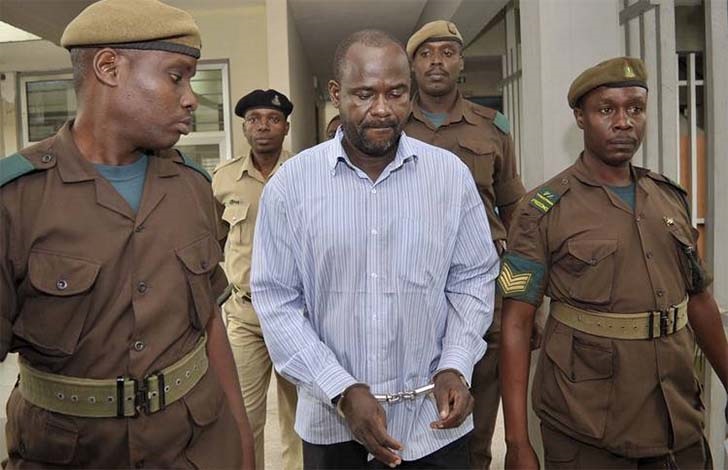
Jamilu Mukulu ushered into court by Tanzanian police officers
HABARI DAILY I Kampala, Uganda I The decision by the Office of the Director of Public Prosecutions (DPP) to withdraw terrorism-related charges against Daniel Wanyama and Robert Wandera, who had been jointly charged alongside former Allied Democratic Forces (ADF) commander Jamilu Mukulu, highlights serious concerns about the integrity and fairness of the prosecution process.
The withdrawal, entered through a nolle prosequi and presented in court by Assistant Director of Public Prosecutions Thomas Jatiko, effectively discontinued proceedings against the two accused persons. While the DPP exercised its constitutional mandate in making this decision, the circumstances surrounding the case strongly suggest that the move was influenced by weaknesses in the prosecution’s case and prolonged procedural delays.
Defence lawyer Wandera Ogalo sharply criticized the handling of the matter, pointing to the excessive time the accused had spent on remand—over 11 years—without conclusion of their trial. He argued that such prolonged detention, particularly in the face of what he described as weak evidence, raises serious concerns about fairness and a potential abuse of court processes.
His argument underscores a fundamental principle of justice: that individuals should not be deprived of liberty for extended periods without timely and credible prosecution.
Ogalo also highlighted significant delays in handling bail applications, further reinforcing concerns about due process. A bail application filed in 2016 was not heard promptly and remained pending for an extended period.
Another application, heard in March 2017, was only ruled upon in October 2019—more than two years later—and ultimately dismissed. These delays point to systemic inefficiencies that may have undermined the accused persons’ right to a fair and speedy trial.
The withdrawal of charges can therefore be interpreted as an acknowledgment by the prosecution that sustaining a conviction under such circumstances would be difficult. Continuing with a case marred by weak evidence, delayed proceedings, and prolonged detention could have exposed the judicial process to further criticism and possibly resulted in an acquittal.
Importantly, the defence did not object to the withdrawal, suggesting that both sides recognized the challenges in proceeding with the case. While Mukulu and other accused individuals still face serious allegations, including murder and terrorism-related offences committed between 2002 and 2015, the discontinuation of charges against Wanyama and Wandera reflects a broader issue within the justice system.
Ultimately, the DPP’s decision appears to be a corrective step—one that implicitly acknowledges flaws in the prosecution’s case and the need to uphold fairness, even in complex and high-profile criminal proceedings.