
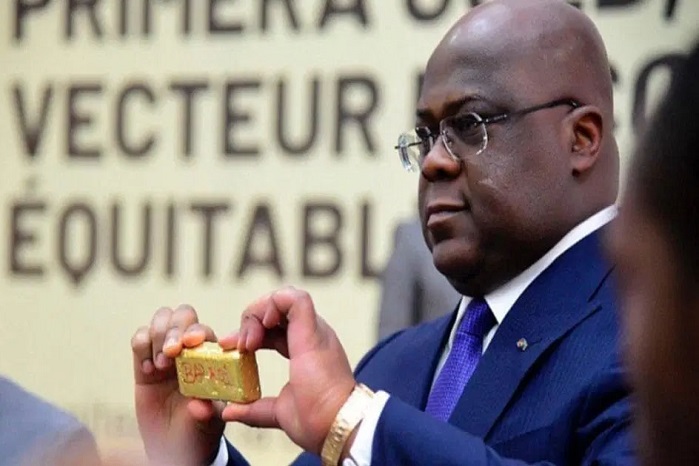
President Tishekedi received the first batch of gold from DRC Gold Refinery SA
HABARI DAILY I Kampala, Uganda I The Democratic Republic of the Congo has announced sweeping monetary reforms that will effectively end the widespread use of the US dollar in everyday cash transactions, in a bold effort to restore confidence in its local currency and tighten financial controls.
In a statement released this week, the Central Bank of the Congo outlined a new policy that will prohibit all cash transactions in foreign currencies starting April 9, 2027. The directive marks one of the most aggressive steps yet by authorities to reverse decades of heavy dollarisation.
“From April 9, 2027, no individual or legal entity will be authorised to conduct cash transactions in foreign currencies. All such operations must be executed through electronic or scriptural banking channels,” the central bank said in its official communication.
Under the new framework, the central bank will also become the sole institution permitted to import foreign currency into the country, effectively barring commercial banks and private actors from bringing in physical dollars. Authorities say the measure is designed to enhance oversight of foreign exchange flows and reduce illicit financial activity.
Hyperinflation crisis
The US dollar has long dominated the Congolese economy, a legacy of the hyperinflation crisis of the 1990s that eroded trust in the local franc. Today, most transactions above five dollars are conducted in US currency, particularly in urban centres and the informal sector.
Officials argue that the new restrictions are necessary to address persistent financial vulnerabilities. The country remains on the grey list of the Financial Action Task Force, an indication of gaps in anti-money laundering and counter-terrorism financing controls.
“The objective of these measures is to reduce excessive dollarisation, combat money laundering and the financing of terrorism, and restore confidence in the Congolese franc,” the central bank stated.
However, analysts warn that enforcing the ban could prove difficult in a largely cash-based economy where banking penetration remains low. A significant portion of the population relies on informal markets where the dollar is widely trusted and accepted, raising concerns about compliance and potential disruption to trade.
First batch of gold
The currency reforms come alongside broader efforts by the Congolese government to strengthen its financial position and reduce dependence on foreign currencies. In a parallel development, the central bank confirmed it has received its first batch of refined gold ingots under a new national reserve programme.
The initiative, implemented in partnership with state-owned DRC Gold Trading SA and DRC Gold Refinery SA, is aimed at formalising gold production and boosting official reserves. Artisanal gold is now being purchased, refined, and converted into standardised bullion for inclusion in national reserves.
For decades, much of the country’s gold output has been lost through smuggling and informal trade. Officials say the new programme will improve traceability, curb illicit flows, and ensure that mineral wealth contributes directly to the national economy.
The move aligns with a growing trend among African central banks seeking to increase gold holdings as a hedge against currency volatility and external shocks.
Gold to contribute to national wealth
Officials say the programme is designed to improve traceability, curb smuggling, and ensure that gold production contributes directly to national wealth. Historically, the DRC has not significantly accumulated monetary gold for nearly five decades, making the latest development a strategic shift toward strengthening its financial position and enhancing reserve diversification.
By formalising its gold sector and integrating it into official reserves, the DRC is positioning itself to capture greater value from its vast mineral resources while reinforcing macroeconomic stability in an increasingly volatile global financial environment.
Together, the dollar restrictions and gold reserve strategy signal a significant shift in economic policy for the Democratic Republic of the Congo, as authorities attempt to stabilise the financial system, strengthen the local currency, and assert greater control over the country’s vast natural and monetary resources.







About the Author