
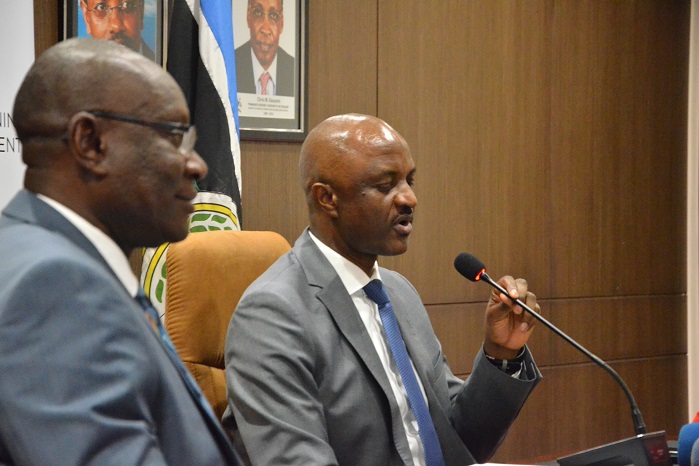
Ramathan Ggoobi (R) and Hanington Ashaba, the Ag Director Budget at the Finance Ministry
HABARI DAILY I Kampala, Uganda I The Uganda Government has prioritised peace and security in the release of the FY2025/26 Third Quarter Expenditure Limits, with the Ministry of Finance underscoring that stability is indispensable in an election year.
The Permanent Secretary and Secretary to the Treasury (PSST), Ramathan Ggoobi, said the Shs16.537 trillion released for Quarter Three reflects a deliberate balance between fiscal discipline, macroeconomic stability and safeguarding national security as Uganda prepares for the 2026 general elections.
“The Quarter Three Expenditure Limits have been informed by our fiscal consolidation agenda that prioritises implementation of Government’s objective of sustaining macroeconomic stability and maintaining fiscal discipline,” Ggoobi said. He emphasised that in an election year, maintaining peace and security is not optional. “Without peace and security, you cannot have elections, you cannot have investment, and you cannot sustain economic growth,” he added.
Under the security sector, Government has released substantial funding to institutions tasked with maintaining law and order. The Ministry of Defence and Veteran Affairs received Shs270.05 billion, while the Uganda Police Force was allocated Shs42.12 billion. State House received Shs17.92 billion, the Uganda Prisons Service Shs73.04 billion, the Office of the President Shs45.68 billion, Internal Security Organisation (ISO) Shs42.92 billion and External Security Organisation (ESO) Shs18.39 billion.
“These allocations are deliberate and strategic,” Ggoobi said. “In an election year, our responsibility as Government is to ensure that Ugandans can exercise their democratic rights in an environment that is peaceful, secure and predictable.” He added that funding the security agencies adequately is aimed at prevention rather than reaction. “We want to prevent insecurity before it happens, not to manage crises after they have escalated,” he said.
The PSST stressed that security spending should be understood within the broader macroeconomic framework. “Peace and security are a public good,” Ggoobi noted. “They underpin investor confidence, tourism, trade and the daily functioning of the economy. When we allocate resources to security, we are protecting the economy and the livelihoods of our people.”
Beyond security, the total Quarter Three release of Shs16.537 trillion covers wages, non-wage expenditure, development financing, treasury operations and local revenue. Of this, Shs2.175 trillion has been allocated to wages and salaries across Government, while Shs2.898 trillion is for non-wage recurrent expenditure.
GoU development spending stands at Shs514 billion, external financing at Shs3.277 trillion, treasury operations at Shs7.591 trillion and local revenue at Shs82 billion.
Ggoobi said meeting statutory obligations remains a top priority. “We have provided Shs7.59 trillion for debt and treasury operations because honouring our obligations is critical for credibility and stability,” he said. In addition, Shs318.24 billion has been allocated for pensions and gratuity, Shs91.65 billion for Parliament, Shs28.27 billion for the Judiciary and Shs18.351 billion for the Office of the Auditor General. “Strong institutions are essential, especially in an election year,” he said.
The budget also continues to support the ATMS strategy—Agro-industrialisation, Tourism development, Mineral-based industrial development and Science, Technology and Innovation—which Government views as the pathway to tenfold economic growth. However, Ggoobi cautioned that these growth drivers depend heavily on stability.
“You cannot industrialise, you cannot attract tourists, and you cannot roll out ICT solutions in an environment of insecurity,” he said. “That is why peace and security are at the centre of this budget.”
Infrastructure development, including roads, energy and urban services, has also been funded to maintain economic momentum and reduce social tensions associated with poor service delivery. Similarly, human capital investments in health and education are intended to ensure social stability during the election period.
Local governments received Shs519.866 billion to support service delivery at the grassroots, while revenue-generating agencies such as the Uganda Revenue Authority, Immigration and UNBS were funded to strengthen domestic revenue mobilisation.
Ggoobi concluded by linking fiscal discipline, security and democracy. “Our message is clear: Uganda will go through the 2026 elections peacefully, with a stable economy and disciplined public finances,” he said. “This budget is about protecting peace, safeguarding democracy and keeping the economy on a steady path.”







About the Author