

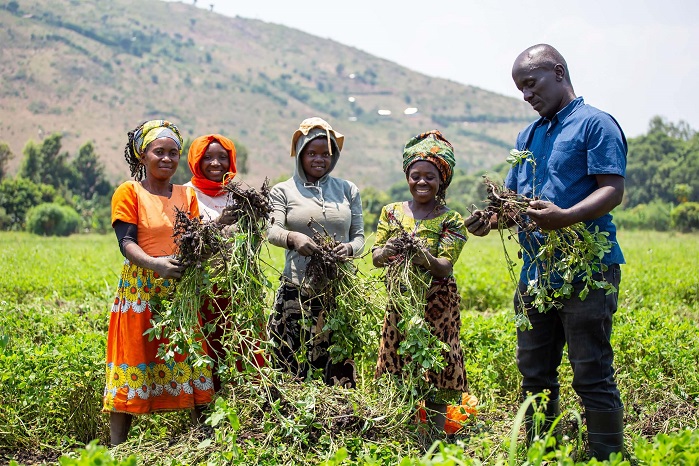
Ugandan farmers
HABARI DAILY I Kampala, Uganda I The Generating Growth Opportunities and Productivity for Women Enterprises (GROW) Project continues to embed strong environmental and social (E&S) safeguards into women-focused lending, ensuring that business growth supported by the programme remains responsible, inclusive and sustainable.
According to the latest implementation report, over 97 percent of enterprises financed under the GROW Loan have been rated low environmental and social risk, with no major E&S incidents reported across participating financial institutions (PFIs).
Dr Ruth Aisha Biyinzika Kasolo, the GROW Project Coordinator at the Private Sector Foundation Uganda (PSFU), said the safeguards framework is a cornerstone of the programme’s design. “From inception, GROW has treated environmental and social safeguards not as an afterthought, but as a core requirement,” Dr Kasolo said.
“All activities are guided by an Environmental and Social Commitment Plan, and compliance with ESS2 standards is a condition for releasing GFF funds.”
She explained that adherence to the safeguards framework was a prerequisite for disbursement, which PFIs successfully met. “This ensured that women’s enterprises accessing finance are not exposed to environmental harm, unsafe labour practices or social risks that could undermine both their businesses and communities,” she said.
The report shows that the GROW E&S team continues to work closely with PFIs to monitor borrower compliance, review risk ratings and support the development of simple risk management plans where needed. “Our role is supportive rather than punitive,” Dr Kasolo noted. “We help PFIs and borrowers understand potential risks early and manage them before they escalate.”
E&S oversight has been reinforced through participation in quarterly PFI review meetings, where the team provides feedback on reports submitted by banks. “These engagements allow us to identify trends, address gaps and continuously improve how safeguards are implemented on the ground,” she said.
While no major environmental or social issues were recorded, the report highlights operational complaints linked to delayed loan disbursements. Centenary Bank alone received 47 complaints from women applicants across Kampala, Wakiso, Mukono, Luweero, Bugiri, Busoga and Busia.
Dr Kasolo acknowledged the challenge, noting that delays can have real social consequences. “Timing matters in business,” she said. “We had cases where women made investment decisions based on expected loan timelines, only to face setbacks when funds were delayed.”
One such case involved a woman entrepreneur who planned to open a second restaurant. She secured premises in anticipation of the loan, but delays meant the landlord leased the space to another tenant. “While she eventually used the funds to expand her existing restaurant, the experience underscores why efficient disbursement is also a social safeguard issue,” Dr Kasolo explained.
The report also flags emerging gender-related risks, particularly increased interest by men seeking to access GROW loans through their wives or partners, and in some cases demanding the return of pledged collateral before loan maturity. Dr Kasolo said this requires sustained sensitisation.
“GROW is a women-focused programme, and both men and women must clearly understand eligibility rules and loan obligations,” she said. “Financial empowerment should strengthen households, not create new tensions.”
Beyond safeguards, PSFU has advanced complementary activities to strengthen oversight and accountability. The selection of additional Tier IV institutions, including MFIs and SACCOs, has been completed, with eight new institutions approved, pending World Bank clearance.
In addition, PSFU has proposed modifications to portfolio expansion and beneficiary performance grants to promote equitable regional distribution, including refugees and vulnerable minority groups.
To reinforce integrity, PSFU contracted KPMG to conduct due diligence on loans disbursed, repayments received and grants earned. “Independent verification is critical,” Dr Kasolo said. “Due diligence assures government, donors and beneficiaries that resources are reaching eligible women and being managed transparently.” KPMG has so far completed three rounds of reviews across PFIs.
Quarterly reviews with PFIs have also revealed positive institutional impacts linked to GROW. Banks reported the opening of over 55,000 new accounts tied to women seeking access to GROW loans, alongside improved staff capacity in E&S management, monitoring and reporting.
“These systemic changes mean the impact of GROW extends beyond individual borrowers to the broader financial sector,” Dr Kasolo said.
She emphasised that strong safeguards and sound systems go hand in hand. “Sustainable women’s entrepreneurship is not just about capital,” Dr Kasolo said. “It is about protecting people, businesses and communities as they grow. That is the standard GROW is setting.”







About the Author