
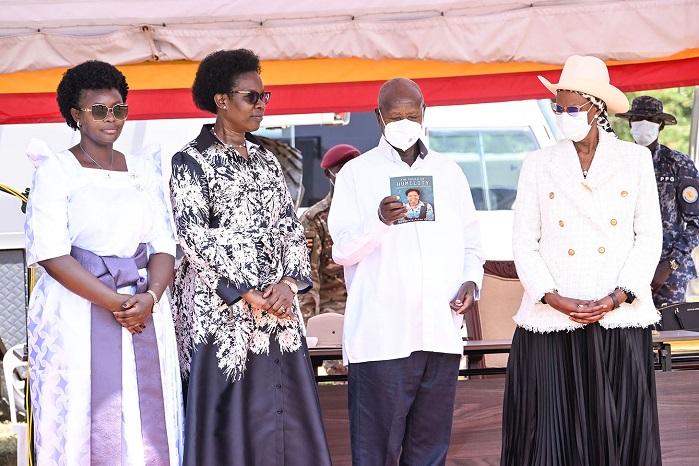
President Museveni launching Deputy IGG Dr. Patrocia Okiria’s book (2nd L) as First Lady Janet Museveni (R) and Hon Lillian Aber (L) look on during Archbishop Janani Luwumu Day in Mucwuni, Kitgum on Monday
HABARI DAILY I Kampala, Uganda I President Yoweri Museveni said that he has consistently rejected assassinations and attacks on individuals outside the battlefield.
“I recall rejecting proposals by some fighters to assassinate then–army commander Oyite Ojok at his home, insisting such acts would amount to cowardice,” he said, adding that even in conflict, both the cause and the methods must be just.
Oyite Ojok was a senior commander of the Uganda National Liberation Army (UNLA). He played a central role in the 1979 war that toppled Idi Amin. His battlefield leadership, particularly during the Tanzanian-backed push toward Kampala, cemented his reputation.
Speaking in Kitgum District during the 49th commemoration of the martyrdom of Archbishop Janani Luwum, President Museveni said Amin’s rule was defined by fear, bloodshed, and intimidation, which plunged the country into suffering and stagnation.
“Amin ruled me only for a few hours,” Museveni said, recalling the 1971 military coup that brought Amin to power. “Leaders should not impose themselves on citizens. They must persuade them through good services and leadership by example.” Citing biblical teachings, the President said leaders must let their good deeds shine before others, warning that reliance on intimidation only repeats Amin’s fatal mistakes.
He highlighted the devastating cost of atrocities committed during the brutal regime of former dictator Idi Amin, saying the scars left on Uganda’s political, social, and moral fabric remain a stark reminder of the dangers of authoritarian leadership.
Museveni described Amin’s first major error as seizing power through force, undermining constitutional order and public trust. His second, he said, was using killings, arbitrary arrests, and terror to silence opponents. “Any leader who depends on violence and fear mirrors the same path Amin took, and that path only leads to destruction,” he said.
Endless atrocities
The President emphasized that the atrocities of Amin’s regime came at an enormous cost: thousands of lives lost, families shattered, institutions destroyed, and the economy ruined. He noted that the murder of national figures such as Archbishop Luwum and former Chief Justice Ben Kiwanuka symbolized the depth of the brutality and the moral collapse of the state.
While acknowledging Uganda’s history of armed struggle, Museveni said
Museveni expressed satisfaction that those who orchestrated atrocities under Amin ultimately failed, noting that the sacrifices of leaders like Luwum were not in vain. “Their blood watered the seeds of freedom and justice. Today, Uganda stands as proof that tyranny cannot prevail forever,” he said.
The national event, held under the theme “Anchored in Christ for Stability, Peace and Unity” (Ephesians 2:14–17), began with a church service before the President and First Lady, Maama Janet Kataaha Museveni, laid wreaths at Wii-Gweng in Mucwini, the final resting place of Archbishop Luwum and his wife, Mama Mary Lawil Luwum.
Cost of dictatorship
St. Janani Luwum Day, observed annually on February 16, honors the Archbishop who was killed in 1977 after boldly condemning human rights abuses, arbitrary arrests, and killings under Amin’s rule. His death remains one of the darkest chapters in Uganda’s history, symbolizing the enormous human cost of dictatorship.
In his address, the Archbishop of the Church of Uganda, Stephen Samuel Kaziimba Mugalu, welcomed pilgrims from across the country, saying the commemoration was not only about remembering an individual, but about reaffirming faith, justice, and moral courage.
“As the Church of Uganda, we continue to celebrate the life and martyrdom of Archbishop Janani Luwum. His legacy challenges us to stand firm for truth, peace, and reconciliation,” Archbishop Kaziimba said.
He noted that institutions bearing Luwum’s name — including churches and schools — serve as living testimonies to his enduring influence, urging Ugandans to remain anchored in Christ for unity and stability.
Other leaders, including Bishop Alfred Olwa of Lango Diocese and State Minister for Ethics and Integrity Rose Lilly Akello, echoed the call for peace, unity, and national reflection. Akello announced plans to develop Luwum’s burial site into an international pilgrimage center, complete with a school, hospital, and administrative block.
Kitgum Woman MP and State Minister for Disaster Preparedness, Lillian Aber praised Luwum’s moral courage, saying his faith continues to inspire resilience among the Acholi people.
Nearly five decades after his martyrdom, the memory of Janani Luwum remains a powerful symbol of resistance against tyranny and a reminder of the heavy price Uganda paid under Idi Amin’s brutal rule — a cost that continues to shape the nation’s collective conscience and commitment to peace.







About the Author