
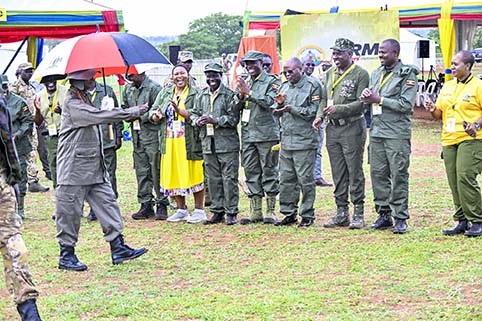
President Museveni greets NRM leaders at a retreat being held at NALI on 8th April 2026
HABARI DAILY I Kampala, Uganda I National Resistance Movement (NRM) legislators are set to be equipped with ideological clarity and policy direction as they begin their term in the 12th Parliament, at a week-long retreat that is being held at the National Leadership Institute (NALI) in Kyankwanzi.
This followed the official opening of the retreat for newly elected National Resistance Movement (NRM) Members of Parliament and party-leaning independents by President Yoweri Museveni today.
The retreat is being held under the theme: “Aligning the NRM leadership towards protecting the gains and making a bold, qualitative leap towards a higher middle-income status society”.
In his address, President Museveni warned leaders against corruption, describing it as a major threat to government programmes such as the Parish Development Model (PDM).
“If you are corrupt, you not only waste government resources but also become a bad example. I will not tolerate corruption—it diverts us from our mission,” he cautioned.
He cited complaints about mismanagement of PDM funds in some areas and called on leaders to act as “clean brooms.”
Drawing from his personal experience, the President emphasized hard work and self-reliance.
“My father gave me 22 cows in 1965. Today there are thousands. I owe nobody anything. You cannot think that the shortcut is stealing,” he said.
Winners hailed
He congratulated the legislators on their electoral victory, while urging them to reflect on areas that require improvement.
“First of all, I congratulate all of you for winning the elections. I also congratulate the NRM and its members in the country for delivering a big victory, although we could have done more if we got rid of some weaknesses,” he said.
He also extended condolences to families of fallen party members, including leaders from Kikube and Abim, describing their loss as a setback to the movement.
Museveni emphasized the distinction between ordinary supporters and leaders within the party, urging MPs to go beyond surface-level understanding of the movement.
“You are now not only followers of the NRM but leaders. A follower may support some aspects of the movement without going deep into its beliefs, but a leader must understand the ideology, philosophy and strategy,” he noted.
He likened the retreat at Kyankwanzi to a “seminary,” where leaders are equipped with deeper ideological grounding.
President Museveni further explained that ideology involves diagnosing societal problems, just as a doctor diagnoses a patient.
“The political leader must carry out a diagnosis of the society—identify the problems, understand the people and then prescribe solutions,” he said.
Human nature and motivation
On philosophy, President Museveni said leaders must understand human nature and motivations, while strategy involves applying correct methods to address societal challenges.
The President also stressed that prosperity must be built through production and not dependency.
“Prosperity does not come from begging or corruption. Every adult must produce a good or a service and earn from it,” he said.
He highlighted the importance of markets, warning against identity-based politics that limit trade.
“If we emphasize religion and tribes, some of your products will not be bought. That is why we said we should love Uganda first,” he explained.
This, President Museveni said, informed the NRM’s principle of patriotism, which later expanded to Pan-Africanism due to the limitations of local markets.
African unity
Museveni urged leaders to support regional and continental integration, including the East African Community and the African Continental Free Trade Area (AfCFTA).
“Integration means strength. Fragmentation means weakness,” he said. He added that Africa must unite to achieve strategic security and shared prosperity.
The President outlined the NRM’s four ideological pillars: patriotism, Pan-Africanism, socio-economic transformation and democracy as key to achieving Africa’s historical mission of prosperity, strategic security and brotherhood.
He noted that Africa’s past marked by slavery and colonial poverty places responsibility on the current generation to transform the continent.
“This generation must create prosperity for the African people. In the past, Africans were slaves, and during colonial times there was poverty. By 1962, only about six per cent were in the money economy,” he said.
President Museveni reiterated the importance of private sector-led growth, saying it has driven Uganda’s economic progress.
“When we came, we rejected inefficient state enterprises and said no let us have private sector-led growth. That is why the economy is growing,” he said.
He identified four key sectors for wealth creation: commercial agriculture, manufacturing, services and ICT.
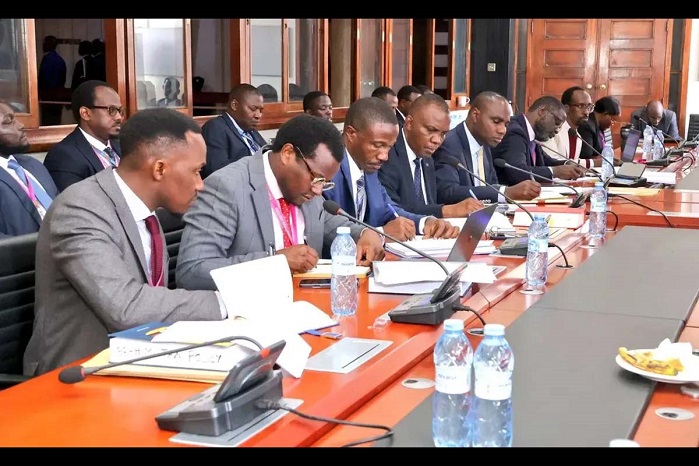
The retreat is being attended by hundreds of NRM stalwarts, among whom is the Vice President, Jessica Alupo, Deputy Speaker, Thomas Tayebwa, NRM Secretary General, Richard Todwong and members of the Central Executive Committee.







About the Author