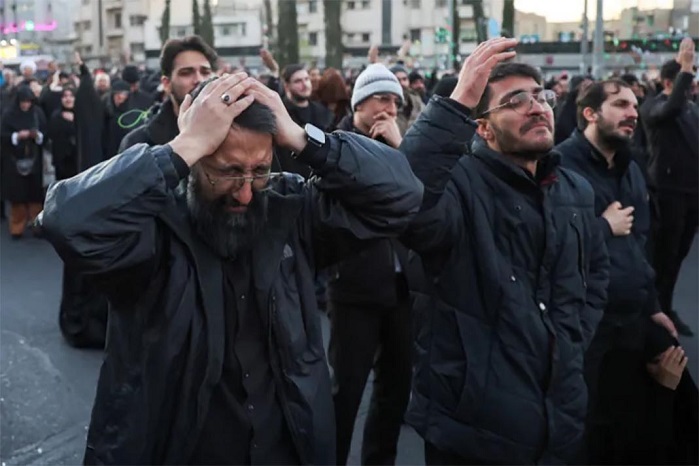
Iranians mourning for the Supreme Leader Ayatollah Ali Khamenei in Tehran
HABARI DAILY I Kampala, Uganda I Iran has unleashed a sweeping wave of retaliatory military strikes across the Middle East following the killing of Supreme Leader Ayatollah Ali Khamenei and at least 201 civilians in joint United States and Israeli attacks, plunging the region into its most dangerous escalation in decades.
The Islamic Republic has also entered a 40-day national mourning period after Khamenei was killed in Saturday’s air strikes, which also claimed the lives of senior security officials, his daughter, son-in-law and grandson. The deaths mark one of the most devastating blows to Iran’s leadership since the 1979 Islamic Revolution, triggering mass demonstrations, deep public grief and fierce vows of revenge.
President Masoud Pezeshkian condemned the killing as “a great crime” and declared seven days of public holidays in addition to the traditional mourning period. “This cowardly act will not go unanswered,” he said in a statement, calling on Iranians to remain united and resilient.
Across Tehran, tens of thousands of people poured into the streets following confirmation of Khamenei’s death. Crowds gathered at Enghelab Square, chanting anti-American and anti-Israeli slogans, waving national flags and holding portraits of the slain leader. Scenes of mourning were also broadcast from the holy city of Mashhad, where devotees wept openly at the shrine of Imam Reza, with some collapsing in grief.
Similar protests erupted in Shiraz, Yasuj and Lorestan, as authorities prepared for days of ceremonies, funerals and public commemorations, even as bombardment continued across parts of the country.
Islamic Revolutionary Guard Corps jump into action
In response, the Islamic Revolutionary Guard Corps (IRGC) announced a large-scale retaliatory campaign, targeting what it described as 27 military bases hosting US troops and Israeli military facilities. Missile and drone strikes were reported in Israel, Qatar, the United Arab Emirates, Kuwait, Bahrain, Jordan, Saudi Arabia and Iraq, raising fears of a full-scale regional war.
“The blood of our martyrs will not be forgotten,” an IRGC statement said. “The aggressors will face consequences across every battlefield they have opened.”
The human toll of the war has continued to climb rapidly. Iranian state media reported that at least 201 people have been killed in joint US-Israeli strikes across 24 provinces. One of the deadliest attacks occurred in Minab, in southern Iran, where a missile strike on an elementary girls’ school killed at least 148 people and wounded 95 others. The Red Crescent said rescue teams were still searching through rubble, warning that the death toll could rise further.
Explosions rocked parts of Doha and Abu Dhabi, while security alerts were raised across the Gulf. In Tel Aviv, air defence systems intercepted multiple incoming projectiles, though Israeli officials acknowledged damage to military infrastructure.
Americans promises furry
US President Donald Trump responded with a stern warning, declaring that Iran would be struck with “a force that has never been seen before” if it continued retaliatory operations. Despite the threat, Tehran insisted its actions were justified self-defence and vowed to continue its campaign.
In neighbouring Iraq, the government declared three days of national mourning as thousands of demonstrators flooded the streets of Baghdad. Protesters clashed with security forces near the heavily fortified Green Zone, which houses government offices and foreign embassies, with some attempting to march toward the US Embassy. Footage verified by international media showed demonstrators waving flags, blocking roads and chanting anti-US slogans.
In Pakistan, violent protests erupted in Karachi, where demonstrators set fire to and vandalised the US consulate, shattering windows and torching vehicles. Smaller protests were reported in Lebanon, Yemen and Syria, reflecting the deep regional impact of Khamenei’s death.
Inside Iran, political authorities moved swiftly to maintain stability. The official IRNA news agency announced that a three-person council — comprising the president, the head of the judiciary and a jurist from the Guardian Council — would temporarily assume all leadership duties until a new supreme leader is elected.
Ali Larijani, head of Iran’s Supreme National Security Council, accused Washington and Tel Aviv of seeking to destabilise and “plunder Iran.” He urged national unity and warned against any internal divisions. “Groups seeking to weaken or divide Iran should know that we will not tolerate it,” he said.
Deep fractures within Iranian society
Khamenei had ruled Iran since 1989, following the death of revolutionary leader Ayatollah Ruhollah Khomeini. While Khomeini was the ideological architect of the Islamic Republic, Khamenei transformed Iran into a formidable regional power, expanding its military reach and strengthening allied armed groups across the Middle East.
Yet his death has exposed deep fractures within Iranian society. While massive crowds mourned, international news agencies also reported isolated celebrations in Tehran, Karaj and Isfahan, underscoring long-standing discontent over political repression, economic hardship and international isolation.
Western analysts warned that the assassination may have hardened Iran’s resolve rather than weakened it, adding that this will likely fuel retaliation, not compromise.
As Iran presses ahead with its military response, the Middle East stands on the brink of a far wider conflict. With civilian casualties mounting, airstrikes intensifying and diplomacy stalled, fears are growing that the war could spiral into a prolonged and devastating regional confrontation, reshaping geopolitics for years to come.







About the Author