
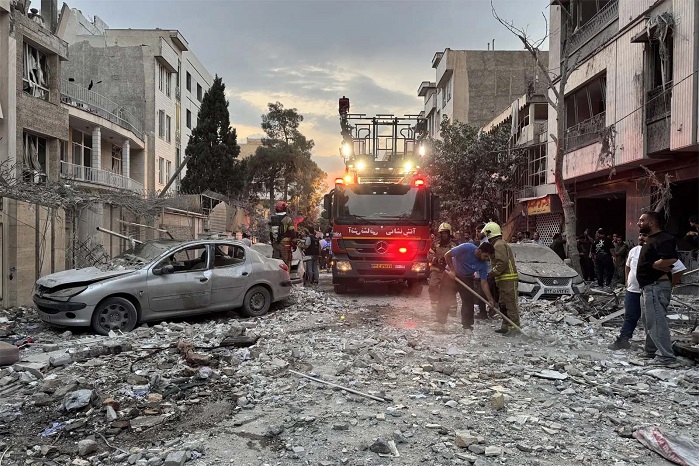
The Iran military has vowed to avenge all the destruction mated on its infrastructure
HABARI DAILY I Kampala, Uganda I Iran has demonstrated the scale of its military firepower in the escalating conflict with the United States and Israel, launching more than 500 ballistic missiles and over 2,000 drones in retaliation for coordinated strikes on its territory.
The attacks mark one of the most intense military exchanges in the Middle East in recent years, highlighting Iran’s extensive missile and drone capabilities despite sustained efforts by the United States and its allies to weaken Tehran’s military infrastructure.
According to Brad Cooper, the US military has responded with a massive campaign targeting Iranian military assets.
“We have severely degraded Iran’s air defenses and destroyed hundreds of Iran’s ballistic missiles, launchers and drones,” Cooper said, adding that American forces had struck nearly 2,000 Iranian targets using more than 2,000 munitions.
“We are seeing Iran’s ability to hit us and our partners is declining, while our combat power, on the other hand, is building,” he added.
Despite those claims, Iran’s retaliatory campaign has demonstrated the resilience of its missile and drone arsenal. Defense analysts say Tehran has invested heavily in asymmetric warfare capabilities over the past two decades, focusing on weapons that can overwhelm sophisticated air defense systems through sheer numbers.
The Iranian strikes have targeted both Israel and US military installations across the Gulf region. Among the most dramatic attacks occurred on Saturday when Iran launched 137 missiles and 209 drones toward the United Arab Emirates, where American military bases are located.
Fires and smoke were reported near iconic landmarks in Dubai, including the Palm Jumeirah and the Burj Al Arab, after debris from intercepted missiles fell across parts of the city.
At Abu Dhabi’s airport, at least one person was killed and seven others injured during what authorities described as a missile-related incident. Airports in Dubai and Kuwait were also affected by the strikes, causing temporary disruptions.
Israel has also suffered casualties from the barrage. In the town of Beit Shemesh, at least nine people were killed and more than 20 injured when Iranian missiles struck residential areas.
Killing of Supreme Leader Ali Khamenei triggered wrath
The current wave of attacks came after Iran vowed revenge following the killing of Supreme Leader Ali Khamenei and several senior Iranian officials during the opening phase of the US-Israeli assault.
Iran’s elite military wing, the Islamic Revolutionary Guard Corps (IRGC), described the retaliation as “the heaviest offensive operations in the history of the armed forces of the Islamic Republic.”
The IRGC has been central to Iran’s military strategy, particularly in the development of drones and missile systems designed to counter technologically superior adversaries.
Iran’s military structure itself is unusually complex. The country operates parallel armed forces, including the regular army known as the Artesh and the IRGC, which functions both as a military force and as a guardian of the Islamic Republic’s political system.
While the Artesh focuses on conventional warfare and territorial defense, the IRGC oversees strategic assets such as missile programs, drone warfare and regional proxy operations.
This layered military structure, analysts say, is designed to protect the regime from both external threats and internal instability.
“Iran’s military strategy is derived from its political structure,” a military specialist familiar with the country’s defense system said. “Their political aim is to safeguard territorial integrity and stop foreign intervention aimed at overthrowing their rule.”
The conflict has also raised concerns about the sustainability of missile defenses used by the United States and its allies.
Interceptor missiles running out
Six days into the war, at least one US ally in the Gulf is already running low on interceptor missiles used to shoot down Iranian rockets and drones. Regional governments have quietly requested additional supplies from Washington to replenish their defenses.
Even Israel, which maintains one of the world’s most advanced air defense systems, is reportedly closely monitoring its interceptor stockpiles as Iranian attacks continue.
According to Dan Caine, each interception of an incoming missile requires significant technological resources and training.
“Each intercept represents hundreds of hours of training, readiness and technology all coming together to work as designed,” Caine said during a press briefing.
Meanwhile, US officials warn that Iran’s missile production capacity remains significant. Secretary of State Marco Rubio said Tehran is believed to manufacture more than 100 missiles per month, far exceeding the rate at which interceptor missiles can be produced.
“Compare that to the six or seven interceptors that can be built a month,” Rubio said, noting that the destruction of Iran’s missile infrastructure is a key objective of the US-led campaign.
President Donald Trump has sought to reassure the public that American weapons stockpiles remain strong despite the intensity of the conflict.
In a social media post, Trump said US munitions reserves “have never been higher or better,” adding that American forces could sustain a prolonged campaign if necessary.
Lawmakers worried
Still, some lawmakers in Washington have raised concerns that the war could eventually strain US weapons supplies, particularly as the United States continues to support both Israel and Ukraine militarily.
Arizona Senator Mark Kelly warned that Iran’s vast inventory of drones and missiles could turn the conflict into a prolonged battle of attrition.
“The Iranians do have the ability to make a lot of Shahed drones, ballistic missiles, medium-range and short-range,” Kelly said. “So at some point this becomes a math problem—how can we resupply air defense munitions, and where are they going to come from?”
For now, the conflict appears far from over. With Iran demonstrating its capacity to unleash massive waves of missiles and drones, and the United States continuing to strike Iranian targets, the war risks evolving into a prolonged and dangerous confrontation that could reshape security across the Middle East.







About the Author