
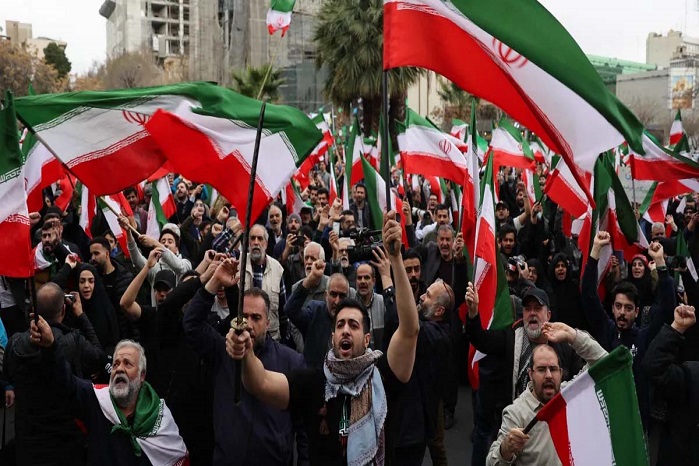
HABARI DAILY I Kampala, Uganda I A fragile two-week ceasefire, which has brought a pause to hostilities between Iran the United States and Israel is holding. This reprieve has given the Iranians space to hold victory parties and actually claim victory after 41 days of incessant bombardment.
While all sides have claimed victory, a closer look at developments on the ground suggests that Iran has emerged with several strategic, political, and psychological gains that underpin its narrative of triumph.
In a strongly worded statement issued from Tehran, Iranian officials said Washington had been forced to accept a 10-point proposal laid out by the Islamic Republic—terms that include a permanent ceasefire, the lifting of sanctions, and the withdrawal of U.S. combat forces from the region.
Resilience under fire
For more than six weeks, Iran endured what US military officials described as strikes on over 13,000 targets. Critical infrastructure—including bridges, railways, power stations, steel plants, and petrochemical facilities—was heavily damaged in sustained aerial bombardments, particularly by Israeli forces.
Yet despite this, the Iranian state did not collapse. Governance structures remained intact, and daily life—though severely disrupted—has begun cautiously returning. Traffic has reappeared in Tehran, and citizens are slowly venturing back into cafes and parks, signaling a population that has absorbed the shock and adapted.
This resilience, many analysts argue, is central to Iran’s claim of victory: survival against overwhelming firepower.
Strategic retaliation
Iran has also demonstrated its capacity to retaliate beyond its borders. Missile and drone strikes reportedly reached several Gulf states, including Saudi Arabia, United Arab Emirates, Qatar, Kuwait, and Bahrain, underscoring Tehran’s ability to project power regionally.
Iranian authorities framed these attacks as retaliatory measures following post-ceasefire strikes on oil facilities near its southern coast. The message was clear: Iran retains the capability and willingness to escalate if provoked.
The Islamic Revolutionary Guard Corps (IRGC) further reinforced this narrative by announcing the downing of a drone over Fars province, showcasing continued operational readiness.
Political consolidation
The war has also consolidated power domestically. Following the death of Ali Khamenei on the first day of the conflict, leadership transitioned to his son, Mojtaba Khamenei. Despite the unprecedented nature of this succession, the state has maintained cohesion.
The Supreme National Security Council has urged unity, discouraging dissent and reinforcing trust in the system. State-organized rallies, religious commemorations, and public displays of solidarity have dominated the streets, especially marking 40 days since the elder Khamenei’s death.
Even as some supporters expressed surprise at the ceasefire, the broader pro-government base continues to mobilize, signaling a regime that remains firmly in control.
Narrative victory
Iran’s leadership has skillfully framed the ceasefire as a victory. While US President Donald Trump also declared success, American officials acknowledged that the agreement represents only a pause rather than a decisive end.
Iranian state media, including Press TV, has gone further, proclaiming the country a “new superpower.” Such rhetoric, while contested internationally, resonates domestically where survival itself is seen as defiance against global powers.
The recirculation of speeches by the late Khamenei urging “resistance” has reinforced a long-standing ideological narrative: that steadfastness against external pressure defines national strength.
Psychological endurance
Perhaps Iran’s most significant victory lies in the psychological domain. Despite widespread destruction, internet blackouts, and strict internal security measures—including increased executions for alleged dissent—the state has maintained order.
Citizens, though fatigued and in some cases pessimistic, have not descended into chaos. Debates in cafes and parks about the future reflect a society still functioning, still engaged, and still invested in what comes next.
Even the shock expressed by figures like Majid Nouri over the ceasefire underscores an important reality: expectations of continued resistance had taken root deeply within the population.
Geopolitical leverage
Finally, Iran enters upcoming negotiations in Islamabad with leverage. The ceasefire, mediated by Pakistan, positions Tehran not as a defeated state but as a negotiating equal.
Its demonstrated resilience, regional reach, and internal cohesion provide bargaining power as talks begin on a potential long-term settlement.
A contested claim
While critics point to the heavy toll on infrastructure, economic strain, and civilian hardship, Iran’s leadership views the outcome through a different lens: survival, resistance, and continued sovereignty in the face of sustained assault.
In that context, the claim of victory—however debated internationally—finds strong grounding within Iran itself.