
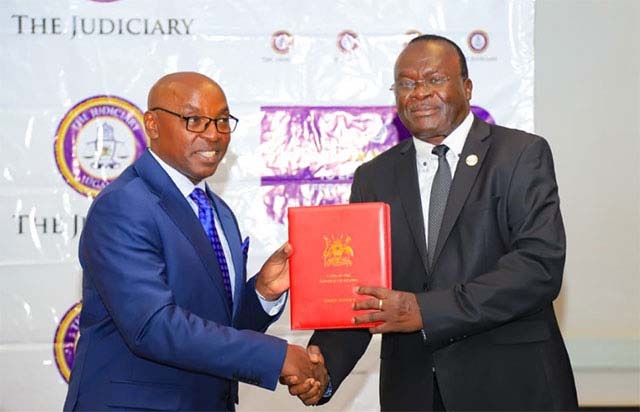
Dr Flavian Zeija, the head of the Ugandan judiciary (L) during the hand over of that office by Justice Alfonse Owiny-Dollo, the former Chief Justice (R)
HABARI DAILY I Kampala, Uganda I Ugandan courts are under mounting pressure as they confront a surge of election petitions following the January 15, 2026 general elections, in what is shaping up to be one of the most demanding periods for the country’s judicial system in recent history.
Across the country, the Judiciary of Uganda is grappling with a growing backlog of cases filed by aggrieved candidates seeking to overturn parliamentary election results. With the swearing-in of successful candidates scheduled for May, judges are racing against time to ensure that justice is delivered within strict constitutional timelines.
The petitions, filed in various High Court circuits, are rooted in a wide range of allegations, including voter bribery, ballot stuffing, multiple voting, illegal alteration of results, and procedural irregularities. Many petitioners also cite non-compliance with the Parliamentary Elections Act, arguing that breaches of electoral law significantly affected the outcomes in their constituencies.
According to judiciary spokesperson James Ereemye, the legal process is both structured and time-bound. “From the date of publication in the Gazette, parties have 16 days to file their petitions,” he explained, warning that no new petitions can be filed after this period unless one obtains leave of court.
The publication of Members of Parliament results by the Electoral Commission in the Uganda Gazette triggered this countdown, leading to a rush of filings across the country.
Ereemye further noted that once hearings begin, the High Court must conclude each election petition within six months. Thereafter, the Court of Appeal acts as the final arbiter in parliamentary election disputes, underscoring the heavy legal and administrative burden placed on the courts.
Several high-profile politicians are already entangled in these legal battles. Former trade minister Amelia Anne Kyambadde is facing a petition from Innocent Hillary Kiyaga, who alleges illegal alteration of election documents in the Mawokota race. Kyambadde was declared winner with 27,075 votes against Kiyaga’s 24,801.
In Kayunga, Jackline Birungi Kobusingye has challenged the victory of Harriet Nakweede, citing violations of Sections 66, 69 and 72 of the electoral law. Nakweede won the seat with 38,547 votes, narrowly defeating Kobusingye who polled 37,246.
The Buvuma District Woman MP seat is also under dispute, with Susan Mugabi contesting the victory of Judith Nagujja on grounds of non-compliance with electoral procedures.
In Luwero, Agnes Kirabo Nantongo has petitioned against Brenda Nabukenya, arguing that the declaration of results disenfranchised her supporters. “The declaration of Nabukenya as the winner was illegal and rendered the votes cast in my favour meaningless,” Nantongo states in her petition. Nabukenya secured 67,399 votes compared to Nantongo’s 55,696.
Other petitions highlight serious allegations of electoral malpractice. Esther Nakawooya has accused Sarah Najjuma of benefiting from ballot pre-ticking, ballot stuffing and multiple voting. In Wakiso, Abdu Kiyimba has challenged the victory of Emmanuel Magoola Matovu, citing multiple tallying of votes.
Questions over candidate eligibility have also emerged. In Busiro South, Joseph Kayemba alleges that Kenan Opio was illegally nominated due to lack of minimum academic qualifications. Similar claims have been raised in Mbarara, where Robert Mwesigwa is contesting the election of Christopher Bakashaba.
Closely contested races have further intensified the judicial workload. In Soroti City, Sarah Inachu is challenging the victory of Joan Achom Alobo, while Sarah Achieng Opendi has contested her narrow loss to Angella Akoth by just 35 votes, alleging that her victory was subverted.
In Kalungu, independent candidate Ismael Ssemakula is disputing the slim win of Joseph Ssewungu, where the margin was only 46 votes. Meanwhile, in Masaka, Rose Nalubowa is contesting the victory of Justine Nameere following a controversial recount that overturned the initial results.
Additional petitions have been filed in Hoima and Mbarara, including one by Princess Dianah Rouse Jane Mugenyi Abwooli against Nyakato Asinansi, citing voter manipulation and bribery.
Legal experts warn that the sheer volume and complexity of these cases could overwhelm the courts. Each petition demands detailed examination of evidence, witness testimonies, and electoral procedures, all within a limited timeframe. The need to balance speed with fairness presents a significant challenge for judges already managing heavy caseloads.
As the country awaits the resolution of these disputes, the judiciary stands at a critical juncture. Its ability to efficiently and transparently adjudicate these petitions will not only determine the legitimacy of contested seats but also shape public confidence in Uganda’s democratic and judicial institutions.







About the Author