
Low Pay Fuels Examiners’ Outcry Over Marking Of UNEB Exams
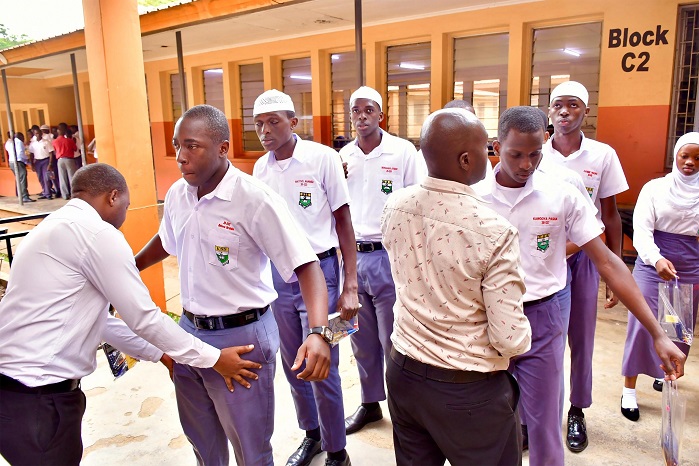
Students lining up for a scheduled UNEB examination recently
HABARI DAILY I Kampala, Uganda I Growing frustration among examiners over low pay has sparked renewed debate about the sustainability and credibility of Uganda’s national examinations system, with the Uganda National Examinations Board (UNEB) warning Parliament that current remuneration levels are dangerously inadequate.
Appearing before the Parliamentary Committee on Education and Sports on February 18, UNEB Executive Director Dan Nokrach Odongo painted a stark picture of the financial strain faced by thousands of teachers who mark national examination scripts each year. He cautioned that unsustainably low payments are undermining morale and could eventually erode the quality and integrity of marking.
To illustrate the problem, Odongo compared the Shs720 paid per Primary Leaving Examination (PLE) script under the old curriculum to the cost of everyday items. “Shs720 cannot even buy a small packet of boiled groundnuts, which now costs about Shs1,000,” he told lawmakers.
Pay not commiserate with inflation
In downtown Kampala, a simple snack of rolex costs around Shs2,500, while a glass of juice goes for about Shs3,000, highlighting how far the current rates fall below basic living expenses.
Under the new competency-based curriculum, PLE examiners earn slightly more, at Shs756 per script. Yet even this marginal increase offers little relief. An examiner who marks 100 scripts earns roughly Shs75,600 — an amount far below what most Ugandans require to meet basic monthly needs.
According to Odongo, such low pay creates a perverse incentive for examiners to rush through marking in order to increase their earnings. This is particularly worrying in the context of the competency-based curriculum, which demands careful assessment of learners’ critical thinking, problem-solving and ability to apply knowledge, rather than simple recall.
“When pay is this low, examiners are forced to choose between making ends meet and giving each script the careful attention it deserves,” Odongo said. “That tension threatens the quality and credibility of national assessment.”
Funding gap widening
UNEB has proposed increasing PLE marking fees to Shs1,000 per script, but even this would leave a funding gap of Shs244 per script. At the Uganda Certificate of Education (UCE) level, examiners currently earn Shs1,260 per script. Uneb is seeking Shs1,500, while examiners themselves argue for Shs2,000.
For the Uganda Advanced Certificate of Education (UACE), the current rate is Shs1,488, with UNEB proposing Shs2,000, leaving a shortfall of Shs512.
“These rates were last reviewed nearly ten years ago,” Odongo noted. “Since then, inflation, rising living costs, and major reforms in assessment have fundamentally changed the demands placed on examiners.”
He explained that under the competency-based system, scripts pass through multiple examiners in a structured digital workflow designed to enhance accuracy and reduce bias. While this system improves quality assurance, it also increases the time and expertise required per script, further exposing the mismatch between workload and pay.
Beyond examiner remuneration, UNEB is grappling with a wider funding crisis. For the 2026/27 financial year, the board requires Shs111.24 billion to effectively carry out its mandate but currently has access to only Shs48.82 billion, leaving a gap of Shs62.02 billion. The board is also seeking to raise invigilation allowances from Shs45,000 to Shs60,000 per person, citing rising costs during examination periods.
Lawmakers expressed alarm at the situation. Emmanuel Ongiertho warned that chronic underfunding could create opportunities for examination malpractice, while Janet Grace Okori-Moe described the requested Shs62 billion as modest, given the central role national exams play in shaping young people’s futures.
Academic standards at stake
Philip Ilukol praised UNEB for maintaining academic standards despite financial constraints and urged Parliament to support the proposed funding increases.
Committee chairperson James Kubeketerya emphasized the need for detailed justification of the additional funds, as required by the Budget Committee, while Deputy Chairperson Molly Asiimwe sought clarity on examiner workloads.
With hundreds of thousands of pupils and students sitting national exams each year, Odongo stressed that fair and credible assessment depends on motivated, well-supported examiners. Without meaningful improvements in pay, he warned, Uganda risks compromising the integrity of a system that determines access to further education, employment and life opportunities for millions of learners.
About the Author