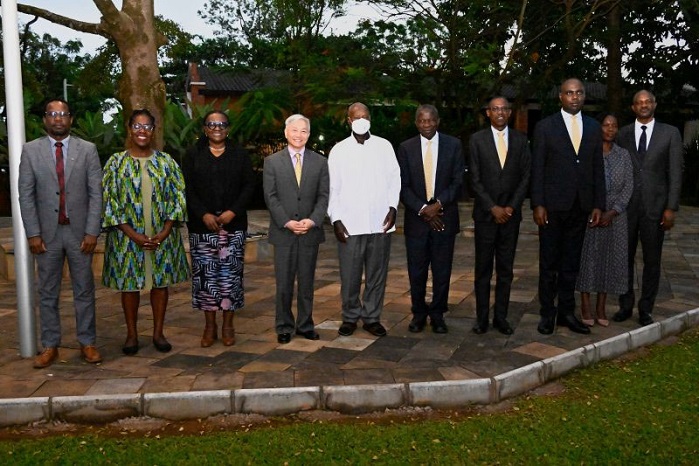


NRM’s Justin Nameere has been declared winner of the seat
HABARI DAILY I Kampala, Uganda I The outcome of the court-ordered vote recount in the disputed Masaka City Woman Member of Parliament election has come under renewed scrutiny, with declared loser Rose Nalubowa and several legal experts arguing that the process was fundamentally flawed and therefore illegitimate.
Chief Magistrate Albert Asiimwe on Saturday declared National Resistance Movement (NRM) candidate Justin Nameere the duly elected MP after a three-day recount conducted at the Electoral Commission offices in Kizungu, Masaka City. According to the court’s final certificate, Nameere secured 25,502 votes, narrowly defeating Nalubowa of the National Unity Platform (NUP), who polled 23,176 votes.
However, Nalubowa has rejected the outcome, insisting that the recount violated established principles of electoral law and ignored binding legal precedents on ballot security.
“The law is very clear that once the integrity of the ballot is compromised, the entire recount becomes meaningless,” Nalubowa said in a statement following the declaration. “What we witnessed in Masaka was an attempt to sanitise a broken process by selectively excluding some polling stations while proceeding with others whose credibility had already been called into question.”
The recount itself was triggered by a petition filed by Nameere challenging Nalubowa’s initial victory in the January 15 election, where she had been declared winner with 25,443 votes against Nameere’s 20,324. Nameere alleged irregularities in 11 of Masaka City’s 314 polling stations.
As the recount progressed, several troubling incidents emerged. Early in the exercise, the court excluded one polling station after its ballot box was found without a security seal — a defect the magistrate ruled was incurable through recounting. More controversially, results from Kimwanyi P7 polling station were disregarded after the ballot box was discovered to contain 97 votes cast exclusively for Nameere, with no votes recorded for any of the other candidates.
Chief Magistrate Asiimwe ruled that such a result was incompatible with a competitive, multi-candidate election and ordered the station excluded from the tally.
While the magistrate maintained that these irregularities were isolated and did not justify halting the recount, Nalubowa and independent legal analysts disagree.
“This approach directly contradicts long-standing Ugandan election jurisprudence,” said a Kampala-based election law expert who followed the proceedings. “Courts have consistently held that once ballot security is breached, the results become incapable of verification, and a recount cannot cure that defect.”
Legal experts point to a landmark 2001 High Court decision in Mbarara, where Justice V. F. Musoke-Kibuuka ruled that a recount could not proceed where ballot boxes were open or unsealed. In that case, the court warned that conducting a recount using compromised ballot boxes amounted to a “false pretence” and an abuse of court process.
Justice Musoke-Kibuuka held that the law on recounts was never intended to provide an illegitimate mechanism for second-guessing election outcomes once the chain of custody had been broken.
That reasoning was later reinforced in Sulaiman Ssembajja v Kigimu Kiwanuka Maurice, where courts declined to order recounts after finding that ballot boxes had not been secured in accordance with the law. Judges ruled that failure to safeguard ballots vitiates the recount process regardless of the number of affected polling stations.
According to analysts, the Masaka recount departed from these principles by attempting to “cure” defects through selective exclusion rather than acknowledging that compromised ballot security fatally undermines the exercise as a whole.
Nalubowa argues that by proceeding with the recount despite acknowledged defects, the court effectively misapplied the law. “You cannot separate contaminated ballots from a contaminated process,” she said.
With the court having formally returned Nameere as the winner, attention now turns to the possibility of an appeal. Legal observers say higher courts may be asked to determine whether any proven tampering — however limited — invalidates a recount entirely.
If challenged, the Masaka decision could become a defining test of whether Uganda’s courts will maintain their historically strict stance on ballot integrity or allow greater judicial discretion in recounts marred by irregularities.







About the Author